
Verbatim vs Clean Transcription: The Three Fidelity Levels
Summarize this article with:
The choice that trips people up most often is deceptively simple: how much of the original speech do you keep? Get this wrong and you either spend hours cleaning up a wall of filler words, or you discover too late that you needed the exact wording your editor quietly removed.
The Three Fidelity Levels
Every transcription style falls on a spectrum from maximum fidelity to maximum readability. The three practical levels are:
| Level | What stays | What goes | Primary use |
|---|---|---|---|
| True verbatim | Every word, filler, false start, repetition, audible pause, non-verbal sound | Nothing | Legal, forensics, conversation analysis |
| Intelligent verbatim (clean verbatim) | Every meaning-bearing word, including grammatical errors and incomplete sentences | Fillers ("um," "uh"), false starts, repeated words | Academic research, interviews, meetings, podcasts |
| Edited | The intended message | Anything that hurts readability, plus grammar tics, hedging, and redundancy | Published articles, books, marketing copy |
Note on terminology: many services label intelligent verbatim "clean verbatim," and a few style guides draw a narrow distinction between the two. In practice, the difference is small enough that the best approach is to ask your transcription provider explicitly what they remove.
True Verbatim: Every Sound
True verbatim captures everything the speaker produces, including the things they probably wish they hadn't. Every "um," every repeated word, every false start where the speaker began a sentence and abandoned it, every audible laugh or cough, and where the style guide calls for it, every pause with its duration marked.
Here is how that looks in practice. A 30-second answer:
Speaker 1: So, um, the, the, the issue is that we, uh, we tried [pause 2s] we tried the new pricing and, you know, it didn't (laughs) didn't really work out the way we, the way we thought it would.
Court transcripts look like this because they have to. When a transcript is entered as evidence, a judge or attorney may need to argue about exactly what the speaker said, how they said it, and whether a hesitation signals something. Qualitative researchers who study discourse patterns, psychologists analyzing speech behavior, and forensic analysts authenticating a recording all need the same thing: nothing changed, nothing removed.
Beyond legal and forensics, two specialized notations extend true verbatim for academic linguistics: phonetic transcription (IPA symbols for pronunciation and dialect) and Jeffersonian transcription (a notation system encoding overlapping speech, pitch shifts, emphasis, and pause duration to the tenth of a second). If you're doing conversation analysis or sociolinguistics, your methodology will specify one of these.
You need true verbatim when:
- A court or arbitration panel will use the transcript as evidence.
- You're studying discourse: analyzing hesitation, turn-taking, or speech patterns.
- A focus-group moderator needs hesitation markers to interpret reactions.
- A forensic team is verifying a recording's authenticity.
Outside those use cases, true verbatim is overkill. It is also the most time-intensive style for human transcriptionists, which drives cost up. More on that below.
Intelligent Verbatim (Clean Verbatim): Meaning Without the Noise
Intelligent verbatim drops the filler and false starts while keeping every word that carries meaning, including grammatically incorrect sentences, colloquialisms, and incomplete thoughts.
The same passage:
Speaker 1: The issue is that we tried the new pricing and it didn't really work out the way we thought it would.
The repeated "the, the, the" and the abandoned start "we, we tried" are gone. The laugh marker is dropped. But the sentence is otherwise exactly as spoken, right down to "didn't really work out" rather than a polished paraphrase.
This is the standard for most qualitative research: thematic analysis, grounded theory, dissertation interviews, oral histories, and ethnographic field research. It is also the default for most podcast transcripts and meeting notes where the audience needs to read the content without parsing every false start. As a transcription for interview recordings workflow, intelligent verbatim gives you quotable material that still sounds like the speaker.
If your speaker says "ain't" or "between you and I," those stay in. The cleanup is limited to noise, not style.
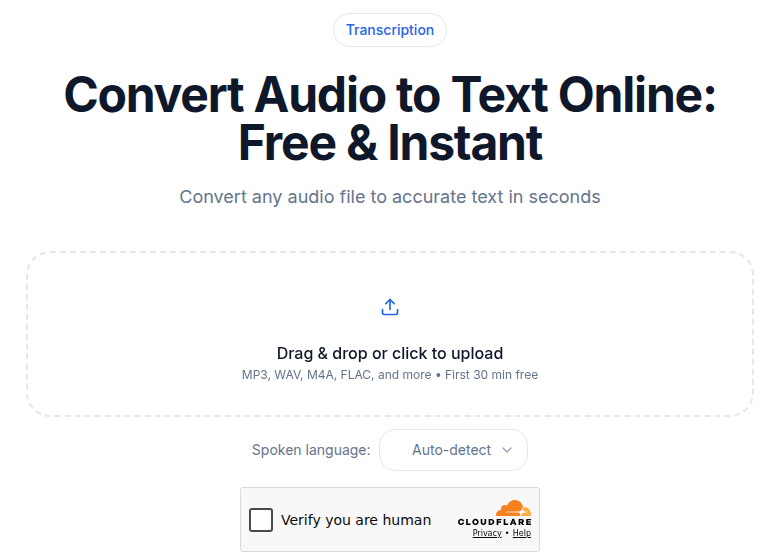 ConvertAudioToText audio upload tool - drop a file to get an intelligent verbatim transcript in minutes
My take: for 90 percent of the audio that lands on a hard drive, intelligent verbatim is the right answer. It is readable, it represents the speaker accurately, and it does not require a rewrite before you can use it.
Edited: Speech Turned Into Prose
Edited transcripts prioritize what the speaker meant over what they literally said. Sentences are restructured for clarity, redundant content is dropped, and the result reads like an article rather than a conversation.
The same passage edited:
Speaker 1: We tried the new pricing model, and it didn't perform as expected.
Notice that the speaker almost certainly did not say "performed as expected." An editor inferred the meaning and rewrote it. That is the defining move of edited transcription: interpretation replaces literal rendering.
Edited transcripts work for:
- Published interviews in magazines and online outlets.
- Memoir and biography where the author wants consistent prose voice.
- Marketing case studies where a customer quote needs to land in one clean sentence.
- Training materials and learning assets that non-specialist audiences will scan quickly.
The risk is fidelity. An edited transcript is one editor's interpretation of what was said, not a verbatim record. For any quote that might be challenged, you need the original recording and an intelligent verbatim transcript as the authoritative source.
How to Choose
A short decision path:
- Will this be used in legal proceedings, as evidence, or for discourse analysis? True verbatim.
- Is this for academic research, a dissertation, or analysis where you need to quote participants accurately? Intelligent verbatim.
- Are you producing show notes, meeting summaries, or content your team will read? Intelligent verbatim.
- Are you writing a published article, book chapter, or marketing case study? Start with intelligent verbatim, then edit by hand.
When in doubt, start more detailed. You can always strip filler from an intelligent verbatim transcript in minutes. Going the other direction without the original audio is not possible.
Converting Between Styles
You can move toward less fidelity easily. You cannot recover fidelity without the original recording.
- True verbatim to intelligent verbatim: Find and replace "um," "uh," "you know," strip pause markers and non-verbal cues. AI text editors handle this quickly on clean transcripts.
- Intelligent verbatim to edited: This is real writing. Budget 15-30 minutes per 1,000 words. The transcript gives you the raw material; the editor shapes it.
- Edited back to verbatim: Not possible from the text alone. You need the audio.
This asymmetry is why researchers and journalists keep the original recording and an intelligent verbatim transcript on file, then derive other styles from those as needed. The transcription workflow best practices post covers the full file-management side of this.
What This Costs
For AI tools, the style choice is essentially free. Whether the tool produces true verbatim or strips fillers, the per-minute rate is the same. You are paying for transcription time, not post-processing. Most AI tools default to intelligent verbatim and let you toggle filler removal on or off.
For human services, verbatim is a premium style. The base rate for human transcription runs roughly $1.50 to $1.99 per audio minute for standard projects, per current pricing from services like Ditto and Rev. Verbatim transcription (capturing every filler and false start) is typically an add-on or tiered rate above the clean default. See cost of transcription per hour for a detailed market breakdown across services.
For a comparison of AI versus human transcription for different use cases, the AI vs human transcription post covers accuracy, cost, and turnaround time.
If you need a fast intelligent verbatim transcript without signing up for an account, ConvertAudioToText accepts audio and video files directly and outputs clean text, with speaker labels on the premium engine.
Common Questions
What is the difference between true verbatim and intelligent verbatim?
True verbatim captures every filler word, false start, pause, and non-verbal sound exactly as produced. Intelligent verbatim removes that noise while preserving every meaning-bearing word. The distinction matters most in legal and research contexts: a court or discourse analyst needs what was literally said; most other readers need what was meant.
Is "clean verbatim" the same as "intelligent verbatim"?
In most industry usage, yes. Both terms refer to removing filler words and false starts while keeping all substantive speech. Some style guides draw a narrower line (clean verbatim fixes minor grammar tics; intelligent verbatim does not), but most transcription providers use the terms interchangeably. Always ask your provider what they specifically remove.
When should I use edited transcription instead of intelligent verbatim?
When the final product is prose intended for publication, and you have both the original audio and an intelligent verbatim transcript as your source of truth. Edited transcription is a writing task, not a transcription task. Use it for published interviews, book chapters, and marketing copy. Do not use it when the exact wording might be disputed or quoted in a research paper.
Can AI transcription tools produce true verbatim output?
Yes. Most AI tools default to intelligent verbatim (filler removal on) and expose a toggle to disable filler removal, producing true verbatim output. What AI tools generally cannot do well is produce the specialized notations (pause duration, pitch markers, overlapping speech) required for conversation analysis or Jeffersonian transcription. Those still require a trained human transcriptionist.
Sources
- Rev: Human Transcription Services: https://www.rev.com/services/human-transcription (checked 2026-07-02)
- Rev: What Does Clean Verbatim Transcription Mean: https://www.rev.com/resources/what-does-clean-verbatim-transcription-mean (checked 2026-07-02)
- Happy Scribe: Types of Transcription in Qualitative Research: https://www.happyscribe.com/blog/what-are-types-of-transcription-in-qualitative-research (checked 2026-07-02)
- GoTranscript: Clean Verbatim vs Edited Transcript: https://gotranscript.com/en/blog/clean-verbatim-vs-edited-transcript (checked 2026-07-02)
- Ditto Transcripts: Human Transcription Cost Guide: https://www.dittotranscripts.com/blog/how-much-do-human-transcription-services-cost/ (checked 2026-07-02)
- TranscriptionCertificationInstitute: What Is Verbatim Transcription: https://www.transcriptioncertificationinstitute.org/blog/what-is-verbatim-transcription (checked 2026-07-02)
Try transcription free
Convert any audio or video to clean, unwatermarked text — speaker labels, timestamps, and AI summaries included. First 30 minutes free, no account.
Related Articles
Speaker Diarization Explained: How Transcripts Know Who Spoke
Learn how speaker diarization works, where it fails, and how to improve speaker labels in interviews, meetings, focus groups and podcasts.

Transcription Accuracy Explained: What 99% Really Means
What 95% transcription accuracy actually means: WER math, benchmark tricks, and the editing time behind each accuracy band.