
When NOT to Use AI Transcription (Honest 2026 Limits)
Summarize this article with:
Skip AI Transcription When
Your work involves evidence-grade certification, protected health data without a proper business associate agreement, or audio so degraded that even a careful human struggles to parse it. The cases below are not edge cases you can work around with a better prompt. They are structural limits.
This post exists because most transcription companies will not write it. Pretending AI is the right tool for every job puts customers at legal and professional risk. The honest answer is more useful than a convincing one.
Case 1: Court-Admissible and Legal Proceedings
AI-generated transcripts are not admissible as official court records in US federal and state courts without certified human review. Per published legal guidance, courts require a Certified Court Reporter (CCR) or licensed transcriptionist to review and attest to accuracy before a transcript enters the official record. AI alone cannot satisfy that requirement.
Three specific failure points:
Chain of custody. Certified transcriptionists stake their professional license on the document. An AI engine cannot testify to methodology or accuracy under oath.
Verbatim standard. Court reporting requires "true verbatim" capture: filler words, repetitions, partial words, false starts, non-verbal cues. AI engines smooth these out by default. "Intelligent verbatim" is not the legal standard.
Error rate at scale. A 95% accurate transcript means roughly 1 word in 20 is wrong. In depositions and sworn statements, a single word substitution can alter meaning in ways that affect outcomes.
For depositions, sworn statements, or any work that enters a court record, use a Certified Court Reporter or a legal transcription service where a human certifies the final output. Some services now use AI as a first-pass draft with human certification on top. That workflow is acceptable. Uncertified AI output is not.
See also: is AI transcription court admissible for a deeper look at the evolving jurisdictional landscape.
Case 2: Protected Health Information (PHI) Without a BAA
Processing audio that identifies patients is regulated by HIPAA in the US. Using any transcription service for PHI without a signed Business Associate Agreement (BAA) puts you in violation, regardless of accuracy.
What HIPAA requires for any service that touches PHI:
- A signed BAA before you process any data (retroactive signing does not make past data compliant)
- Encryption in transit and at rest
- Audit logging and breach notification controls
- Defined retention and deletion procedures
- Explicit prohibition on using patient data to train or fine-tune AI models
ConvertAudioToText does not offer a BAA. Using it for clinical recordings, doctor dictation, patient research interviews, or any audio where a patient could be identified is not compliant, regardless of how accurate the transcription is.
For PHI workflows, options that support BAAs include:
- AWS Transcribe Medical (BAA available via AWS Artifact console, self-service)
- Google Cloud Speech-to-Text (BAA available through Google Cloud HIPAA program)
- Medical transcription vendors with documented BAAs and HIPAA-specific controls
The BAA is necessary but not sufficient. Signing it without also meeting encryption, access control, and audit requirements does not produce a compliant deployment. Work with a compliance professional, not just a vendor checklist.
For more on what each regulation actually requires: HIPAA compliant transcription and GDPR compliant transcription.
Case 3: Six-Plus-Speaker Meetings With Active Crosstalk
This is the AI failure case that companies understate. A six-person conference room with a ceiling mic, active discussion, and people talking over each other produces audio that pushes accuracy well below useful thresholds.
Overlapping speech causes AI to lose roughly 10-15 percentage points of accuracy during cross-talk segments, with the words typically attributed to whichever voice is loudest. In severe cases, accuracy can fall to 60-65% for the overlapping portions. That is not an editing task. That is a rewrite.
What breaks specifically:
- Speaker diarization assigns the wrong words to the wrong person
- Sentence boundaries blur when multiple speakers contribute to the same utterance
- The engine picks one voice and ignores the other, so content is lost, not just mislabeled
For high-stakes multi-speaker work where crosstalk is unavoidable, a human transcriptionist listens at reduced speed, uses context, and separates voices the way another person in the room would.
The better fix is upstream: per-participant audio streams eliminate the problem entirely. Zoom's "record separate audio per participant" mode gives the engine individual clean tracks. Per-speaker lavalier mics do the same in physical rooms. If you can change the recording setup, do that first. If you cannot, this is a human transcription case.
See: speaker diarization explained for a clear walkthrough of how diarization works and where it breaks.
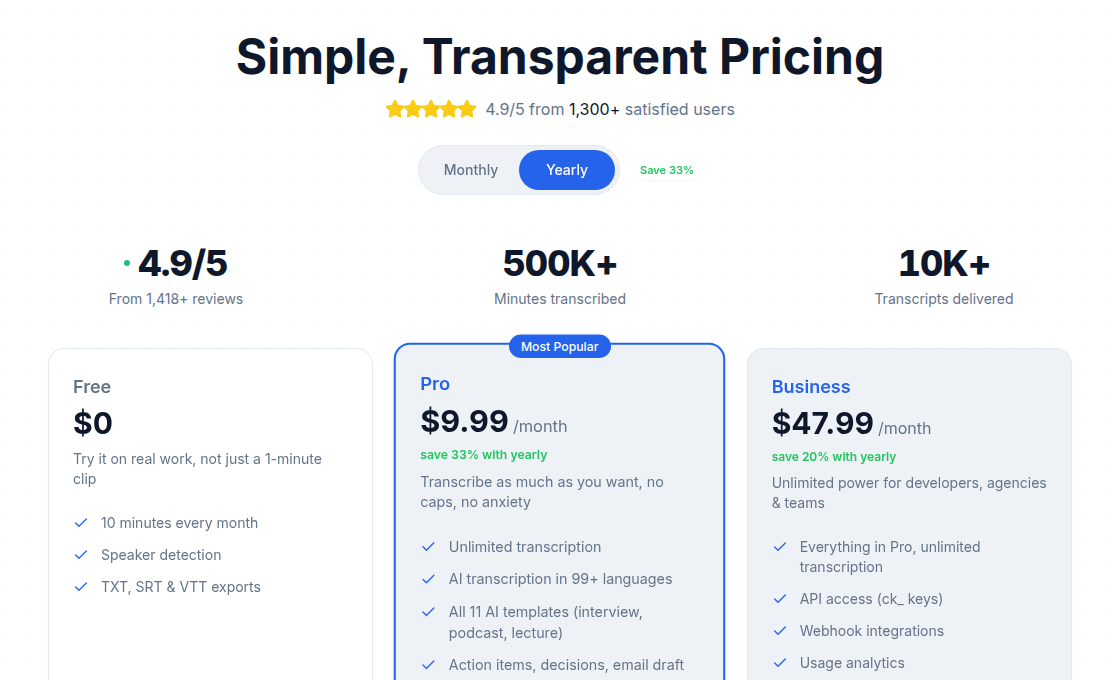 Sometimes the right plan is not buying one at all
Case 4: Highly Technical or Proprietary Vocabulary
AI engines transcribe phonetically when they encounter terms not in their training corpus. For standard medical and legal vocabulary, most major engines do reasonably well. For niche subfields, internal product terminology, or highly specialized scientific work, the engine produces plausible-sounding wrong words.
Examples of where this bites:
- Novel drug names or very new research terminology not yet in the training data
- Company-specific internal product names, especially invented words
- Narrow academic subfields with jargon specific to a small research community
The transcript looks fluent and is wrong in exactly the places that matter most.
Workarounds, roughly in order of effectiveness:
- APIs that support custom vocabulary lists (provide the terms in advance)
- Domain-tuned models (some providers train on legal or medical corpora specifically)
- Hybrid approach: AI first pass, subject-matter-familiar human edits the specialized terms
Pure human transcription with domain familiarity is the ceiling for quality here. The economics often favor the hybrid: AI handles 90% of the words, a human fixes the 10% that matters.
Case 5: Audio With Heavy Background Music at Vocal Frequency
When music with vocals plays at similar volume to the speaker, the engine cannot reliably separate the two signals. The transcript may incorporate song lyrics, skip passages entirely, or substitute words from the music for words actually spoken. This is not a model limitation that will be solved by a better prompt. It is a signal separation problem.
Options:
- Trim music sections before sending to transcription (most podcasts use music only at intro and outro)
- Run audio through a stem separation tool to isolate the speech track, then transcribe the clean output
- Human transcription if the music cannot be removed and the content is essential
The stem separation approach works well and is worth trying before paying for human transcription on this case.
Case 6: Severely Degraded Source Audio
Some recordings have quality so low that accuracy falls to 50-70% even with the best available engine. If a careful human listener struggles to parse the speech, AI will perform worse. The content recovery problem is fundamental, not a model version problem.
The specific scenarios where this applies:
- Old tape archives with significant degradation
- Phone recordings with severe line noise, crackling, or extended dropouts
- Video recorded from across a room with the mic far from the speaker
A human familiar with degraded audio can listen at varied speeds, use audio enhancement plugins, and lean on context in ways that improve recovery. It is still hard. Sometimes the content is simply gone.
If the audio is borderline, the practical test is this: play it to a human who does not know the subject and ask them to write what they hear. If they struggle, AI will struggle more. If they can follow it with effort, AI may do fine.
Case 7: Sworn Statements and Depositions (Separate Note)
Depositions and sworn statements are legal proceedings with their own formal requirements beyond general court admissibility. They require real-time transcription in many cases, specific formatting conventions, and notarization or attestation that gives the transcript official status.
This is a distinct profession. Court reporters attend proceedings live, interrupt when they cannot hear, and produce a certified record on-site. AI is not the right tool for this workflow, and a post-hoc AI transcript of a deposition recording is not a substitute for a certified court reporter at the proceeding.
Case 8: Young Child Speech for Research or Clinical Purposes
Speech recognition models are trained predominantly on adult speech. Young child speech, particularly under age six, has different acoustic characteristics: higher pitch, less consistent articulation, and vowel patterns that differ from adult norms. AI accuracy on young child speech is substantially lower than on adult speech even on clean recordings, with meaningful gaps remaining despite recent research improvements.
For developmental research, speech-language pathology documentation, or any clinical use involving child audio, the accuracy gap is professionally significant. Human transcribers experienced with child speech outperform AI here and can flag clinically relevant features like prosodic patterns that an engine would normalize out.
Where the Line Has Moved
Some workflows that needed human transcription two to three years ago now work reliably on AI:
- Non-native English accents. The accuracy gap has narrowed to 1-3 percentage points on most accents, not the 10-25 point gap of earlier models.
- Single-speaker noisy environments. Coffee shop ambient noise, traffic, HVAC, and standard room reverb are now well-handled by current engines.
- Phone-quality 8kHz audio. Still lower accuracy than high-quality audio, but now usable for most business workflows when the speaker is clear.
- Code-switching in short bursts. A bilingual sentence mixing English and Spanish processes correctly. Sustained, dense code-switching still causes problems.
The trend is real. Cases that required humans in 2023 do not now. Cases that require humans today may not in 2027. The question is what your work needs right now, with current tools.
What to Use for the Cases Above
My take: for certified legal work, there is no substitute for a licensed court reporter or certifying transcriptionist. For PHI, the vendor selection decision starts with the BAA question, not the accuracy question.
For everything else on the list (noisy multi-speaker meetings, degraded audio, child speech, music-over-speech), the practical choice is Rev's human transcription tier, priced at $1.99 per audio minute as of mid-2026, with standard 12-hour turnaround. That is slower and more expensive than AI by a large margin. It is worth that margin when the cases above apply.
If your audio is clean and your use case is standard, AI is the right tool. The cost difference is roughly 100x and the speed difference is 60x or more compared to human transcription. For most business, research, and content workflows, AI wins decisively.
If you have clean audio and just need a fast, accurate transcript without a meeting bot or account setup, ConvertAudioToText handles it with no signup required for short files.
FAQ
Can an AI transcript be used as evidence in court?
In most US jurisdictions, an AI-generated transcript cannot be admitted as an official court record without a certified court reporter or licensed transcriptionist reviewing and attesting to it. AI may be used to produce a draft, but human certification is required before it enters the official record. Check local jurisdiction rules, as requirements vary by state and case type.
Does using AI transcription for medical audio violate HIPAA?
It depends entirely on whether the service has a signed Business Associate Agreement (BAA) with you and whether the rest of your deployment meets HIPAA's technical and administrative safeguards. AI transcription without a BAA is not compliant for PHI. A BAA alone is also not sufficient without meeting encryption, audit logging, and data retention controls.
Why does AI transcription fail on meetings with overlapping speakers?
When two speakers talk simultaneously, the audio signal merges and the engine cannot reliably separate which words came from which voice. Most engines attribute the overlapping speech to the louder voice and miss the other. Accuracy on cross-talk segments typically drops 10-15 percentage points. The best mitigation is per-participant audio tracks recorded separately, which gives the engine individual clean signals.
When is human transcription actually worth the cost?
Human transcription at roughly $1.50-$2.00 per audio minute is worth the cost when: accuracy has professional or legal consequences, the audio has overlapping speakers or severe degradation, the work involves certified legal or medical contexts, or the vocabulary is so specialized that errors in specific terms could cause misunderstanding. For standard business and content workflows on clean audio, AI at 100x lower cost and 60x faster turnaround is the better choice.
Sources
- Rev human transcription pricing (verified July 2026): https://www.rev.com/services/transcription
- AWS HIPAA-eligible services and BAA requirements: https://aws.amazon.com/compliance/hipaa-eligible-services-reference/
- Google Cloud HIPAA compliance and BAA: https://cloud.google.com/security/compliance/hipaa
- Court reporter certification and AI admissibility: https://courtscribes.com/are-ai-assisted-transcripts-court-admissible/
- AI transcription accuracy benchmarks 2026: https://gotranscript.com/en/blog/ai-transcription-accuracy-benchmarks-2026
- Whisper benchmarks on real-world audio 2026: https://novascribe.ai/how-accurate-is-whisper
Try transcription free
Convert any audio or video to clean, unwatermarked text — speaker labels, timestamps, and AI summaries included. First 30 minutes free, no account.
Related Articles
Spotify Transcript Extractor: How to Copy and Download Episode Text
Get a Spotify podcast transcript you can copy and download: paste a public episode link, 30 minutes free with no signup, TXT or SRT files on eligible plans.
Focus Group Transcription for UX Researchers: Turn Multi-Speaker Audio Into Usable Evidence
A practical guide to focus group transcription for UX and insights teams. See how CATT handles speaker labels, timestamps, AI summaries, and clean export.