
Exam Prep From Lecture Transcripts: The 3-Week Plan (2026)
Summarize this article with:
Two weeks before finals, most students discover their notes have gaps. Three weeks before finals, you still have time to close them systematically. A lecture transcript gives you a searchable, complete record of everything said in class, every emphasized point, every "this will be on the exam" aside, every definition the professor gave. This plan shows you how to turn that material into a study system that actually moves information into memory.
The 3-Week Plan
Start three weeks out and you have enough runway to build real study materials, not just organize what you already have. The plan runs in four phases: capture, mine, map, and recall. Each phase feeds the next. By exam day, you are reviewing a system you built, not a pile of source material.
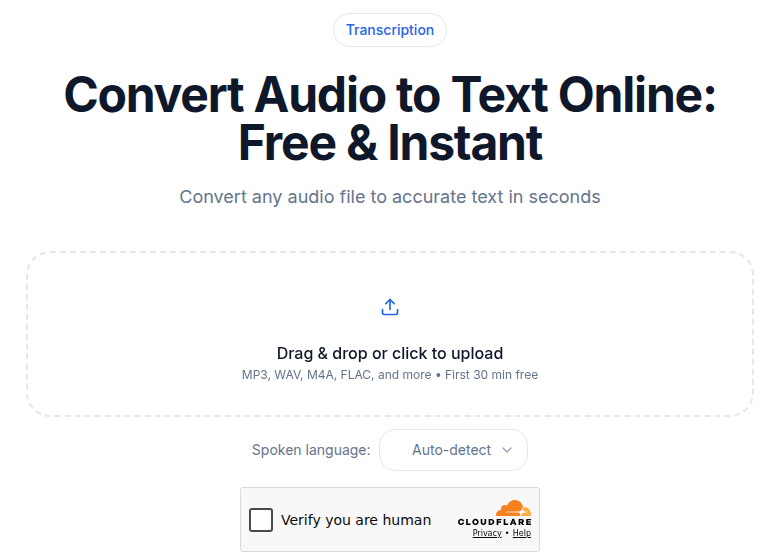 ConvertAudioToText audio upload tool for transcribing lecture recordings
Phase 1: Capture (Days 21-15)
Your first job is to close the transcript gap. Inventory every lecture in the course. Mark which ones you have as transcripts, which ones have recordings you have not yet transcribed, and which ones have neither.
For missing recordings, check three places: the course management system (Canvas, Blackboard), the lecture capture platform your institution uses (Panopto is common), and classmates who recorded and are willing to share. Many students have recordings they never re-listened to and will share freely.
For recordings you do have, transcribe them now while you still have time to act on what you find. A single lecture audio file typically produces a transcript in two to three minutes. See how to transcribe lecture recordings for notes for the recording setup that gets the cleanest source audio.
If you are starting fresh this week, a few notes on quality:
- Auto-captions from Panopto and Canvas are useful as a first pass. Reported accuracy rates range from around 80 to 95 percent on general speech, dropping on technical courses where specialized terminology gets routinely misread. Re-transcribing with a dedicated tool is worth it for high-stakes content.
- For lectures you record yourself, recording lecture with permission covers the practical and policy side before you start.
- The free tier on ConvertAudioToText runs every new account's first file on the premium engine (up to an hour), then keeps transcribing free: up to 30 files a day, up to 30 minutes each. Reading and copying transcripts is free. The Pro plan at $14.99/month gives unlimited transcription, which handles a full semester's backlog in one sitting.
Save every transcript in a folder named for the course. Use a consistent naming convention: LEC01_2026-02-03_Cell_Division.txt. Inconsistent naming costs you time later when you are searching across files.
Phase 2: Mine for High-Yield Content (Days 14-10)
Professors signal what matters, and they use consistent language to do it. Once you have the transcripts, the first analytical move is to search for those signals.
Open each transcript and search for: "important," "remember," "you should know," "this will be on," "high yield," "definitely," "key point," "make note," "make sure." Copy every sentence containing one of these phrases into a single document. This is your raw high-yield list.
My take: this step consistently surfaces 30 to 50 sentences per course that represent the core exam targets. The professor is not hiding what matters, they are announcing it. Most students miss these cues because they are writing when the professor says them, not listening.
A second pass worth doing: search for definition markers. Sentences containing "is defined as," "we call this," "the term," "means," and "refers to" identify every concept the professor explicitly defined. These become flashcard candidates. For terminology-heavy courses (pharmacology, law, accounting), a full semester of transcripts typically yields 80 to 150 definable terms.
For more on building a complete study workflow from this material, see the transcription for students study guide, which covers the broader semester system. This post focuses on the exam-specific moves.
Phase 3: Map to Past Papers (Days 9-7)
This is the step most students skip and the one that produces the biggest return.
Pull the last two or three years of past exams for the course. Most professors reuse question structures even when they change the specific content. For each past exam question, identify the lecture or set of lectures it draws from. Then check: do your transcripts cover that material?
The mapping works like this. Take a past exam question about, say, the mechanism of action of a particular drug class. Search your transcript folder for the drug name, the mechanism keyword, and any synonyms the professor used. Mark the exact transcript sections that contain the relevant content. Now you know exactly where the answer lives.
Build a simple table: past exam question in one column, transcript reference in the second, confidence level (high / shaky / missing) in the third. This table tells you where your gaps are and where to put your study time. It also tells you, usefully, where you are already solid and can stop reviewing.
A course with three years of past exams typically has 60 to 120 questions to map. The exercise takes three to four hours. It is the highest-value three to four hours in your exam prep because you stop studying things you already know and start targeting the actual exam.
Phase 4: Active Recall (Days 6-1)
Passive re-reading is documented in the research literature as one of the least effective study methods. Dunlosky and colleagues, in a 2013 review published in Psychological Science in the Public Interest, rated re-reading "low utility" across nearly every outcome measure. Roediger and Karpicke showed in 2006 that students who spent study time testing themselves recalled 61% of material after a week, compared to 40% for students who re-read. The transcript itself, read passively, does not help much more than re-reading your notes. What matters is what you turn it into.
By day 7, you should have:
- A high-yield sentences document (from Phase 2)
- A past-paper mapping table (from Phase 3)
- A flashcard deck for any terminology-heavy topics
The final six days are for active recall only.
Days 6-4: Generate and answer practice questions. Paste your high-yield document and individual lecture sections into an AI assistant with a prompt like: "Generate 10 practice questions from this material: 5 recall questions and 5 application questions. Include answers." Answer them from memory, on paper, before checking. Mark anything wrong or uncertain.
For courses with predictable exam formats, specify the format in your prompt. "Generate 5 questions in the style of multiple-choice pharmacology board exam questions" produces questions that feel much closer to what you will see.
Days 3-2: Spaced pass through weak areas. Return to every question you marked wrong or uncertain. Do not re-read the transcript for these. First, try to answer again from memory. Then, if you still cannot, find the specific passage in your transcript and read until you can reproduce the answer without looking. Retrieval practice on material you got wrong is more efficient than a second pass through material you already know.
Day 1: Review the mapping table only. On the day before, look at your past-paper table and confirm you have a confident answer for every question. Do not introduce new material. If a topic is still shaky, read the relevant transcript passage once, close it, and write out the key points from memory.
Practice Question Generation at Scale
For courses running 14 to 16 weeks of lectures, generating questions one lecture at a time is slow. A more efficient approach:
- Run each transcript through a summarizer to get a 500-word topic summary per lecture.
- Paste the summaries for a two-week topic block into your AI tool together.
- Ask for questions that integrate across lectures within the block.
Questions that cut across multiple lectures are closer to actual exam questions than single-lecture recall questions. Most exams test integration, not isolated fact recall.
The audio summarizer tool can handle this step directly from the audio file if you have not already built text summaries.
Group Study With Transcripts
The classic group-study failure mode is four students with four different sets of notes arguing about what the professor actually said. Transcripts end that argument in seconds.
Assign one transcript per person to mine before the group meets. Each person arrives with their high-yield sentences already extracted, not with raw notes. The group's job is to compare lists, identify disagreements about what is important, and map those to the past-paper table together. Four people doing this mapping work in parallel cuts the time by roughly 75%.
Groups that use a shared transcript folder where everyone can search also resolve "I think the professor said X" disputes without any argument: search the file.
FAQ
How many transcripts do I actually need to make this work?
You don't need a full semester's worth. Even 60-70% coverage is useful. Prioritize transcribing the lectures that overlap with topics your professor flagged as important, and any classes where your notes feel thin. The 3-week plan above works with a partial set.
What if my university already provides auto-captions in Panopto or Canvas?
Use them as a starting point, not a finished product. Machine-generated captions from lecture platforms run at roughly 80-95% accuracy on general speech, but technical courses can push error rates higher because specialized terms are routinely misread. Re-transcribe any lecture where accuracy matters for high-stakes content.
Can I use AI to generate practice questions from a transcript?
Yes, and it's one of the best uses of a transcript. Paste a section into any AI assistant with a prompt like: 'Generate 8 practice questions from this lecture: 4 recall, 4 application. Include answers.' For courses with predictable exam formats, specify that format in your prompt. The questions tend to resemble actual exam questions because both draw from the same lecture material.
How is this different from just re-reading my notes?
Re-reading, including re-reading transcripts passively, is one of the least effective study methods documented in the research literature. The transcript is a source, not a study method. Its value is in what you turn it into: a searchable keyword index, a past-paper mapping document, a flashcard deck, a set of practice questions. The active-recall and retrieval-practice techniques that work require you to generate answers from memory, not consume text.
Sources
- Dunlosky, J., Rawson, K. A., Marsh, E. J., Nathan, M. J., & Willingham, D. T. (2013). Improving Students' Learning with Effective Learning Techniques. Psychological Science in the Public Interest, 14(1), 4-58. https://pubmed.ncbi.nlm.nih.gov/26173288/
- Roediger, H. L., & Karpicke, J. D. (2006). The Power of Testing Memory. Perspectives on Psychological Science, 1(3), 181-210. https://notes.andymatuschak.org/zGfjkW1ociSmSUCLcpbhKjf
- Panopto auto-caption accuracy documentation: https://teaching.pitt.edu/resources/how-to-add-captions-to-your-panopto-video/
- ConvertAudioToText pricing page: https://convertaudiototext.com/pricing
Try transcription free
Convert any audio or video to clean, unwatermarked text — speaker labels, timestamps, and AI summaries included. First 30 minutes free, no account.
Related Articles

Best Transcription Tools for Students in 2026: Budget-Ranked
Ranked by real cost and verified free-tier limits: the best transcription tools for students in 2026, from free university options to paid picks for heavy lecture loads.

Transcribe Lecture for Notes: Cornell Format in 4 Steps (2026)
Turn any lecture recording into structured, exam-ready notes using a 4-step transcript workflow. Cornell mapping, condensing tips, and course-type templates.