
Hindi Transcription and the Hinglish Problem (2026)
Summarize this article with:
The Real Problem: Your Hindi Audio Is Probably Hinglish
Most modern Hindi audio is not pure Hindi. A sentence from a business podcast might sound like: "Aaj meeting mein hum decide kiya ki next quarter mein hum launch karenge, but pricing strategy abhi finalize nahi hui hai." That is one sentence, seven Hindi words and seven English words, spoken in a single breath. The AI engine has to figure out, word by word, whether to output Devanagari or Latin characters.
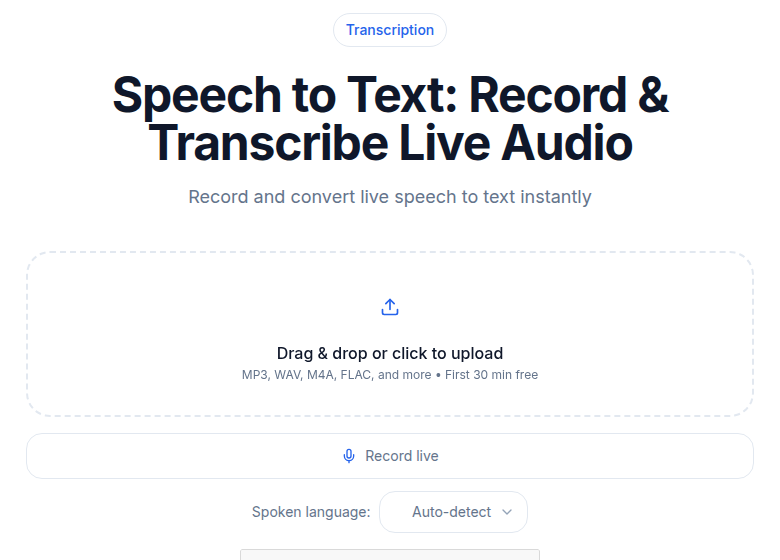 Hinglish audio: set Hindi and review the code-switched sections
This is the core difficulty of Hindi transcription in 2026. It is not an accuracy problem in the standard sense. It is a script-switching problem layered on top of a language-switching problem. Engines that handle this well produce readable, natural output. Engines that do not produce either all-Devanagari (with English words awkwardly transliterated) or transcription that drops the Hindi entirely and treats everything as English.
This guide covers how the major engines actually handle this, verified from documentation and developer reports, not benchmarks conducted in a lab.
Devanagari: What the Script Requires
Hindi is written in Devanagari, an abugida with 47 primary characters (14 vowels and 33 consonants). Characters are written left to right. The distinctive feature is the shirorekha, a horizontal bar that runs along the top of each character, linking letters into words visually.
Several mechanics matter for transcription:
Matras (vowel marks): Vowels are often written as diacritics attached to the preceding consonant, not as standalone characters. A model that handles consonants correctly but botches matra placement produces garbled Devanagari.
Conjunct consonants (samyukta vyanjan): When two consonants meet without a vowel between them, they merge into a single ligature. "ज्ञान" (knowledge) is a conjunct. Getting these wrong is a sign the model was not trained on sufficient Devanagari data.
Nukta dots: A dot below a consonant indicates a foreign sound not native to Sanskrit-derived Hindi. "ज़" (za), "क़" (qa), and "फ़" (fa) all use nuktas and appear frequently in Urdu-influenced Hindi and in transliterated English loanwords.
Schwa deletion: In spoken Hindi, the short "a" vowel (schwa) at the end of a syllable is often deleted. "राम" is pronounced "Raam," not "Raama." Transcription engines that do not model schwa deletion produce phonemically incorrect output.
For a correct Hindi transcript, all of these need to land correctly. If your tool returns "main aapka shukriya ada karta hoon" in romanized Hindi instead of "मैं आपका शुक्रिया अदा करता हूँ", you have a tool that is not actually handling Hindi.
Hinglish: Scale and Code-Switching Mechanics
More than 350 million urban Indians use Hinglish regularly, according to New York Times reporting. Research from IIT Delhi found Hinglish usage grew 2% year-over-year between 2022 and 2024. About 83% of Hindi speakers mix English words into their speech to some degree.
The code-switching in Hinglish is not random. There are consistent patterns:
- Nouns and technical terms switch to English first. "Budget," "deadline," "meeting," "strategy" stay in English even in deeply Hindi-dominant speech.
- Verbs stay Hindi more often, but English verbs get Hindi-ized: "launch karna," "finalize karna," "decide kiya."
- Sentence-level switching is common in formal registers, where a speaker might open a thought in Hindi and close it in English.
- Word-level mixing dominates casual speech, social media, and Bollywood dialogue.
The result is that no single language code fully describes what the speaker is doing. Setting language=hi gives you Devanagari output but may not handle the English portions correctly. Setting language=en drops the Hindi entirely. Setting language=multi is the right call on engines that support it, but behavior varies.
See how code-switching affects transcription pipelines for a broader treatment of the technical issues.
How Each Engine Handles Hinglish
OpenAI Whisper (large-v3)
Whisper large-v3 is the best-known multilingual model and handles pure Hindi well when you set language=hi explicitly. On Hinglish content, the behavior is consistent but not ideal for most use cases: the model transcribes English loanwords and code-switched English phrases into Devanagari script. So "next quarter mein launch karenge" might come back as "नेक्स्ट क्वार्टर में लॉन्च करेंगे," with "next quarter" transliterated into Devanagari rather than kept in Latin.
There is no official flag to request mixed-script Hinglish output from Whisper. The community workaround is Trelis Research's finetuned Whisper-Hinglish model, which introduces a |mixedcode| token that triggers Devanagari-Latin mixing, but this is not in the standard API.
One additional hazard: with auto-detection, Whisper base models sometimes misidentify Hindi as Urdu (the languages are linguistically close and share a spoken form). Urdu uses Nastaliq script, which would make your transcript unreadable to a Hindi audience. Always set language=hi explicitly with Whisper.
Deepgram Nova-3
Nova-3 supports Hindi (hi) natively. For pure Hindi audio, this is Deepgram's strongest offering for the language.
For Hinglish, Nova-3 offers a separate multilingual mode (language=multi) that supports Hindi-English code-switching among 10 languages. In this mode, Nova-3 naturally emits the speaker's script choice: Hindi words in Devanagari, English words in Latin. The model was trained on real code-switched data rather than synthetic mixtures. This is architecturally the right approach.
In practice, there have been developer reports of Nova-3 multi misidentifying Hindi as Spanish in some Hinglish recordings, which causes a significant transcription failure. This appears to be a language-detection reliability issue in the multilingual model, not a fundamental architecture problem. The workaround that some developers have found is reverting to Nova-2 or Nova-1 with the hi language code, accepting the all-Devanagari output limitation.
Deepgram also published a BRIDGE framework specifically analyzing why standard WER metrics fail Indian languages, which is a sign they are thinking seriously about this problem. See Deepgram Nova-3 explained for more on the model's architecture.
AssemblyAI Universal-3
AssemblyAI's Universal-3 model supports 99 languages with automatic code-switching and speaker diarization. Hindi is listed as a supported language. AssemblyAI expanded Hindi to include speaker diarization specifically (alongside Chinese, Japanese, Korean, and Vietnamese), which means multi-speaker Hindi and Hinglish content gets labeled correctly.
For Universal-3 Pro, Hindi falls into the "Good accuracy" tier, which AssemblyAI defines as 10-25% WER. That is not best-in-class but is functional. AssemblyAI's diarization maintains speaker identity across language switches, so a podcast where one host speaks more Hindi and another speaks more English still gets labeled correctly.
Google Cloud STT (Chirp)
Google Cloud's Chirp model supports 125+ languages and uses per-minute metered pricing. Hindi is supported. For code-switching, Google's recommendation has historically been to set language_codes to include both hi-IN and en-IN, which allows the model to handle mixed audio, though output consistency on Hinglish varies.
Pure API Use Cases (Deepgram, AssemblyAI)
If you are building a pipeline, both Deepgram and AssemblyAI offer REST APIs with Hindi support. Deepgram's API pricing and AssemblyAI's metered model are compared in depth in the speech-to-text API pricing overview.
Engine Comparison Table
| Engine | Pure Hindi | Hinglish mode | Script output on Hinglish | Diarization |
|---|---|---|---|---|
| Whisper large-v3 | Strong | No dedicated mode | All-Devanagari (English words transliterated) | No native |
Deepgram Nova-3 (hi) | Strong | No | All-Devanagari | Yes |
Deepgram Nova-3 (multi) | N/A | Yes | Mixed (Devanagari + Latin) | Yes |
| AssemblyAI Universal-3 | Good (10-25% WER) | Auto code-switch | Mixed | Yes (improved 2026) |
| Google Cloud Chirp | Good | Multi-language param | Mixed | Yes |
My take: for Hinglish content where you want readable mixed-script output, Deepgram Nova-3 multi is architecturally the best fit when the language detection works correctly. For pure Hindi audio with strict Devanagari requirements, Whisper large-v3 with explicit language=hi is reliable. AssemblyAI is the better choice when diarization across language switches is the priority.
Regional Hindi Accents and Accuracy
India has dozens of regional Hindi accents, each with distinct phonetic patterns that AI engines handle differently:
Delhi/NCR Hindi (urban, heavy English mixing): Best-supported in training data. Closest to what is tested in benchmarks.
Mumbai Hindi (Bambaiya): Marathi phonology influences the retroflex consonants and vowel length. "Bhai" becomes a distinct social marker. Accuracy is lower than Delhi Hindi but reasonable on major engines.
Lucknow/Awadhi-influenced Hindi: More formal phonology, distinct "l" vs "r" treatment, elevated register vocabulary. Generally handles well.
Bhojpuri-influenced Hindi (Bihar, eastern UP): Bhojpuri-influenced Hindi is phonologically quite different. Schwa retention patterns differ from standard Hindi. Accuracy drops notably.
South Indian Hindi (heavy Tamil, Telugu, Kannada accent): The phonological transfer from Dravidian languages is significant. Retroflex vs dental distinctions are affected. This is the category that most needs post-review on any engine.
For Bhojpuri-specific content, Magahi, Maithili, Marwari, or Awadhi as languages (not accents): these are distinct languages, not regional accents of Hindi. Transcribing them with a Hindi model will produce degraded output and is not a supported use case on any major engine.
Formality Registers and What They Affect
Hindi has two honorific levels that affect verb conjugation, pronouns, and vocabulary:
- Aap (आप): Formal third person "you," used with elders and strangers
- Tum (तुम): Intermediate, used with peers
- Tu (तू): Intimate, used with close friends and children (or as an insult to strangers)
These distinctions affect the vocabulary around verbs (करते हैं vs करते हो vs करता/करती है) and create different transcript text. A transcription engine that normalizes these distinctions to a single form is losing social meaning.
More practically: formal speech (news, lectures, speeches) and casual speech (WhatsApp voice notes, casual podcasts) have very different Hinglish ratios. Formal speech leans toward pure Hindi or full English sentences. Casual speech is the densest Hinglish.
Real Use Cases for Hindi Transcription
Indian podcast and YouTube creators are the highest-volume use case. The Indian podcast scene is among the fastest-growing globally. Hosts switch between Hindi and English within episodes and sometimes within sentences. The practical need is readable show notes and chapter markers that match how the audience actually reads, which means mixed-script Hinglish.
Hindi newsrooms transcribing political speeches and panel interviews need Devanagari output that goes directly into Hindi-language articles. Speaker diarization matters here because panel shows have 3-6 speakers.
Customer support and call centers processing Hindi or Hinglish customer calls need Latin-script output (or Devanagari, depending on CRM system) and speaker labels distinguishing agent from customer. This is a growing machine learning use case with companies specifically finetuning models on call-center Hinglish.
Legal and academic transcription in formal Hindi needs accurate Devanagari with correct matra and conjunct handling, since the output often goes into records.
Educational content (lectures, training videos) spans the full spectrum from pure Hindi to Hinglish depending on the institution and subject.
If you just need a clean transcript without building a custom pipeline, ConvertAudioToText's audio-to-text tool handles Hindi with Devanagari output and Hinglish mixing. On a free account your first file runs on the premium engine (up to an hour), then it keeps transcribing free (up to 30 files a day, up to 30 minutes each), with reading and copying free, enough to test your specific audio before committing.
Tips That Actually Matter for Hindi Audio
Set the language explicitly. Do not rely on auto-detection for Hindi. The language is phonologically similar to Urdu, and some auto-detectors mis-route Hindi audio to Urdu, producing Nastaliq script output that is unreadable to Hindi-script readers.
Choose your mode based on output need. If your downstream system needs Devanagari only, use language=hi and accept the all-Devanagari Hinglish transliteration. If you need readable mixed-script output, use a multilingual mode.
Use custom vocabulary for Indian proper nouns. Indian personal names have enormous variation in spelling: "Priya" vs "Priyaa," "Suresh" vs "Suresh Kumar." Place names differ from their romanized versions. A glossary helps significantly.
Background noise is a real problem in Indian audio, especially content recorded in outdoor markets, busy offices, or street environments. This affects all engines equally and is the biggest accuracy lever outside of engine choice.
Do not use Hindi models for Bhojpuri or Marwari content. The model will try its best and fail. These are separate languages.
Comparing Tools for Hindi Workflows
| Tool | Free tier | Paid pricing | Hinglish handling | Hindi AI summary |
|---|---|---|---|---|
| ConvertAudioToText | First file premium, then up to 30 files a day, up to 30 min each | $14.99/mo unlimited | Mixed script | Yes (Hinglish) |
| Otter.ai | 300 min/month | $8.33/mo annual (1,200 min) | Latin only | English only |
| Sonix | None (trial) | $10/hr or $5/hr + $22/user/mo | Native | No |
| Google Cloud STT | 60 min/month (Chirp) | Per-minute metered | Multi-language param | No |
Note on Otter: the 300-minute free tier is generous, but Otter transcribes Hindi audio in Latin script only and generates summaries in English regardless of audio language. For Indian creators publishing content to Hindi-speaking audiences, that is a workflow mismatch, not a minor limitation.
The hidden costs of transcription services covers what to watch for beyond headline pricing, including per-seat fees and export limitations.
Common Questions
Does Whisper transcribe Hinglish in mixed script?
Not by default. When you set language=hi, Whisper transcribes everything in Devanagari, including English words and loanwords. English words like "meeting" come out as "मीटिंग." There is no standard API flag to change this. A community finetuned model (Whisper-Hinglish by Trelis Research) adds a code-switch mode, but it is not part of the official Whisper API.
What is the difference between Hindi and Hinglish for transcription purposes?
Hindi is the standard language, written in Devanagari, with Sanskrit-derived vocabulary for formal registers. Hinglish is spoken Hindi that mixes English words and phrases within sentences, requiring an engine to make a per-word decision about which script to output. The challenge is that there is no fixed rule: "meeting" can legitimately appear as "मीटिंग" or "meeting" in a Hindi-language document, depending on the publication style. This ambiguity is why Hinglish transcription varies so much between engines.
Can AI engines handle South Indian accents in Hindi?
Yes, but accuracy drops compared to Delhi or Mumbai Hindi. The phonological transfer from Dravidian languages (Tamil, Telugu, Kannada, Malayalam) into Hindi produces retroflex consonant patterns and vowel lengths that differ from the training distribution of most Hindi models. Expect more review work on this content, regardless of which engine you use.
Is speaker diarization available for Hindi content?
Yes, on Deepgram Nova-3, AssemblyAI Universal-3, and Google Cloud STT. AssemblyAI expanded Hindi speaker diarization specifically in 2025-2026. Two-speaker formal interviews generally produce better diarization than multi-speaker panel discussions with overlapping speech, which is true for all languages, not just Hindi.
How do I transcribe Bhojpuri or Marwari audio?
You cannot reliably use a Hindi transcription model for Bhojpuri, Marwari, Magahi, or Maithili content. These are separate languages with distinct phonology. No major commercial engine lists Bhojpuri as a supported language as of mid-2026. If you need Bhojpuri transcription, human transcription from a specialist is the practical path. Using a Hindi model will produce a partial, error-heavy output at best.
Sources
- Deepgram Models and Languages Overview: https://developers.deepgram.com/docs/models-languages-overview
- Deepgram Multilingual Code-Switching documentation: https://developers.deepgram.com/docs/multilingual-code-switching
- Deepgram Nova-3 Multilingual blog post: https://deepgram.com/learn/nova-3-multilingual-major-wer-improvements-across-languages
- Deepgram Nova-3 Hindi-English GitHub discussion: https://github.com/orgs/deepgram/discussions/1208
- AssemblyAI Supported Languages documentation: https://www.assemblyai.com/docs/supported-languages
- AssemblyAI Universal-3 Pro announcement: https://www.assemblyai.com/blog/introducing-universal-3-pro
- Otter.ai pricing: https://otter.ai/pricing
- Sonix pricing: https://sonix.ai/pricing
- ConvertAudioToText pricing: https://convertaudiototext.com/pricing
- Whisper Hindi script discussion: https://github.com/openai/whisper/discussions/1662
- Whisper Hinglish finetuned model: https://trelis.substack.com/p/whisper-hinglish
- Hinglish prevalence data: https://www.gan.studio/blog/posts/the-prevalence-of-hinglish-in-urban-india-a-data-driven-exploration
- OriserveAI Whisper-Hindi2Hinglish: https://github.com/OriserveAI/Whisper-Hindi2Hinglish
Try transcription free
Convert any audio or video to clean, unwatermarked text — speaker labels, timestamps, and AI summaries included. First 30 minutes free, no account.
Related Articles
Arabic Transcription: MSA vs Dialects in ASR (2026 Guide)
How diglossia shapes Arabic speech-to-text accuracy. MSA vs Egyptian, Gulf, Levantine, and Maghrebi dialects: WER data, engine support, and script mechanics explained.
Mandarin Transcription: Simplified, Traditional, and Tones
Mandarin Chinese transcription: Simplified vs Traditional output, tone homophones, Cantonese honesty, and engine support in 2026.