Korean Transcription Guide: Hangul, Honorifics, Konglish
Summarize this article with:
The Short Version
For standard Seoul Korean, Deepgram Nova-3 and Whisper Large-v3 both produce accurate Hangul transcripts with correct speech-level verb endings. For Jeju dialect or dialect-heavy content, only specialized Korean-native engines handle the gap well. If you need a clean transcript without a meeting bot or account setup, ConvertAudioToText covers Korean; a free account runs your first file on the premium engine with speaker labels, then keeps transcribing free (up to 30 files a day, up to 30 minutes each). Reading, copying and TXT download are free; SRT and other file downloads come with the first file, the Weekly Pass, a top-up or a paid plan.
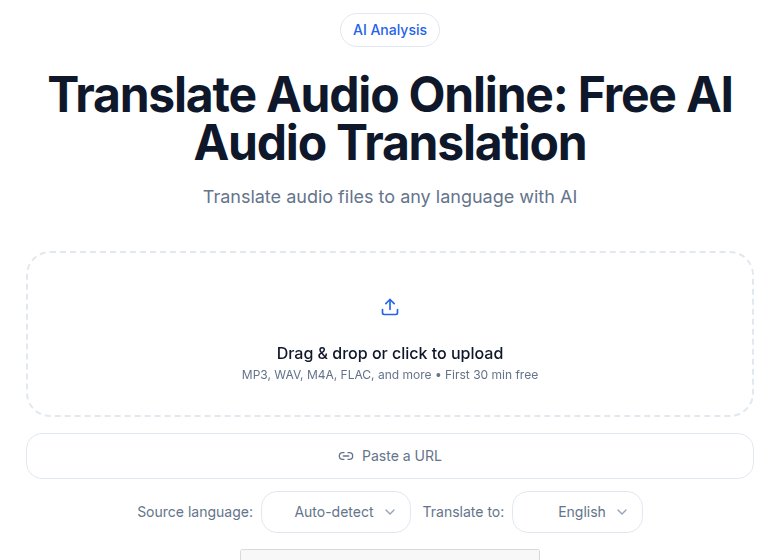 Korean transcription and translation are separate steps with separate accuracy
Why Korean Transcription Has Its Own Class of Problems
Korean is not hard for AI because of its alphabet. Hangul is one of the most phonemically regular writing systems in the world: each syllable block encodes consonants and vowels in a fixed pattern, and there is no character ambiguity of the kind that makes Chinese transcription a different problem entirely.
The real difficulty is structural and social:
Korean spacing is optional and contested. The formal term is 띄어쓰기 (tteui-eo-sseu-gi), and the rules are genuinely ambiguous even among native speakers. Auxiliary verbs may be written attached or separate; bound nouns are officially written separately but commonly attached. In speech, there are no pauses marking these boundaries, so an AI engine must decide where to split agglutinative verb chains. Deepgram has documented Korean compound-noun spacing as one of the "core challenges" addressed in Nova-3. Whisper's evaluation papers use character error rate (CER) for Korean rather than word error rate (WER), specifically because word segmentation is variable. An engine that merges "받아도 돼요" into "받아도돼요" is producing a different grammatical structure, not just a formatting preference.
Korean verbs encode social hierarchy. Getting the words right is not enough. A transcript that normalizes everyone to 해요체 when one speaker used 하십시오체 and another used 해체 has lost information that a Korean reader would use to reconstruct the relationship between participants. See the honorific section below.
Loanwords live in two scripts simultaneously. A Korean business conversation mixes Hangul-rendered English (핸드폰, 카페, 아파트) with Latin-script acronyms and brand names (PM, OKR, KPI, ChatGPT). A correct transcript must put each in the right script, and the mapping is not predictable from phonetics alone: 컴퓨터 (computer) comes back in Hangul, while "IT" stays in Latin, because that is how Koreans write them.
The Honorific Problem and Why It Matters for Transcripts
Korean has a system of speech levels called 존댓말 (jondaemal), distinct from honorific vocabulary. Speech levels are encoded in verb endings and signal the speaker's relationship to the listener, not to the subject. A Korean transcript must reproduce the speaker's actual verb endings.
The three levels still common in modern speech:
- 하십시오체 (hasipsio-che): Formal polite. Standard in news broadcasts, job interviews, military, business presentations, service industry, and first meetings with people significantly senior. Verb ending: -(으)십시오, -(으)ㅂ니다.
- 해요체 (haeyo-che): Casual polite. The default for adult daily conversation, most customer interactions, and content creators addressing their audience.
- 해체 (hae-che): Informal. Used with close friends, peers of equal age, and by adults addressing children.
The other forms, 하소서체 (archaic high formal), 하게체 (semi-formal, now rare among younger speakers), and 해라체 (plain/narrative, common in written narration), appear less often in speech but still carry meaning.
Why this matters for transcription accuracy: A business meeting transcript that consistently renders 하십시오체 endings correctly tells a Korean reader who was speaking to whom, in what capacity, and at what level of formality. A transcript that flattens to a single level loses that. Whisper Large-v3 preserves speech levels because it transcribes what was said rather than normalizing register. Deepgram Nova-3, trained specifically on Korean broadcast and business data, similarly reflects the speaker's actual endings.
Engine Support Tiers: What Is Verified
These tiers reflect what vendors have documented or what independent evaluations have published. I have not invented accuracy percentages.
Tier 1: Strong Korean support, documented improvements
- Deepgram Nova-3 (ko / ko-KR): Deepgram published a blog post documenting "up to 27% WER reduction" over Nova-2 for Korean, citing Hangul spacing ambiguity, rapid conjugation, and syllable blocks as the specific challenges addressed. Keyterm Prompting is available for Korean, which is useful for brand names and technical vocabulary. Nova-3 and Nova-2 both support
koandko-KRlanguage codes. - OpenAI Whisper Large-v3: Korean is among the better-represented languages in Whisper's training data, and OpenAI uses CER (not WER) for Korean benchmarking. The large-v3 release showed 10-20% error reduction over large-v2 across supported languages. See the Whisper API pricing breakdown if you are choosing between the hosted API and self-hosting.
Tier 2: Good accuracy, limited Korean-specific documentation
- AssemblyAI Universal-2: AssemblyAI's documentation lists Korean under the "Good accuracy" band, defined as greater than 10% to 25% WER. Diarization and auto-chapters work for Korean; LeMUR-based summarization in Korean depends on the underlying LLM, not the STT layer. Real-time streaming for Korean is not currently supported.
- Google Cloud Speech-to-Text (Chirp model): Korean is among the 125+ supported languages. Chirp's pricing is per-second, billed in 15-second increments, with a free 60-minute monthly allowance. No published WER for Korean on Chirp. Read the full Google Cloud STT pricing breakdown before committing to volume.
Tier 3: Korean-native, Korea-infrastructure
- Naver Clova Speech: Naver's model trains on Korean-only data, which gives it an advantage on regional dialects and colloquial speech. Pricing is per-second, won-denominated (available on the Naver Cloud Platform pricing calculator). The service is available in Korea, US, Singapore, Japan, and Germany regions. For multilingual Korean-English content, Clova is a weaker choice than the Tier 1 engines.
Not available for Korean:
- Otter.ai: Officially supports English, Spanish, French, German, Japanese, and Chinese. Korean is not listed. The accuracy figures in older comparison tables assigning Otter a Korean WER score are unverifiable and should be disregarded.
Hangul-Only Output and the Hanja Exception
Modern Korean writing is almost entirely Hangul. Hanja (Chinese characters historically used for Korean vocabulary) appear occasionally in formal legal texts, newspaper headlines from older publications, and academic citations, but almost never in speech. A correct Korean transcript produces Hangul output.
If a speaker references a word with a Hanja origin (nearly all Sino-Korean vocabulary), the transcript writes it in Hangul phonetic form. This matches how a Korean native reader expects to see it: 대학교 (university), not 大學校, unless the context is a historical document.
Modern Korean punctuation follows Western conventions: a period is a period (.), a comma is a comma (,). Older editorial styles used Japanese-derived full-width punctuation (。、), but these do not appear in contemporary transcripts from AI engines.
Konglish and Code-Switching: How Engines Should Handle It
Korean business and tech speech is heavily interspersed with English. This is not informal slang but the standard register of Korean professional life. A meeting at a Korean software company routinely produces sentences like "저는 PM이에요, OKR 설정해야 돼요" or "이 API 문서 업데이트해줘요."
The rule for what script each element gets:
| Type | Example (spoken) | Expected transcript |
|---|---|---|
| Fully integrated loanword | haendeupon | 핸드폰 |
| Integrated but shortened | kape (cafe) | 카페 |
| English acronym, stays Latin | O-K-R | OKR |
| English brand name | ChatGPT | ChatGPT |
| English technical term, often Hangul | seobeo | 서버 |
| Mixed compound | UI/UX | UI/UX or 유아이/유엑스 (engine-dependent) |
Whisper Large-v3 and Deepgram Nova-3 both handle this code-switching correctly for common loanwords. The edge cases are Konglish words that are not standard English: 아이쇼핑 (window shopping, from "eye shopping"), 핸드폰 (cell phone, from "hand phone"), 아파트 (apartment, shortened). A well-maintained keyterm list covers the unusual ones.
For a deeper look at how code-switching strains engine accuracy, see how to fix multilingual code-switching in transcripts.
Regional Dialects: Seoul as the Baseline, Jeju as the Outlier
All major AI engines benchmark Korean accuracy against Seoul Standard Korean (서울말), which is the dialect of broadcast media, national education, and most online content.
Regional dialects introduce varying degrees of divergence:
- Gyeongsang (경상도, includes Busan, Daegu): Distinctive pitch accent, different verb endings. Measurably harder than Seoul Korean for standard engines.
- Jeolla (전라도, includes Gwangju): Different intonation patterns and some vocabulary. Recognized by most engines with some accuracy drop.
- Jeju (제주): Linguistically distinct enough that UNESCO classified it as an endangered language separate from Korean proper. It retains Middle Korean features absent from standard Korean and is mutually unintelligible to many mainland Korean speakers. General-purpose AI engines fail substantially on Jeju. Only specialized systems with dedicated Jeju training data, like PersonaAI (which allocated approximately one-quarter of its 50,000-hour Korean training corpus to dialect data), handle Jeju with meaningful accuracy.
If your content includes Jeju speakers, set expectations accordingly and consider whether a human post-editor is required.
Speaker Diarization for Korean Content
Korean formal speech is turn-structured. Casual Korean (variety show panels, group podcasts) has significant overlap and crosstalk.
For speaker diarization, conditions matter more than language:
- 2-speaker formal interview recorded on separate mics: diarization works reliably.
- 4-6 person business meeting, single-room recording: more challenging, especially when speakers defer to each other with brief acknowledgments (네, 맞아요, 그렇죠).
- Variety show or panel format: crosstalk and overlapping reactions reduce accuracy on any engine.
Per-channel recording (each speaker on their own track) is the single most effective improvement for diarization quality, regardless of engine choice.
Practical Workflow for Korean Content
Podcasts and YouTube: Upload the audio or video file, set the language to Korean explicitly rather than relying on auto-detect (auto-detect is slightly slower and can confuse heavily Konglish content with English). Enable speaker labels for multi-host shows. Export Korean SRT for subtitle files. For the mechanics of subtitle generation, see the subtitle generator tool.
Business meetings: If your platform exports an audio or video file, any of the Tier 1 engines produces a usable Korean transcript. Note that meeting bot tools (Otter, Fireflies) lack Korean support as of mid-2026, so file-based transcription is the reliable path.
Research interviews: Korean qualitative research produces transcripts that need speech-level accuracy preserved. A glossary of proper nouns (Korean names have multiple possible Hangul spellings; 이 can be 이, 리, or 리 in different names) prevents the most common misrecognitions.
YouTube content: The YouTube transcript generator accepts Korean-language videos directly.
My take: for most Korean content, the choice between Whisper Large-v3 and Deepgram Nova-3 is marginal in practice. Deepgram's documented Korean improvements and its keyterm prompting are meaningful for domain-heavy content (legal, medical, technical). Whisper is the better choice when you need a self-hosted or cost-controlled option. Naver Clova is the right call when you are building a Korea-market product on Korean-only content and want the tightest dialect coverage.
If you just need a clean Korean transcript without configuring an API or deploying infrastructure, ConvertAudioToText handles Korean with your first file on the premium engine at signup (with speaker labels and SRT/VTT export), then free standard transcription (up to 30 files a day, up to 30 minutes each). TXT downloads are free on every account; DOCX, PDF, SRT, VTT and JSON come with the first file, the Weekly Pass, a top-up or a paid plan. The paid Pro plan is $14.99 per month for unlimited transcription across all supported languages.
Tips for Better Korean Transcription Results
- Set the language code explicitly.
koorko-KRprevents engines from spending inference time on language detection. - Provide a keyterm list for Korean proper nouns. Korean names like 이준호, 박민서, and 김지원 each have plausible alternative Hangul spellings; anchoring them prevents substitution errors.
- For brand and product names, include both the Korean Hangul form and any Latin-script version the speaker might use interchangeably.
- Record in low-background-noise environments. Korean sibilants (ㅅ, ㅆ, ㅈ, ㅊ) lose definition in ambient noise, producing the highest-frequency misrecognition errors.
- For Jeju speakers, set expectations before transcription. Either source a specialized engine or budget for human post-editing.
- Do not assume a transcript that reads correctly in English (for the loanword segments) is accurate overall. Verify the Hangul segments separately.
For a comparison of how Korean stacks up against similar-difficulty languages, see why AI struggles with low-resource languages and the Japanese transcription guide for a CJK parallel.
FAQ
Does Whisper support Korean well?
Yes. Korean is among the better-represented languages in Whisper Large-v3's training data. OpenAI benchmarks Korean using character error rate (CER) rather than word error rate (WER) because Korean word spacing is optional, which makes WER an unreliable metric. The large-v3 model shows a 10-20% error reduction over large-v2 across supported languages. For standard Seoul Korean in clear audio conditions, Whisper performs reliably. Regional dialects, especially Jeju, are substantially harder.
Does Otter.ai support Korean transcription?
No. As of mid-2026, Otter officially supports English, Spanish, French, German, Japanese, and Chinese. Korean is not on that list. Otter's meeting bot architecture also lacks Korean AI summary generation. If your meetings are in Korean, file-based transcription against Deepgram or Whisper is the current path.
How should a Korean AI transcript handle honorific speech levels?
A correct transcript reproduces the speaker's actual verb endings rather than normalizing to a single register. 하십시오체 endings (-(으)ㅂ니다, -(으)십시오) in the audio must appear as 하십시오체 in the text. This matters because Korean readers use those endings to infer the relationship between speakers. Both Whisper and Deepgram preserve speech levels correctly because they transcribe what was said, not a normalized form of it.
What happens to English loanwords in a Korean transcript?
It depends on whether the word is a fully integrated Korean loanword or a live English term. Integrated loanwords like 핸드폰 (haendeupon, cell phone) and 카페 (kape, cafe) come back in Hangul because that is how Koreans write them. Latin-script acronyms like OKR, PM, and KPI stay in Latin script because Korean convention keeps them that way. English brand names (ChatGPT, Google) stay in Latin. The boundary between these categories can be engine-dependent for uncommon terms, which is where a keyterm list helps.
Is the Jeju dialect just a strong Korean accent?
No. Jeju (제주어) is a divergent Korean variety classified by UNESCO as a critically endangered language, not a dialect. It retains features of Middle Korean not found in standard modern Korean and is partially or fully unintelligible to mainland Korean speakers unfamiliar with it. General-purpose speech engines trained on standard Korean fail substantially on Jeju. Only engines with dedicated Jeju training data (like PersonaAI's Korean-native model, which allocated a significant portion of its 50,000-hour corpus to regional speech) produce reliable Jeju transcripts. Budget for human review if Jeju content is part of your workflow.
Sources
- Deepgram: "Deepgram Expands Nova-3 with 11 New Languages Across Europe and Asia", https://deepgram.com/learn/deepgram-expands-nova-3-with-11-new-languages-across-europe-and-asia
- Deepgram: Models and Languages Overview, https://developers.deepgram.com/docs/models-languages-overview
- OpenAI Whisper Large-v3 release discussion, https://github.com/openai/whisper/discussions/1762
- AssemblyAI: Supported Languages documentation, https://www.assemblyai.com/docs/supported-languages
- Otter.ai pricing page, https://otter.ai/pricing
- Sonix pricing page, https://sonix.ai/pricing
- Naver Cloud Platform: CLOVA Speech product page, https://www.ncloud.com/product/aiService/clovaSpeech
- Google Cloud: Speech-to-Text pricing, https://cloud.google.com/speech-to-text/pricing
- PersonaAI Korean dialect speech model (The Asia Business Daily, 2026-01-15), https://www.asiae.co.kr/en/article/2026011515473523659
- Language Log: "The challenging importance of spacing in Korean", https://languagelog.ldc.upenn.edu/nll/?p=44437
Try transcription free
Convert any audio or video to clean, unwatermarked text — speaker labels, timestamps, and AI summaries included. First 30 minutes free, no account.
Related Articles

Arabic Transcription: MSA vs Dialects in ASR (2026 Guide)
How diglossia shapes Arabic speech-to-text accuracy. MSA vs Egyptian, Gulf, Levantine, and Maghrebi dialects: WER data, engine support, and script mechanics explained.
Best Transcription for Asian Languages in 2026
Verified guide to transcribing Mandarin, Japanese, Korean, Hindi, Thai, and Vietnamese audio in 2026. Covers CER benchmarks, engine strengths, and pricing by language.