Legal Transcription Best Practices: A 2026 Handbook
Summarize this article with:
Legal transcription holds a 99-99.5% accuracy standard, which AI alone cannot consistently meet. For depositions, sworn statements, and court filings, a certified court reporter or human-reviewed service is required. For client interviews, witness prep, and internal strategy notes, AI with a structured human review pass is appropriate and cost-effective. The critical variables are verbatim vs. clean-read style, speaker certainty, timestamp density, chain-of-custody logging, and privilege marking. This guide covers the checklist for each.
The core rule in legal transcription: match the tool and process to the document's legal function. A client intake note and a deposition transcript are not the same document, and they should not be produced the same way. The practices below are organized as a working checklist, from the decisions you make before recording to the log entry you write after the transcript is filed.
The Checklist at a Glance
Before reading the detail on each item, here is the full practice checklist:
- Confirm recording consent for every participant, documented in the matter file
- Choose verbatim or clean-read based on the document's legal function
- Verify speaker labels against documented names before any transcript is shared
- Include timestamps at defined intervals (every 5 minutes for depositions; periodic for internal work)
- Add inaudible/unintelligible markers, not blank spaces or guesses
- Mark privilege on every page of protected transcripts
- Log chain of custody at each processing step
- Run a human review pass against the audio on any AI-generated transcript
- Store in matter management with appropriate access controls
- Apply your firm's document retention schedule to transcripts specifically
Each item is covered below.
The Accuracy Standard and What It Requires
Certified legal transcription targets 99-99.5% accuracy. Court reporters and certified human transcription services attest to this level; it is the threshold for any transcript that may be filed or admitted as evidence. Modern AI transcription on clean, single-speaker audio reaches 95-98% accuracy, which sounds close but means a 1-in-50 word error rate. In a 120-page deposition, that is hundreds of potential errors.
The gap matters specifically for:
- Names of parties, attorneys, judges, and witnesses (a misspelled name in a deposition creates downstream errors in every brief that cites it)
- Monetary amounts ("thirteen hundred" vs. "thirty hundred" is a $1,700 error)
- Legal terms of art ("negligence" vs. "gross negligence" are different causes of action)
- Dates and case citation numbers
- Verbatim quoted language relied on for impeachment
The practical response is a written policy that distinguishes two categories: matters where the 99% standard is required (depositions, sworn statements, court filings), and matters where AI with human review is appropriate (client interviews, witness prep, internal meetings). That distinction drives every other decision in this checklist.
For deeper background on how accuracy is measured, see transcription accuracy explained and AI vs. human transcription.
Verbatim vs. Clean-Read: A Hard Line
For depositions and court hearings, the transcript must be verbatim. That means every "um," every "you know," every false start, every interruption, and every moment of cross-talk. Anything omitted becomes a discrepancy if the recording is later compared to the transcript.
For internal work product, clean-read (also called intelligent verbatim) is usually better work product. It is faster to scan, easier to quote, and produces cleaner summaries. Filler words do not change the substance of what a client said in an intake interview.
The distinction matters because AI transcription tools produce clean-read output by default. This is the right default for internal use. It is not appropriate for formal records.
One additional marker to know: "off-the-record" sections require explicit markers in the transcript, whether that is "(OFF THE RECORD)" or a convention your jurisdiction specifies. These markers belong in verbatim transcripts; for internal notes, it is enough to log that a break occurred.
Speaker Certainty
Speaker labels are not decorative; they create the record of who said what. Three standard formats:
By role: "ATTORNEY:" / "WITNESS:" / "INTERPRETER:" / "THE COURT:"
By name: "MR. SMITH:" / "MS. JONES:" (standard for multi-party depositions)
Q-and-A format: "Q. (BY MR. SMITH):" / "A.:" (standard format for deposition transcripts per NCRA guidelines)
AI diarization (speaker separation) is good enough for two clearly separated voices on clean audio. It breaks down in four situations:
- Multiple attorneys from the same firm with similar voice profiles
- Cross-talk, where one speaker interrupts another before the first finishes
- Phone-quality audio, where voice signatures compress
- Non-native-English speakers whose voice patterns the model was not trained on
The review protocol for speaker labels: before any AI transcript leaves the drafting stage, verify every speaker label against the documented participant list. "Speaker 1" and "Speaker 2" are not acceptable in a finished legal document. Labels that were wrong when the transcript was created will be wrong in every downstream citation.
For matters with complex multi-party audio, see speaker diarization explained for what current models can and cannot do.
Timestamps
For court hearings and depositions, timestamps belong at minimum every five minutes. This is the standard in most jurisdictions, though specific courts may require tighter intervals. Check your local rules.
For internal work product, timestamps serve a navigation function. A client intake interview of 90 minutes with timestamps every 10 minutes allows the reviewing attorney to jump to the relevant section without scrubbing audio. That is worth including even when not required by any rule.
Two specific timestamp requirements that are sometimes missed:
First, exhibit references. When the audio mentions an exhibit ("I'm referring to Plaintiff's Exhibit 3"), the transcript should flag the exhibit at that point. "PLAINTIFF'S EXHIBIT 3 INTRODUCED" or similar. Courts have specific conventions; check yours.
Second, (INAUDIBLE) markers. When audio is unclear, mark it "(INAUDIBLE)" with a timestamp. Never guess at what was said. Never leave a blank. An honest "(INAUDIBLE)" at 00:47:23 is a clean record; a filled-in guess is a fabrication.
Chain of Custody
For any transcript that may be referenced in litigation, document the chain of custody in a single log entry per file:
Recording taken by [name/role] on [date]. Transcribed by [tool or service] on [date]. Reviewed by [name/role] on [date]. Stored in matter [number] at [path or location].
That is it. Four facts. The log itself is rarely admitted as evidence, but it exists so that if the transcript's reliability is challenged, you have a contemporaneous record of exactly how it was created and who touched it.
For AI-generated transcripts, the chain of custody log should identify the specific tool. "AI-assisted transcript, reviewed by [attorney name]" is a cleaner record than claiming the output is an unassisted human product.
The Review Protocol for AI Transcripts
An AI transcript without a human review pass is a draft, not a final document. The review protocol does not require listening to the entire recording at normal speed. A trained paralegal using a standard approach:
- Read the transcript at 1.25x-1.5x while the audio plays
- Flag every proper noun (names, places, courts, case names) and verify spelling against the matter file
- Verify every number and every dollar amount against the audio
- Verify every speaker label against the participant list
- Check every legal term of art for correct transcription (Latin phrases, terms of art in your practice area, citation formats)
- Confirm every (INAUDIBLE) marker matches the audio at that timestamp
A 60-minute interview takes roughly 60-90 minutes to review this way. That is the correct budget for a transcript that will be quoted in a brief.
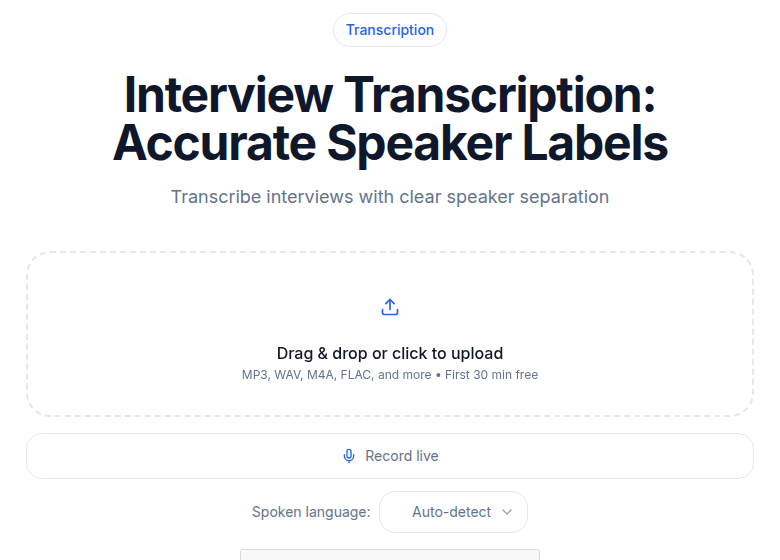 Interview transcription in ConvertAudioToText, showing clean-read output with speaker labels ready for legal review
Privilege Marking
Every page of a privileged transcript gets a header. Two categories:
"ATTORNEY-CLIENT PRIVILEGED AND CONFIDENTIAL" for communications between attorney and client.
"ATTORNEY WORK PRODUCT" for internal strategy documents, interview summaries, and materials prepared in anticipation of litigation.
Both headers belong on a document that qualifies under both (common for witness-prep notes where the attorney's strategy is apparent from the questions).
Storage: privileged transcripts belong in the privileged subfolder of the matter management system, with access limited to the case team. If your system logs access, the access log is itself a form of custody chain.
When an AI tool processes the audio, the processing is generally consistent with privilege if the tool is acting as a vendor under the firm's direction and the relationship is documented. But the burden is yours: confirm that the vendor has a contractual no-training commitment and does not retain audio beyond processing. If you cannot confirm that, do not use the tool for privileged communications.
For a full analysis, see transcription and attorney-client privilege and legal transcription best practices for discovery.
Recording Consent
Recording a conversation without required consent can render the recording inadmissible and creates separate legal exposure.
All-party consent states require every participant to consent before recording. As of July 2026, those states are: California, Connecticut, Delaware, Florida, Illinois, Maryland, Massachusetts, Montana, New Hampshire, Oregon, Pennsylvania, and Washington. Connecticut and Oregon treat in-person and telephone conversations differently in some circumstances. Michigan's statute reads "all-party" but courts have reached conflicting results; treat it as all-party until your jurisdiction's law is clear.
One-party consent states allow any participant to record without informing the others. Most US states follow this rule.
The practice standard regardless of law: get explicit verbal consent at the start of every recorded session ("I want to note that this session is being recorded. Does everyone agree to that?"), document the consent in the matter file, and apply this consistently. This removes the edge cases and creates a clean record.
Internationally, the EU requires informed consent under GDPR. Other jurisdictions vary. For cross-border matters, verify local rules before recording.
This is not legal advice; consult counsel for your jurisdiction's specific requirements.
Transcripts in Discovery
Internal transcripts of communications relevant to a lawsuit can be discoverable. This is not a reason to avoid creating transcripts; it is a reason to treat them with the same document retention discipline as other firm records.
Work-product protection applies to transcripts created at counsel's direction in anticipation of litigation. A 2026 federal court case (Warner v. Gilbarco, Inc., E.D. Mich.) confirmed that using AI tools to create internal materials does not, by itself, waive work-product protection, as long as the material reflects the attorney's mental impressions and is not disclosed to an adversary. That protection is not absolute: disclosure to a third party in a way that substantially increases the likelihood the material reaches an adversary is a waiver.
Practical implications:
- Document retention policies should cover transcripts explicitly, with the same retention periods as other matter documents
- For active litigation, consult counsel before destroying any transcript that might be relevant to the matter
- Privileged transcripts should be tracked in the matter management system, not in a general shared drive
See transcription for legal discovery for a deeper treatment.
When to Use Certified Human Transcription
The decision tree is simpler than it may seem.
Always use a certified human service or court reporter for:
- Formal depositions (required by civil procedure rules)
- Court hearings (typically produced by the court system's reporter)
- Trial proceedings
- Sworn statements that may be admitted as evidence
- Matters involving CJIS-regulated content, where specific security controls apply to the service provider
- High-stakes matters where a transcript error could materially affect the outcome
AI with human review is appropriate for:
- Client intake interviews
- Witness preparation sessions
- Internal strategy meetings
- Expert consultation calls
- Research interviews and case investigation calls
For the middle category (recorded witness statements that may be quoted in briefs, expert depositions with dense technical vocabulary), a hybrid is often right: AI-generated first pass, with a human transcriptionist reviewing against the audio before the transcript is finalized.
On pricing: Rev's human transcription service charges $1.99 per audio minute as of July 2026, which translates to roughly $120 per recorded hour (verified July 2026 at rev.com/pricing). Volume discounts are available on subscription plans. For the AI-appropriate categories, if you need a clean-read transcript quickly without a meeting bot, ConvertAudioToText produces structured output with speaker diarization starting from $14.99/month; it is not a certified service and is not suitable for court filings or sworn records.
Formatting Standards for Formal Transcripts
NCRA guidelines for deposition transcripts specify: 25 numbered lines per page on 8.5x11 paper, left margin no more than 1.75 inches, right margin no more than 0.375 inches, Q-and-A format with each question and answer beginning on a separate line no more than 5 spaces from the left margin. Case caption and page number on every page.
For internal work product, simpler formatting is appropriate. The case name and date on the first page, speaker labels, periodic timestamps, and a consistent format are sufficient. Line-numbered pages are overkill for a client intake summary.
For video evidence, SRT or VTT synchronized subtitle files are often more useful than a paginated transcript. They allow playback with the audio visible simultaneously.
The Firm Policy
If your firm does not have a written transcription policy, write one. It does not need to be long. A two-page document should cover:
- Which use cases require certified human transcription vs. AI with review
- Who is responsible for the human review pass on AI transcripts, and what the review covers
- How privilege is marked and where privileged transcripts are stored
- What the document retention schedule is for transcripts
- How chain of custody is logged
Once the policy exists, training associates and paralegals on it is straightforward. Without a policy, the decision gets made differently by each person who handles a transcript, and the inconsistency itself becomes a liability.
FAQ
Is AI transcription accurate enough for legal work?
For internal work product such as client intake notes and witness prep sessions, AI transcription reaching 95-98% accuracy on clean audio is sufficient when paired with a trained human review pass. For depositions, sworn statements, or any transcript that may be filed or admitted as evidence, the certified 99% standard applies and AI alone does not meet it.
What is the difference between verbatim and clean-read transcription?
Verbatim transcripts capture every word, filler, false start, and cross-talk exactly as spoken. They are required for depositions and formal legal proceedings. Clean-read transcripts (sometimes called intelligent verbatim) remove filler words and repetitions while preserving content, and are appropriate for client interviews, witness prep, and most internal work product.
Do I need consent before recording a client or witness?
It depends on the jurisdiction. As of 2026, twelve states require all-party consent before recording: California, Connecticut, Delaware, Florida, Illinois, Maryland, Massachusetts, Montana, New Hampshire, Oregon, Pennsylvania, and Washington. The conservative practice is to obtain explicit verbal consent at the start of every session and document it in the matter file, regardless of your state's rule. This is not legal advice; verify requirements for your specific jurisdiction.
Can AI-generated transcripts be used in discovery or admitted as evidence?
AI-generated transcripts of internal communications can be subject to discovery if they are relevant to litigation. Work-product protection applies where they are created at counsel's direction in anticipation of litigation, and a 2026 federal case (Warner v. Gilbarco) confirmed that use of AI tools does not automatically waive that protection. For admission as evidence, courts continue to require human verification to reach the 99% accuracy threshold for certified records. A proposed Federal Rule of Evidence 707 (under review through 2026) would require AI-generated evidence to meet expert-testimony standards.
How do I protect attorney-client privilege when using AI transcription tools?
Before using any third-party AI service for privileged communications, confirm that the vendor has a contractual no-training commitment and does not store audio beyond processing. Mark every privileged transcript with "ATTORNEY-CLIENT PRIVILEGED" on each page. Store transcripts in the privileged section of your matter management system with access limited to the case team. For matters requiring strict compliance, obtain a data processing agreement from the vendor and document the relationship in the matter file.
Sources
- Rev pricing, verified July 2026: https://www.rev.com/pricing
- Recording consent laws by state, 2026: https://www.recordinglaw.com/party-two-party-consent-states/
- NCRA transcript formatting guidelines: https://omegareporting.com/client-services/formatting-guidelines/
- CJIS Security Policy v6.0 (December 2024), FBI: https://le.fbi.gov/file-repository/cjis_security_policy_v6-0_20241227.pdf
- AI attorney-client privilege, ABA Business Law Today (2024): https://www.americanbar.org/groups/business_law/resources/business-law-today/2024-september/ai-attorney-client-privilege/
- Warner v. Gilbarco, Inc. (E.D. Mich. 2026) / work product doctrine and AI tools: https://www.klgates.com/Litigation-Minute-Generative-AI-Data-Attorney-Client-Privilege-and-the-Work-Product-Doctrine-2-23-2026
- Proposed FRE 707, AI-generated evidence: https://ailegalauthority.com/ai-evidence-admissibility
- Certified transcription for court, 2026 guide: https://translators-usa.com/certified-transcription-for-court-the-2026-legal-professionals-guide/
Try transcription free
Convert any audio or video to clean, unwatermarked text — speaker labels, timestamps, and AI summaries included. First 30 minutes free, no account.
Related Articles
How Lawyers and Paralegals Use Legal Transcription Software for Faster Case Review
Learn how lawyers and paralegals use legal transcription software for depositions, client intake, and meetings, with speaker labels, summaries, and exports.

Spotify Transcript Extractor: How to Copy and Download Episode Text
Get a Spotify podcast transcript you can copy and download: paste a public episode link, 30 minutes free with no signup, TXT or SRT files on eligible plans.