
Localization vs Translation: The Budget-Changing Difference
Summarize this article with:
Translation converts words accurately between languages. Localization adapts the full experience, including dates, currency, cultural references, and brand register, to feel native in a target market. Transcreation goes further still: it rewrites creatively to preserve emotional impact, often diverging completely from the source. Matching the right tier to the right content type is the budget decision that determines whether international expansion pays off.
Translation and localization are not the same thing, and the gap between them is where international content budgets go wrong. Translation converts words accurately. Localization adapts the full experience. Transcreation rewrites creatively to preserve emotional impact when no accurate translation could do the job. Which level you need depends entirely on what your content is trying to accomplish.
Three Concepts, Three Different Jobs
Think of the three as layers, not synonyms.
Translation is faithful word-for-word (or sense-for-sense) conversion between languages. A good translation preserves meaning, preserves register (formal stays formal, casual stays casual), and uses natural phrasing in the target language. For reference content, technical documentation, or internal transcripts, accurate translation is usually all you need.
Localization goes beyond the words. It adapts the full content experience so it makes sense to a person in the target market: date formats, currency, measurement systems, cultural references, imagery, seasonal timing, legal copy, and brand voice register. A localized piece of content doesn't just say the same thing in a new language. It feels like it was written for that market.
Transcreation is a creative rewrite that may diverge significantly from the source text to capture its intended emotional effect in the target culture. It is what you need when the words themselves cannot carry the meaning across. Transcreators are bilingual copywriters, not translators.
Where the Lines Break Down: Concrete Examples
Date formats
A content team in the US writes "Join us 07/04/2026 for our summer sale." An exact translation into British English produces the same string. A British reader interprets it as April 7, not July 4. The sale is in the past. Localization catches this by converting to the DD/MM/YYYY format used in the UK (and roughly 178 other countries), or using the unambiguous written form: "4 July 2026."
ISO 8601 (YYYY-MM-DD) is the unambiguous international format and the right default for any technical context, but consumer-facing content should follow the convention the target market expects, not the universal standard.
Idioms and register
A US fitness app sends a push notification: "You've got this!" It translates accurately into German. It reads as condescending. German B2C communication defaults to a more measured, informational tone. The equivalent message for Germany rewrites the sentiment entirely to feel credible rather than cheerleader-adjacent. That is a localization decision, not a translation error.
Japanese business communication operates within keigo, a layered honorific system with no equivalent in English. Getting the register wrong in Japanese content does not just sound awkward; it signals that the brand does not understand the market. Defaulting to polite-formal (desu/masu form) for B2B and most B2C is the correct localization choice, not the most direct translation.
Cultural references and slogans
When KFC launched in China in 1987, someone translated "Finger Lickin' Good" as a literal string: "eat your fingers off." The intent (food so good you ignore table manners) vanished completely in the literal rendering. KFC corrected it quickly, and China went on to become one of the chain's largest markets. But the original error is a clean illustration of what happens when a phrase built on cultural idiom is treated as a translation exercise.
Nike's "Just Do It" was adapted for the Chinese market not by translating the phrase but by reimagining the underlying idea. The impulsive, individualistic energy of "Just Do It" reads differently in a market where collective context and measured action carry more cultural weight. Nike tested different narrative framings entirely rather than looking for a Chinese sentence that said the same thing.
Coca-Cola's entry into China is a positive counterexample. The company commissioned a phonetic Chinese name, 可口可乐 (Kekou Kele), which roughly means "let your mouth rejoice." It sounds close to "Coca-Cola" and carries a positive meaning. Early unofficial signs by individual shopkeepers using random phonetic characters had produced nonsensical strings like "bite the wax tadpole," but the company had already registered its intentional, meaning-bearing name before wide marketing began. The lesson: transcreate the name before you enter the market, not after.
Register and dialect choice
Spanish for Mexico and Spanish for Spain are not the same choice. Spain uses "vosotros" as an informal second-person plural, which Latin American markets rarely use. The word for "computer" is "ordenador" in Spain and "computadora" in Mexico. A formal Castilian register can read as stiff to a Mexican audience. These are localization decisions your translation workflow needs to make explicitly, not assume.
The same is true for Portuguese (Brazil vs. Portugal) and Chinese (Mandarin for mainland China vs. Cantonese for Hong Kong). Picking the wrong dialect does not just reduce resonance; in some cases it signals that the content was not made for the reader's market.
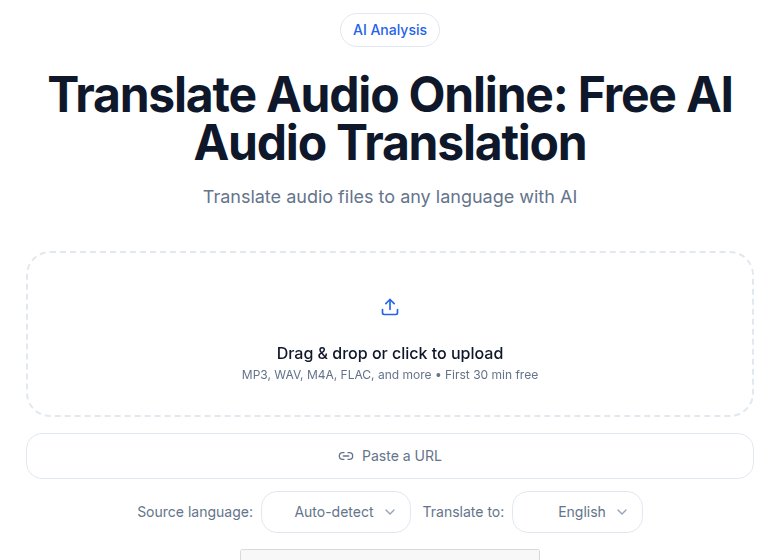 ConvertAudioToText audio translation tool for multilingual transcription workflows
The Spectrum in Practice
Content sits on a spectrum from pure translation to full transcreation. Matching the tier to the content type is the budget decision.
| Content type | Right tier | Approximate cost signal |
|---|---|---|
| Internal transcripts, support docs, legal text | Translation only | $0.07 to $0.14/word (human); $0.05 to $0.12 (MTPE) |
| Consumer blog posts, product descriptions | Translation plus cultural review | Add human editor pass on top of MTPE base |
| Marketing campaigns, hero landing pages | Full localization | Substantially higher per project; varies by visual scope |
| Taglines, slogans, ad copy | Transcreation | Billed by project or hour, not per word |
The cost figures above are drawn from Alconost's 2026 analysis of 3,200+ localization projects and corroborated by multiple agency pricing guides. Rates shift based on language pair rarity, content complexity, and turnaround.
One thing to be aware of: "localization" as a project category often quotes only the translation layer. Visual adaptation, cultural reference rewrites, and legal copy adjustments are frequently priced as separate line items or skipped in cheaper bids. If you are comparing vendor quotes, check what the localization scope actually covers.
What AI Does Well and Where It Still Falls Short
AI translation in 2026 handles most non-specialized content accurately. DeepL, GPT, and Claude are capable of producing translation quality that required human specialists five years ago. For the practical purposes of most content teams, AI-plus-human-review is the right starting point, not a full human translation pipeline.
Where AI still underperforms:
- Replacing a cultural reference that doesn't survive translation with a market-appropriate equivalent (requires knowledge of the target culture, not just the target language)
- Adapting brand voice to match market formality expectations (Japan's keigo system, Germany's du vs. Sie distinction)
- Selecting examples, case studies, and imagery that resonate locally
- Producing transcreation-quality output for high-stakes marketing copy
A hybrid workflow covers most consumer content at roughly the cost of AI post-editing, with a human pass that catches the cultural gaps the model doesn't flag.
Localization for Audio and Video Content
For podcasts, courses, interviews, and video, localization is more layered than text:
Audio localization goes beyond translating a transcript. Voice talent selection matters: a native speaker of the target market sounds different from a fluent non-native. Cultural reference adjustment in the script needs to happen before recording, not after. Some sound effects and music choices carry cultural associations that don't cross markets cleanly.
Video localization adds on-screen text (graphics, lower-thirds, burned-in captions) and visual context (showing target-market settings, faces, products). Subtitle timing can shift because sentence structures in different languages produce different spoken lengths. A sentence that takes 3 seconds in English might take 4.5 seconds in German, breaking subtitle timing.
For any audio or video localization workflow, transcription is step one. You need a source-language transcript before translation can start, and the quality of that transcript directly affects everything downstream. See the transcribe and translate workflow for a full pipeline overview, and AI vs human translation for the tradeoffs at each tier.
If your content starts as audio, ConvertAudioToText produces transcripts in 99+ languages with no signup required, which can serve as the source document for your translation or localization pass.
The Localization Mistakes That Are Most Expensive
Treating localization as a translation step. If your process is "translate the English into Spanish," you have translation, not localization. Localization requires people with target-market expertise involved in the content, not just the language conversion.
Inconsistent terminology across channels. A "subscription" in English should map to the same word in every piece of Spanish content across your site, emails, and app. "Suscripción" becoming "abono" on a different page signals poor coordination. Translation memory tools (Smartling, Phrase, Memsource) enforce this across large projects.
Forgetting micro-content. Button labels, push notification copy, email subject lines, and error messages are frequently left out of localization scope. Poor micro-content makes a localized experience feel half-finished to native speakers.
Skipping visuals. Translated text with original-market imagery still signals "this is a translated piece, not made for us." A US family photo in content localized for Japan or India undermines the localization investment in the words.
Going wide instead of deep. My take: one fully localized market beats three half-translated ones every time. A Spanish-language experience built for Mexico, with native examples, market-appropriate register, and localized visuals, will outperform the same budget spread thin across Spanish, Portuguese, French, and German.
A Practical Workflow for Smaller Teams
- Start with AI translation plus a light human edit. Get the content into the target language quickly.
- Monitor engagement in the target language. Bounce rate, time on page, conversion, and shares all signal whether the content is landing.
- If the market shows real traction, invest in localization for the highest-performing content types.
- Reserve transcreation and full localization for marketing campaigns, hero content, and any piece where emotional resonance drives the outcome.
- Keep translation-only for support content, documentation, and anything internal.
For deeper reading on the translation tier specifically, the AI vs human translation piece covers when human review is worth the cost. For the subtitle localization piece of the workflow, see subtitle translation for video.
FAQ
What is the difference between translation and localization?
Translation converts text from one language to another as accurately as possible. Localization adapts the entire content experience for a target market, including tone, date and number formats, currency, cultural references, imagery, and legal copy. A translated page says the same thing in a new language. A localized page feels like it was made for that market.
When should you use transcreation instead of translation?
Use transcreation for content whose entire job is to provoke an emotional response: slogans, taglines, ad copy, campaign headlines, and email subject lines for unfamiliar markets. If a direct translation would produce flat, unpersuasive copy (because the humor, rhythm, or cultural reference doesn't carry over), transcreation is the right choice. For reference documents, support content, or internal memos, translation is sufficient.
How much does localization cost compared to translation?
Human translation runs roughly $0.07 to $0.30 per word depending on language pair and content type. AI-assisted translation with human post-editing (MTPE) is typically $0.05 to $0.15 per word. Full localization adds cultural review, visual adaptation, and regional copywriting, so costs rise substantially per project. Transcreation is usually billed by the hour or by project rather than per word, because a single tagline can require hours of creative work.
Can AI handle localization in 2026?
AI handles translation well for most non-specialized content in 2026. It can also manage date and number format conversion, basic idiom adaptation with the right prompting, and tone shifting. What it still does poorly: replacing cultural references that don't survive the crossing, adapting brand voice for markets with fundamentally different formality expectations (like Japanese keigo), and selecting imagery or examples that resonate locally. A hybrid AI-plus-human workflow covers most consumer content at a lower cost than full human localization.
Sources
- Lokalise: What is Transcreation? (checked 2026-07-02)
- Phrase: Localization vs Translation (checked 2026-07-02)
- Smartling: How is Translation Different from Localization (checked 2026-07-02)
- Smartling: Six Ways Transcreation Differs from Translation (checked 2026-07-02)
- Alconost: Localization Cost (3,200+ projects) (checked 2026-07-02)
- Translators USA: Translation Services Pricing Per Word 2026 (checked 2026-07-02)
- Snopes: Bite the Wax Tadpole (Coca-Cola China) (checked 2026-07-02)
- Mashed: KFC China Slogan Mistranslation (checked 2026-07-02)
- Wikipedia: List of Date Formats by Country (checked 2026-07-02)
- Elite Asia: AI Translation Accuracy Rate in 2026 (checked 2026-07-02)
- LinkedIn: Formal vs Informal Speech Localization Challenges (checked 2026-07-02)
Try transcription free
Convert any audio or video to clean, unwatermarked text — speaker labels, timestamps, and AI summaries included. First 30 minutes free, no account.
Related Articles
How to Translate a Podcast to Spanish: 2026 Workflow
A practical 2026 workflow for translating English podcasts to Spanish, covering transcription, translation tools, subtitles, AI dubbing, and Spanish register choices by region.

AI Translation vs Human Translator: When Each One Is Right
A stakes-based decision guide for AI vs human translation in 2026. Covers legal, marketing, and subtitle use cases with verified costs and the PEMT hybrid workflow.