Open Source vs Proprietary Transcription Models 2026
Summarize this article with:
Under roughly 10,000 minutes a month, a proprietary API (Deepgram, AssemblyAI) usually beats self-hosting Whisper on total cost once GPU and engineering time are counted; above that volume the math flips fast. Proprietary also wins on streaming latency and built-in diarization; open source wins on privacy, control, and zero marginal cost. Many production teams run both: an API for real-time, self-hosted Whisper for batch.
The Real Tradeoffs
If you transcribe fewer than 10,000 minutes a month, a proprietary API almost always beats self-hosting Whisper on total cost. The open-source model weights are free, but the GPU compute is not, and the engineering time to run it in production rarely is either. Above that volume, the math flips fast, and the case for self-hosting becomes genuinely compelling.
The 2026 question is not ideological. Both ecosystems are mature. The useful answer lives in four dimensions: cost at your actual volume, accuracy on your actual audio, how much latency tolerance you have, and how much operational complexity your team can absorb. This post walks each one honestly.
What Each Side Actually Includes
The Open-Source Side
The open-source speech recognition stack has three main layers worth knowing:
- OpenAI Whisper and its successive versions through Large-v3. The model weights are MIT-licensed. You run them on your own infrastructure, pay only for compute, and keep the audio on your servers.
- Faster implementations like faster-whisper (CTranslate2 backend), whisper.cpp (C++ port), and MLX Whisper (Apple Silicon). These run identical Whisper weights with 4-6x better throughput and roughly half the VRAM. The faster-whisper INT8 quantization drops VRAM usage another 40% with negligible accuracy loss.
- Adjacent open models: NVIDIA NeMo's Parakeet and Canary families, Hugging Face's Distil-Whisper (a faster, smaller Whisper derivative), and SenseVoice for multilingual tasks. The ecosystem around Whisper is now a platform, not just one model.
For a deeper look at how the Whisper architecture actually works, see Whisper Large-v3 explained.
The Proprietary Side
Proprietary APIs sell the same capability minus the deployment work:
- Deepgram Nova-3: currently among the fastest for batch and streaming, priced at approximately $0.0043 per minute for pre-recorded audio (pay-as-you-go) and $0.0048 per minute for streaming. Growth-plan annual pricing drops both further. See Deepgram Nova-3 explained for a detailed breakdown.
- OpenAI Whisper API: hosted Large-v3 at $0.006 per minute. Simpler integration than any self-hosted route, with the slower queue and scheduling overhead that managed hosting implies.
- AssemblyAI Universal-2: $0.15 per hour ($0.0025/min) for base transcription, with add-ons for diarization (+$0.02/hr), entity detection, and summarization priced separately. Note that effective July 1, 2026, in-region pricing increased 10%; using
"model_region": "global"in API requests avoids that increase. - AWS Transcribe: $0.024 per minute at the standard tier (0-250K minutes/month), dropping in four volume tiers down to $0.0078/min at 5M+ minutes. Medical and call analytics cost more.
- Google Cloud STT v2 (Chirp model): $0.016 per minute standard, with batch/dynamic processing available at $0.003 per minute for non-time-sensitive workloads. Google bills in 15-second increments rounded up, which matters for short clips.
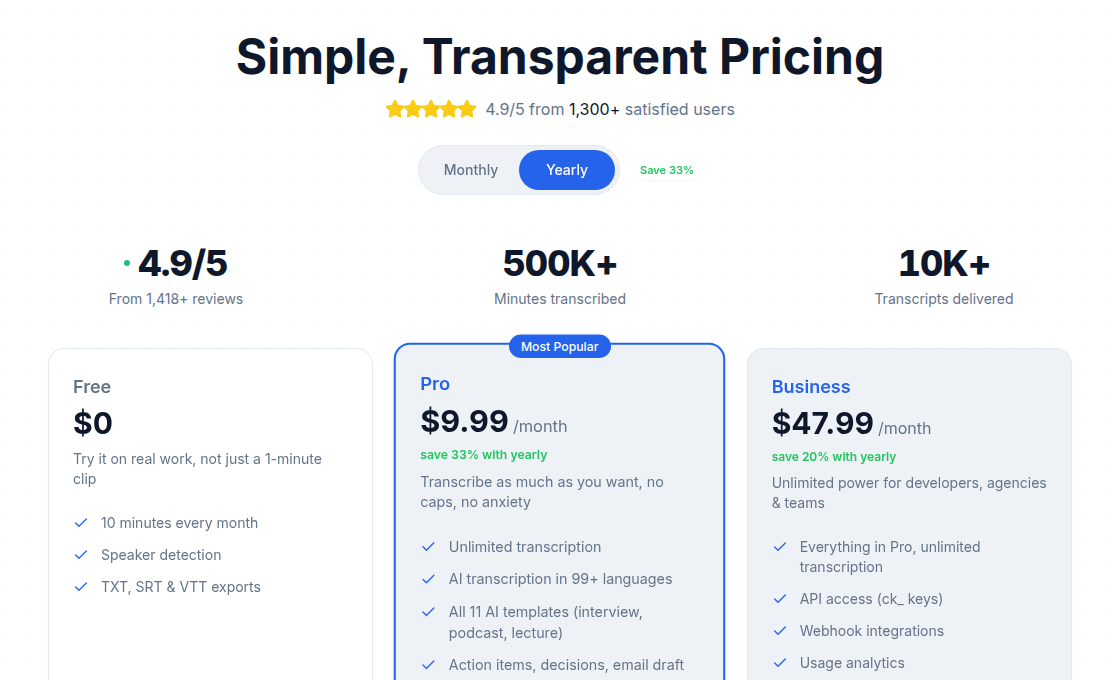 The ConvertAudioToText pricing page showing plan options
Accuracy: Benchmark Numbers vs. Production Reality
The single most misleading thing in this space is a simple WER table without context. Every major system is competitive on academic benchmarks. Real-world performance spreads much wider.
Whisper Large-v3 hits 2.7% WER on LibriSpeech test-clean, a controlled read-speech dataset. On mixed real-world recordings the same model averages around 7-8% WER, rising to 17% or more on low-quality phone audio. Deepgram Nova-3 in Deepgram's own production benchmarks (2,703 files across nine domains) shows a median 5.26% WER on batch and 6.84% on streaming, though vendor-published benchmarks use curated datasets.
Context shifts the winner:
- Noisy/telephony audio: Deepgram Nova-3 has a consistent edge here. Proprietary models trained heavily on call-center data handle phone audio better than Whisper, which was optimized on a broad multilingual corpus.
- Low-resource languages and accented speech: Whisper Large-v3, trained on 680,000 hours of multilingual audio, handles unfamiliar accents and code-switching better than most proprietary APIs. For why this gap persists, see why AI struggles with low-resource languages.
- Long-form audio: Whisper has a known tendency to hallucinate during long silences. Proprietary APIs handle chunking and silence detection at the infrastructure layer, so this is effectively not your problem.
- Speaker diarization: All systems handle this imperfectly. Deepgram and AssemblyAI invest specifically in the diarization layer on top of their base models. Self-hosting Whisper means integrating Pyannote or NeMo separately. See speaker diarization explained for how it works.
My take: if your audio is clear meeting or podcast quality in a mainstream language, the accuracy difference between any serious option is small enough that cost and ops complexity should drive the decision. If your audio is phone-quality, accented, or multilingual, test all candidates on a real sample before committing.
Cost: The Crossover Happens Around 10,000 Minutes Per Month
The most important table in this post. Proprietary vs self-hosted costs at three volumes, using Deepgram Nova-3 pre-recorded pricing (~$0.0043/min) and realistic self-hosting cost on RunPod (A100 from ~$1.29/hr):
| Volume per month | Deepgram Nova-3 | Self-hosted faster-whisper |
|---|---|---|
| 1,000 minutes | ~$4.30 | $40-80 (GPU minimum floor) |
| 10,000 minutes | ~$43 | $60-120 |
| 50,000 minutes | ~$215 | $100-200 |
| 500,000 minutes | ~$2,150 | $400-900 |
The GPU floor is the key insight. A persistent GPU instance costs money whether or not it is transcribing. At low volume, you pay mostly for idle time. At high volume, you are spreading that fixed cost over enough work that the per-minute effective rate falls well below any API.
The crossover depends on how efficiently you pack GPU work. With queuing and batch scheduling, a single A100 on faster-whisper can process several hundred hours per day. If your workload fills it, self-hosting beats every proprietary price at high volume. If it sits 80% idle, you have given back the advantage.
For the full cross-service pricing comparison, see transcription pricing comparison 2026.
Latency: Where Proprietary Has a Real Edge
Deepgram Nova-3 streaming returns partial transcripts in 100-300ms. Whisper is not an inherently streaming model; approximations via whisper-streaming or WhisperX introduce more latency, typically 500-1500ms for partial results. For real-time captions, live call transcription, or voice-agent loops, this is a meaningful gap.
For batch work (post-recording meetings, podcasts, interviews), the gap is smaller. Deepgram processes an hour-long file in roughly 2-3 minutes. A well-tuned faster-whisper deployment on an A100 does similar work in 4-7 minutes. The hosted OpenAI Whisper API is slower than either due to queue overhead.
If your pipeline runs overnight and no one is waiting, latency differences are largely irrelevant. If users are watching a progress bar, they are not.
Operational Complexity: The Underestimated Cost
Running a production Whisper deployment means owning a set of problems that a managed API absorbs invisibly:
- GPU provisioning: persistent instances cost money when idle; serverless (RunPod, Modal, Replicate) adds cold-start latency.
- Traffic spikes: a burst of uploads hits your fixed-capacity GPU queue, not a globally scaled API with headroom.
- Model maintenance: dependency upgrades, CUDA version compatibility, monitoring.
- Diarization integration: Pyannote or NeMo have separate installation and licensing concerns.
- Output formatting and export: SRT, VTT, punctuation restoration, speaker labels. Proprietary APIs return these. With self-hosted Whisper you build them.
Realistically, this adds one to two engineer-weeks of initial work and meaningful ongoing maintenance. For a two-person startup transcribing 1,000 minutes a month, this is a poor use of time. For a team transcribing 500,000 minutes a month with a dedicated infra person, it is a Tuesday.
The Hybrid Pattern
Many production deployments route by job type rather than committing to one side:
- Proprietary API for the default path. Fast, no maintenance, handles unpredictable traffic.
- Self-hosted for privacy-sensitive audio. Anything that should not leave your infrastructure runs locally.
- Self-hosted for high-volume batch. Overnight batch jobs where latency is irrelevant and volume makes the per-minute cost dominant.
This pattern adds some operational complexity but lets cost and compliance requirements drive each job rather than forcing a single tradeoff across all of them.
When to Pick Each
Pick open-source (self-hosted) if:
- You transcribe more than 10,000 minutes per month and have engineering capacity to deploy and maintain a GPU pipeline.
- Privacy requirements prevent audio from reaching third-party servers.
- You need domain fine-tuning: Whisper weights are openly fine-tunable on your own labeled data.
- You want language flexibility without per-language API surcharges.
Pick a proprietary API if:
- You want working transcription in hours, not weeks.
- Your volume is low to moderate and a fixed GPU cost would dominate.
- You need bundled features: advanced diarization, summarization, entity detection, topic modeling.
- You want a vendor to own reliability, uptime, and throughput scaling.
Pick a managed tool if:
- You need a finished product rather than an API: upload, review, export, done.
- Predictable flat-rate pricing matters more than per-minute optimization.
- You want formatting and editing on top of transcription without building it.
If you want clean transcripts without setting up infrastructure, ConvertAudioToText handles upload-to-text with no account required for short files. It does not pretend to be the only option in this space, but it fits the "finished product" lane cleanly.
FAQ
Is Whisper as accurate as Deepgram Nova-3?
It depends on the audio type. On academic benchmarks like LibriSpeech, Whisper Large-v3 achieves 2.7% WER on clean English. In production across varied audio types, both systems show 5-12% WER depending on conditions. Whisper has an accuracy edge on low-resource languages and accented speech; Deepgram Nova-3 tends to outperform on telephony and call-center audio.
At what volume does self-hosting Whisper start saving money?
Somewhere around 10,000-20,000 minutes per month, though the exact crossover depends on how efficiently you pack GPU work. A persistent A100 on RunPod (~$1.29/hr) that runs at 80% capacity transcribing 50,000 minutes a month costs roughly $100-200 compared to around $215 at Deepgram's base per-minute rate. Below that volume, the GPU floor cost dominates and a per-minute API is cheaper.
Can I use Whisper in a real-time streaming setup?
Not directly: Whisper processes audio in chunks and is not a native streaming model. Libraries like whisper-streaming and WhisperX add streaming approximations, but latency runs 500-1500ms for partial results. Deepgram Nova-3 streaming returns partials in 100-300ms. For live captioning or voice agents, proprietary streaming APIs have a clear practical advantage.
What are the main reasons to choose AssemblyAI over Deepgram?
AssemblyAI's pricing ($0.15/hr base) undercuts Deepgram's pre-recorded rate, and its built-in post-processing layer (summarization, entity detection, topic modeling, sentiment analysis) is a genuine differentiator. If your pipeline needs structured output rather than just a transcript, AssemblyAI bundles that work. If you need maximum speed or streaming, Deepgram has the edge.
Does self-hosting Whisper solve privacy concerns?
Yes, for most practical threat models. Running Whisper on your own infrastructure means audio never leaves your servers. That matters for legal, medical, or otherwise sensitive recordings. The tradeoff is that you own the security of that infrastructure. A managed proprietary API offloads the transcription privacy concern but introduces its own data-processing agreements to review.
Sources
- Deepgram pricing page: https://deepgram.com/pricing
- AssemblyAI pricing page: https://www.assemblyai.com/pricing
- AWS Transcribe pricing: https://aws.amazon.com/transcribe/pricing/
- Google Cloud STT pricing: https://cloud.google.com/speech-to-text/pricing
- OpenAI API pricing: https://openai.com/business/pricing/
- Deepgram Nova-3 introduction: https://deepgram.com/learn/introducing-nova-3-speech-to-text-api
- faster-whisper GitHub: https://github.com/SYSTRAN/faster-whisper
- RunPod GPU pricing: https://www.runpod.io/pricing
Try transcription free
Convert any audio or video to clean, unwatermarked text — speaker labels, timestamps, and AI summaries included. First 30 minutes free, no account.
Related Articles

How AI Transcription Works: The Product Pipeline Explained (2026)
From upload to exported transcript: a clear walkthrough of every stage in the AI transcription pipeline, including VAD, ASR, diarization, post-processing, and export.

Cost Advantages of an All-in-One Speech API Like Deepgram (2026)
Honest 2026 analysis of Deepgram's all-in-one API economics: verified per-minute rates, diarization add-on costs, and when a single-vendor stack wins vs. multi-vendor stitching.