Spanish Transcription: Dialects, Engines, Accuracy 2026
Summarize this article with:
Spanish is a tier-1 language for every major transcription engine, with Whisper Large-v3 achieving roughly 3-6% word error rate on clean audio and Deepgram Nova-3 posting a 21% relative improvement over its previous model. The accuracy challenges that do exist are dialect-specific: Caribbean s-aspiration breaks word-boundary detection, Rioplatense yeismo rehilado confuses models trained on Mexican Spanish, and Chilean slang sits largely outside most training corpora. Setting the correct language code (es, es-419, or a per-locale code like es-MX) and passing a custom vocabulary for proper nouns resolves the majority of remaining errors.
Does Spanish Work Well With AI Transcription?
Spanish is a tier-1 language for every major speech recognition engine, and the question for most producers is not whether AI transcription works but which dialect features are causing errors and what to adjust. Whisper Large-v3 achieves roughly 3-6% word error rate on clean Spanish audio, near-parity with English. Deepgram Nova-3 expanded its Spanish support and posted a 21% relative WER improvement over Nova-2 for streaming. AssemblyAI's Universal-3 Pro recognizes all major Spanish dialect groups under a single es code, including Spanglish. Google Cloud Speech-to-Text lists Spanish alongside English and Mandarin as one of its highest-accuracy languages.
 Set the language explicitly for best Spanish accuracy
The Dialect Landscape: Why One "Spanish" Setting Is Not Enough
Spanish has over 500 million native speakers across 21 countries. The phonological differences across those regions create genuinely different transcription challenges. Identifying your dialect family before setting up a workflow is the most practical first step.
Castilian (Peninsular) Spanish
Castilian Spanish uses distinción: the letters c (before e/i) and z map to the /th/ sound rather than /s/. Madrid speakers say /thapatería/ for "zapatería," while every Latin American speaker says /sapatería/. A model trained predominantly on Latin American data may misread Castilian phonemes as low-confidence sounds, producing errors that do not occur at all on Mexican or Colombian audio.
Castilian also uses vosotros for second-person plural familiar, a conjugation form absent in every Latin American variety. Some engines will occasionally mistranscribe vosotros verb forms from younger speakers who speak quickly, since these forms appear at lower frequency in mixed-corpus training data.
Mexican and US Spanish
Standard Mexican Spanish is the dominant corpus language in most commercial training sets, which makes it the most reliably transcribed Latin American variety. Syllables are clearly articulated, seseo is consistent (no distinción, /s/ everywhere), and tú is the standard second-person singular.
US Spanish, especially among bilingual communities in Texas, California, and Florida, frequently involves Spanglish code-switching: shifting mid-sentence between Spanish and English ("Voy a la store después del meeting"). AssemblyAI's Universal-3 Pro explicitly lists Spanglish as a supported dialect. For more on how modern engines handle mid-sentence language shifts, see fixing multilingual code-switching in transcription.
Caribbean Spanish
Cuban, Dominican, Puerto Rican, and coastal Venezuelan and Colombian Spanish share a distinctive s-aspiration or s-deletion pattern: "estos" becomes something like [ehtoh] or [etoh] in casual speech. This is the single most disruptive feature for word-boundary detection. A model that expects a word-initial /s/ may segment incorrectly when it hears an aspirated [h] instead, splitting or merging tokens that should be separate words.
Caribbean Spanish also tends toward faster speech rates and higher syllable reduction. On Caribbean audio, especially conversational recordings with multiple speakers, plan for a review pass.
Rioplatense Spanish
Argentine and Uruguayan Spanish brings two ASR-relevant features that set it apart from all other varieties.
First, yeismo rehilado: the letters ll and y map to a /sh/ or /zh/ sound (like the French "j"), rather than the /y/ sound used everywhere else. "Yo" sounds like "sho," "ella" like "esha." A model trained on Mexican Spanish may flag these sounds as low-confidence or mistranscribe them.
Second, voseo: the pronoun is "vos" rather than "tú," with its own verb conjugations. "Vos tenés" instead of "tú tienes," "vos sos" instead of "tú eres." Voseo also appears in parts of Colombia, Paraguay, and Central America, though the conjugation patterns vary by region. ASR engines transcribe voseo correctly when the conjugation appears in their training data; the risk is downstream NLP systems that do not recognize voseo verb forms.
If you are producing high-volume Argentine content, a fine-tuned Whisper model (the adriszmar/whisper-large-v3-turbo-es checkpoint on HuggingFace was trained specifically for Argentine Spanish and reduced WER from 6.91% to 5.34% in testing) is worth evaluating against the general model.
Andean and Chilean Spanish
Colombian "paisa" Spanish from Medellín is widely cited as one of the clearest-spoken varieties, with precise articulation and moderate pace. Andean Spanish generally transcribes well on standard models.
Chilean Spanish is the opposite: significant slang density (po, cachai, weon), rapid delivery, frequent word elision, and local terms that will not appear in most training corpora. Chilean audio benefits the most from a custom vocabulary list passed to your engine. Deepgram Nova-3 supports up to 500 tokens of keyterm prompting for this purpose.
Script, Characters, and Punctuation
A correct Spanish transcript preserves more than the letters themselves. The full character set includes:
- Accented vowels: á, é, í, ó, ú. These change meaning in many cases: "continúo" (I continue), "continuo" (continuous), and "continuó" (he/she continued) are three grammatically distinct forms spelled identically without the accent.
- Ñ: a distinct letter, not a stylized n. "Año" (year) and "ano" (anus) are not the same word.
- Ü: appears in words like "pingüino" and "bilingüe," where the diaeresis signals that the u is pronounced rather than silent after g.
- Inverted punctuation: ¿ opens a question, ¡ opens an exclamation. Their absence does not block comprehension but marks the output as typographically non-standard Spanish.
Whisper Large-v3 was trained on properly punctuated Spanish text and restores accents and inverted punctuation automatically on clean audio. If your output is returning "como estas" instead of "¿cómo estás?", the engine is either older-generation or the audio quality is too low for confident diacritic placement. A noise reduction or normalization step before transcription helps on noisy source files.
Language Codes: What to Pass to Your Engine
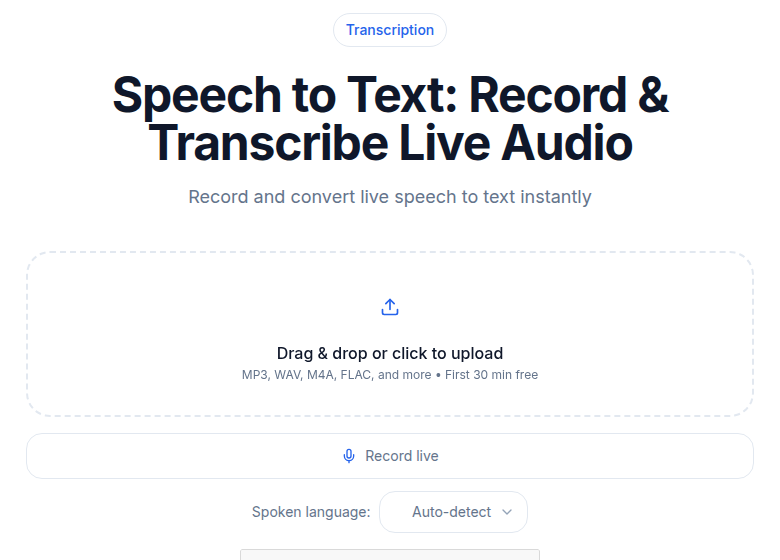
Setting the language explicitly rather than relying on auto-detection saves a processing round-trip and improves accuracy on accented dialects.
| Engine | Spain Spanish | Latin American Spanish |
|---|---|---|
| Whisper / OpenAI API | es | es (dialect handled internally) |
| Deepgram Nova-3 | es | es-419 (BCP 47 for Latin America) |
| AssemblyAI Universal-3 Pro | es | es (dialect handled internally) |
| Google Cloud STT | es-ES | es-MX, es-AR, es-CO, and 10+ locale codes |
| Rev.ai (Reverb) | es | es |
Google's per-locale codes give the most control when your audio is clearly from one country. Deepgram's es-419 (the ISO standard code for Latin American Spanish) is a useful middle ground when content mixes Latin American varieties. Whisper and AssemblyAI handle dialect variation internally without requiring a sub-code, which simplifies pipeline setup.
Which Engines Have the Deepest Spanish Support
Every major engine supports Spanish at tier-1 quality. The differences show in dialect-specific depth, code-switching support, and tooling for proper nouns.
| Engine | Spanish tier | Dialect codes | Code-switching | Proper noun support |
|---|---|---|---|---|
| Deepgram Nova-3 | Tier 1 (21% WER gain vs Nova-2) | es, es-419 | Real-time, 10-language mix | Keyterm prompting, up to 500 tokens |
| AssemblyAI Universal-3 Pro | Tier 1 | es (auto-dialect) | Spanglish listed explicitly | Custom vocabulary |
| Whisper Large-v3 | Tier 1 (~3-6% WER clean audio) | es | Sentence-boundary detection | Custom initial prompt |
| Google Cloud STT | Tier 1 | 10+ per-locale codes | Multilingual model | Phrase hints |
| Rev.ai (Reverb) | Tier 1 | es | Not natively documented | Vocabulary boosting |
For detailed transcription accuracy comparisons at the API level, all five engines are competitive on clean, single-speaker Spanish. The gaps show on noisy audio, overlapping speakers, and rapid Caribbean or Chilean delivery. For a deeper look at Deepgram's architecture and what the Nova-3 improvements mean in practice, see Deepgram Nova-3 explained.
Formality Registers and the Usted/Tú/Vos Question
Written and spoken Spanish maintains three active second-person singular pronouns across different communities: tú (informal, pan-Hispanic), usted (formal, pan-Hispanic), and vos (Rioplatense, Central American, parts of Colombia). Each takes different verb conjugations.
ASR engines transcribe what is spoken, so the register appears correctly in the output when the speaker uses it. The risk is downstream: if you feed transcripts into an LLM for summarization or a search index, the presence of voseo conjugations ("vos tenés," "vos fuiste") may produce inconsistent output if the downstream model is not trained on Rioplatense patterns.
For Colombian and Peruvian business audio, usted is used far more broadly than in Spain or Mexico, even in peer-to-peer conversations. This does not affect transcription quality, but it matters when analyzing formality or tone from the transcript.
Handling Spanglish and Code-Switching
Bilingual US Spanish speakers often shift between Spanish and English at the phrase or word level within a single sentence. Transcribing "Voy a la store después del meeting" accurately requires language detection below the sentence level.
Whisper handles code-switching at sentence boundaries by default. For aggressive in-sentence switching, setting the language to Spanish will produce a best-effort transcript, with English words sometimes rendered phonetically. AssemblyAI Universal-3 Pro explicitly supports Spanglish as a recognized dialect. Deepgram Nova-3 supports real-time code-switching between Spanish and English within its 10-language set.
A short post-processing review resolves most remaining issues. Fixing multilingual code-switching in transcription covers practical approaches to cleaning mixed-language output in more depth.
Speaker Labels in Spanish Conversations
Speaker diarization runs the same underlying model regardless of language, but speaking patterns affect results. Spanish speakers tend to overlap less in formal interviews, but Rioplatense and Caribbean casual conversations involve more interruptions and simultaneous speech.
For a two-speaker Spanish interview with minimal overlap, diarization accuracy is high. For a four-person roundtable where multiple Caribbean speakers are completing each other's sentences, plan a review pass on speaker attribution. The core mechanics of speaker diarization work identically across languages.
Common Spanish-Specific Accuracy Problems and Fixes
S-aspiration in Caribbean Spanish: "estos libros" might segment incorrectly if the model expects a word-initial /s/ but hears an aspirated [h]. Fix: test a model with explicit Caribbean dialect support (AssemblyAI Universal-3 Pro lists Caribbean Spanish) or run a post-processing normalization step.
Accents missing from output: The engine is either older-generation or audio quality is insufficient for confident diacritic placement. A noise reduction step before transcription helps on noisy source files.
Yeismo rehilado confusion in Rioplatense: The /sh/ sound for ll/y is underrepresented in most general Spanish training corpora. For high-volume Argentine content, the adriszmar/whisper-large-v3-turbo-es fine-tuned checkpoint shows measurable WER improvement on this variant.
Proper nouns and brand names: Spanish proper nouns (García Márquez, Iñárritu, Añejo) combine accent marks with uncommon letter sequences. Passing a custom vocabulary or keyterm list to your engine reduces misspellings significantly.
What Does Spanish Transcription Cost?
Spanish is not priced differently from English on any major API. You pay the same model rate regardless of language.
Otter.ai's Pro plan is $16.99/month (or $8.33/month on annual billing) and includes 1,200 minutes per month. Trint starts at a subscription tier for 7 files per month. Rev.ai's Reverb model is $0.20/hour for pre-recorded audio. For a full breakdown of how metered vs flat-rate pricing compares at different usage volumes, see transcription pricing comparison 2026.
If you just need a clean Spanish transcript without a meeting bot or a per-seat license, ConvertAudioToText handles every dialect with accented character output, plus speaker detection and all major export formats. TXT downloads are free on every account. The first 30 minutes of any file are free with no sign-in, a free account keeps transcribing up to 30 files a day, up to 30 minutes each, and full-length unlimited transcription starts at $14.99/month.
FAQ
Does AI transcription work well for Spanish?
Yes. Spanish is a tier-1 language for Whisper, Deepgram Nova-3, AssemblyAI, and Google Cloud Speech-to-Text. Whisper Large-v3 achieves roughly 3-6% word error rate on clean Spanish audio. The challenges are dialect-specific: Caribbean s-aspiration, Rioplatense yeismo rehilado, and Chilean slang cause more errors than standard Mexican or Castilian Spanish on general models.
What is the difference between seseo and distinción for transcription?
Seseo (all of Latin America, parts of southern Spain): /s/ is the only sibilant, so "caza" and "casa" sound identical. Distinción (central and northern Spain): /s/ and the /th/ sound are distinct phonemes. Engines trained mainly on Latin American corpora can misinterpret Castilian /th/ sounds, reducing confidence scores for Peninsular Spanish. Engines trained on broad Spanish corpora handle both.
Do I need to specify a dialect code for Spanish?
It depends on the engine. Whisper and AssemblyAI handle Spanish dialect variation internally with a single es code. Deepgram offers es for Spain and es-419 for Latin America, which can improve accuracy when your audio is clearly from one region. Google Cloud Speech-to-Text provides per-locale codes (es-ES, es-MX, es-AR, and others) for the most granular control.
How does AI handle Spanglish code-switching?
Modern engines have improved significantly. AssemblyAI Universal-3 Pro lists Spanglish as an explicitly supported dialect. Deepgram Nova-3 supports real-time code-switching between Spanish and English. Whisper handles sentence-boundary code-switching well; for in-sentence switches, setting language to Spanish and doing a brief review pass is the most reliable workflow.
What characters must a correct Spanish transcript include?
Accented vowels (á, é, í, ó, ú), ñ, ü (in words like pingüino), and inverted punctuation (¿ at the start of questions, ¡ at the start of exclamations). Missing accents can change meaning: "continúo," "continuo," and "continuó" are three grammatically distinct forms. A transcript that strips these characters is not a correct Spanish transcript.
Sources
- Deepgram: Nova-3 Spanish expansion
- Deepgram: Pricing
- AssemblyAI: Supported languages
- Otter.ai: Pricing
- Otter.ai: Spanish transcription help article
- Rev.ai: Pricing
- Trint: Plans
- HuggingFace: openai/whisper-large-v3 model card
- HuggingFace: adriszmar/whisper-large-v3-turbo-es fine-tune
Try transcription free
Convert any audio or video to clean, unwatermarked text — speaker labels, timestamps, and AI summaries included. First 30 minutes free, no account.
Related Articles

Arabic Transcription: MSA vs Dialects in ASR (2026 Guide)
How diglossia shapes Arabic speech-to-text accuracy. MSA vs Egyptian, Gulf, Levantine, and Maghrebi dialects: WER data, engine support, and script mechanics explained.

Mandarin Transcription: Simplified, Traditional, and Tones
Mandarin Chinese transcription: Simplified vs Traditional output, tone homophones, Cantonese honesty, and engine support in 2026.