
Voice to Todoist: Turn Any Transcript Into Tasks (2026)
Summarize this article with:
Action items from voice memos and meetings do not have to be manually copied into Todoist. With a transcription step plus a short automation, anything you say out loud lands in your task list with the right project, priority, and due date. Todoist offers three entry points for external data: a per-project email address, the Quick Add natural-language endpoint, and the full REST API. There is no native audio transcription integration, so you bridge the gap with Zapier, Make, n8n, or direct API calls. This post covers four concrete patterns and the prompts that make task extraction reliable.
The gap between captured ideas and your task list is a routing problem, not a memory problem. Voice memos pile up, meeting recordings sit unreviewed, and the tasks that did make it into Todoist are the ones you typed by hand. Audio-to-task automation closes that gap by connecting a transcription step to Todoist's three ingest paths: email-in, the Quick Add API endpoint, and the full REST API.
There is no native Todoist integration for external audio files. Todoist's own Ramble feature (launched January 2026) transcribes live speech you dictate directly in the app, but it does not accept uploaded recordings or meeting files. Everything in this post is a bridged workflow built on Zapier, Make, n8n, or direct API calls.
The Three Ways to Get Tasks Into Todoist From Outside
Before picking a pattern, know what Todoist exposes for external data:
| Method | Requires | Best for |
|---|---|---|
| Email-in (per-project address) | Any Todoist plan | Simple one-task-per-email flows |
Quick Add API (POST /api/v1/tasks/quick_add) | API token | Natural language input with date/priority parsing |
REST API (POST /api/v1/tasks) | API token | Structured JSON with full field control |
Email-in gives every project a unique forwarding address. Forward an email to it and the subject becomes the task name; the body becomes a comment attachment. On Pro and Business plans, Email Assist (Todoist's AI layer) rewrites the subject into a cleaner task name and extracts dates automatically. All plans can add dates, labels, and priorities inline using Todoist's syntax: <date tomorrow>, @label, p1.
Quick Add is the API equivalent of typing into Todoist's task box. Send natural language like Draft pricing proposal Wednesday p2 @meeting-action and Todoist parses it. Useful when your automation produces plain-text task lines rather than structured JSON.
REST API gives full control. Create tasks with explicit due_string, priority, project_id, labels, and description fields in one call. Attach a source link in the description and the task stays traceable to the meeting or recording it came from.
Pattern 1: Voice Memo to Personal Task
The simplest integration. Record a memo while walking. The memo transcribes, an LLM extracts action items, items land in Todoist.
- Record a voice memo on your phone (30 seconds to 5 minutes covers most personal capture).
- The memo syncs to iCloud Drive, Google Drive, or Dropbox automatically.
- Zapier or Make detects the new file and submits it to a transcription service. If you just need clean text without a meeting bot, ConvertAudioToText's audio-to-text tool handles this step without requiring an account for short files.
- The transcript runs through an LLM with the extraction prompt below.
- For each action item, the automation calls
POST /api/v1/tasksor the Quick Add endpoint.
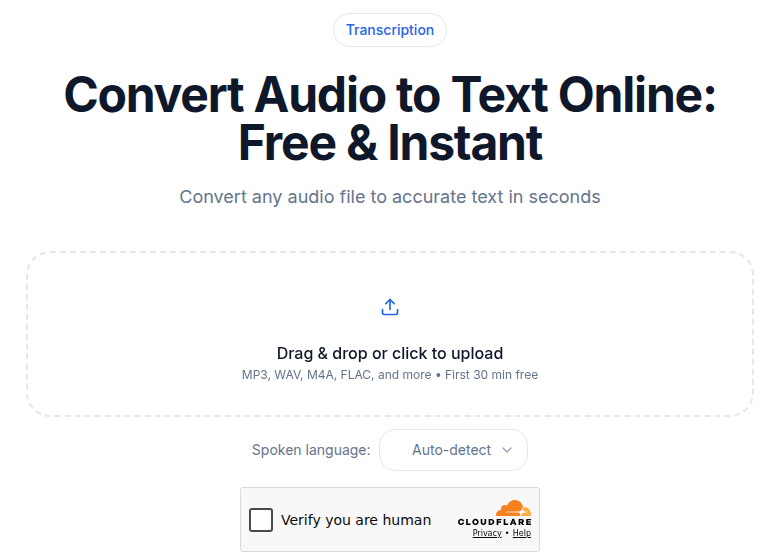 ConvertAudioToText audio upload interface for transcribing voice memos
The extraction prompt:
You are extracting action items from a voice memo where the speaker
was thinking out loud.

Action items are explicit commitments to do something. Require
commitment language: "I will", "I need to", "I should", "let's",
"I'm going to". Skip hypotheticals ("maybe I could"), ramblings,
and observations that did not produce a commitment.

For each action item, output JSON:
{
  "content": "<verb-first task, e.g. Email Sarah about the proposal>",
  "due_string": "<specific date if mentioned, 'this week' if approximate, null if none>",
  "priority": <4=normal, 3=medium, 2=high, 1=urgent based on language>,
  "notes": "<one sentence of context from the memo>"
}

Return an array. If no action items exist, return [].

Transcript:
[transcript]
The notes field becomes the Todoist task description and includes a link to the source transcript. Without that link, a task like "Draft pricing proposal" is untraceable three weeks later.
Pattern 2: Meeting Action Items With Speaker Attribution
Speaker diarization changes what you can automate at the team level. A transcription with labeled speakers lets you assign each action item to the person who said it.
- Record the meeting (Zoom, Meet, Teams).
- Transcribe with speaker diarization enabled. For meeting transcription the diarized output labels each utterance as Speaker 0, Speaker 1, etc.
- Map speaker labels to names (a lookup table in your automation covers this for recurring participants).
- Run the transcript through an extraction prompt that includes speaker information.
- Push each task to the appropriate section or project in a shared Todoist workspace.
The complication: not everyone uses Todoist. For mixed teams, the automation routes to different systems per person. For teams sharing a Todoist workspace, each member gets a dedicated section and tasks land there automatically.
The extraction prompt for meetings:
You are extracting action items from a meeting transcript with
labeled speakers.

For each action item, identify:
- Who committed (the speaker who said it, not who was asked)
- What exactly they committed to (verb-first, active voice)
- Any deadline mentioned
- The rough context (one sentence)

Only extract explicit commitments. "We should" without a named
owner is not an action item. "I'll send that by Friday" is.

Output JSON array with fields: owner, content, due_string, context.

Transcript:
[transcript]
For how to create meeting minutes from audio in a more structured format, the same transcript can power both the minutes document and the task export simultaneously.
Pattern 3: Daily Planning Voice Memo
A daily ritual. Each morning, record a 2-5 minute planning memo. Tasks land in today's Todoist view before you sit down at your desk.
The voice-first nature matters: planning while walking or before the screen turns on produces clearer thinking than planning inside the app. The transcription and task creation run in the background.
One refinement that compounds: schedule the recording at a fixed time. A phone alarm labeled "Morning plan" creates the cue. Consistency builds the habit faster than ad-hoc capture. The automation handles everything once you record.
For this pattern, route tasks directly into the Todoist Inbox, not a filtered project. The daily review of the Inbox takes under five minutes and lets you triage, defer, and delegate before the day starts.
Pattern 4: Project Planning From a Long Recording
For larger projects, a 20-30 minute solo walk talking through a project produces structured output when you prompt for it.
You are converting a voice memo about a project into structured
project notes.

Extract:
- Project name (infer from content)
- Goal (one sentence)
- Key milestones (with target dates if mentioned)
- Action items for the speaker (with deadlines)
- Action items for others (with names and deadlines if mentioned)
- Open questions
- Risks or concerns

Output as structured Markdown with a separate JSON array of
action items at the end, in the same format as the task extraction
prompt above.
The Markdown becomes a note in Notion or Obsidian. The action items push to Todoist with the project name as a label. Both link to the same source transcript. For transcription and note-taking workflows, this pattern extends into a full PKM integration.
The Todoist API: Direct Integration
For workflows that go beyond what Zapier and Make cover, the Todoist API is documented at developer.todoist.com. The current version is v1.
Create a task via REST:
curl -X POST https://api.todoist.com/api/v1/tasks \
  -H "Authorization: Bearer $TODOIST_API_TOKEN" \
  -H "Content-Type: application/json" \
  -d '{
    "content": "Draft pricing proposal",
    "due_string": "Wednesday",
    "priority": 3,
    "project_id": "2203306141",
    "labels": ["meeting-action"],
    "description": "From team sync 2026-07-01: Alice to draft and share before EOD Wednesday. Source: [transcript link]"
  }'
Use Quick Add for natural-language input when your automation produces unstructured text:
curl -X POST https://api.todoist.com/api/v1/tasks/quick_add \
  -H "Authorization: Bearer $TODOIST_API_TOKEN" \
  -H "Content-Type: application/json" \
  -d '{"text": "Draft pricing proposal Wednesday p2 @meeting-action"}'
Quick Add parses the due date, priority flag, and label from the string, the same way the Todoist app does when you type into the task box.
For automation platforms: Zapier's Todoist integration covers task creation, updates, and project queries. Make (formerly Integromat) covers the same and starts at $9/month (Core, billed annually). n8n has a native Todoist node and is self-hostable with no per-task fees if you run it on your own infrastructure.
Avoiding Task List Sprawl
A risk with audio-to-task automation: the task list balloons. A heavy capture week that produces 30-50 items makes the list harder to use than no automation at all.
Strict extraction prompts do most of the work. Requiring explicit commitment language before creating a task eliminates most false positives at the source. The prompt above that requires "I will / I need to / I should" language before extracting is stricter than most defaults.
The Inbox pattern handles the rest: route all voice-memo tasks to a "Voice Memo Inbox" project, not directly into your main lists. Process the inbox once daily, promote real items, delete the rest. Five minutes of triage beats a growing list you learn to ignore.
A third mitigation is source linking. Every task should include a link to the transcript it came from in the description field. Unlinkable tasks from automated capture are often the weakest ones. If the extraction cannot produce a clean source link, treat that as a signal the task may not be worth adding.
Tooling and Cost
A working stack for personal use:
- Phone recorder: Built-in Voice Memos (iOS) or Recorder (Android).
- Cloud sync: iCloud Drive, Google Drive, or Dropbox.
- Transcription: ConvertAudioToText at $14.99/month (unlimited minutes), or pay-per-minute via the speech-to-text API pricing breakdown if volume is low.
- Automation: Make.com Core at $9/month (annual) handles most personal workflows. Zapier starts at $26.69/month (Starter, annual) if you are already invested in that ecosystem.
- LLM API: GPT-4o at $2.50/M input tokens and $10/M output tokens (verified June 2026 via OpenAI pricing page). A week of personal extraction prompts costs well under $1 at typical volume.
- Todoist Pro: $5/month (annual billing). The free Beginner plan covers the email-in feature and API access; Pro unlocks reminders, up to 300 projects, and Email Assist.
My take: the Make Core tier at $9/month paired with the Todoist free plan is a reasonable starting point. Add Pro once reminders become useful or the project count grows.
Common Failure Modes
Weak extraction prompts produce weak tasks. The default LLM behavior treats "maybe we should" as an action item. Add explicit examples of what counts and what does not. One sentence of context on the failure mode saves hours of triage.
Missing due dates let tasks accumulate without pressure. If the voice memo does not mention a date, the automation should either infer a reasonable default (this week) or route the task to a "No date" filter for a weekly review pass. Tasks with no date in Todoist are easy to ignore indefinitely.
No source link makes tasks untrustworthy. "Confirm scope with client" with no reference to when or why it was created is nearly useless after two weeks. The description field in the Todoist API takes a link to the transcript. Always include it.
Todoist's "Inbox" concept and your Voice Memo Inbox are not the same. Keep them separate. The built-in Inbox is for tasks you add manually without a project. The Voice Memo Inbox is a named project you create. This prevents mixing automated and manual capture in one list.
FAQ
Does Todoist have a native audio transcription feature?
Not for external audio files. Todoist's own Ramble feature (launched January 2026) transcribes live speech you dictate directly in the app, but it does not accept uploaded recordings or meeting files. To route an existing audio file into tasks, you need a separate transcription step and an automation tool like Zapier, Make, or n8n to bridge the gap.
Which Todoist plan do I need for the email-in feature?
Email forwarding to a project is available on all Todoist plans, including the free Beginner plan. The AI-powered Email Assist upgrade, which rewrites the subject line into a cleaner task name and extracts dates automatically, requires Pro ($5/month billed annually) or Business ($8/user/month billed annually).
How do I keep the task list from bloating when every voice memo creates tasks?
Two approaches work well together. First, tighten the extraction prompt to require explicit commitment language ('I will', 'I need to', 'let's schedule') and discard hypotheticals. Second, route all voice-memo tasks to a dedicated Inbox project rather than your main lists. Process the inbox once daily, promote real tasks, delete false positives. Five minutes of daily triage prevents a list that grows faster than you can clear it.
Can the workflow handle multiple languages?
Yes, with two caveats. The transcription step must support the source language (ConvertAudioToText covers 99 languages). The LLM extraction step handles multilingual input well but works best when you tell it the source language explicitly in the system prompt. Todoist itself supports task content in any language.
Sources
- Todoist Pricing - verified July 2026
- Forward emails to Todoist - verified July 2026
- Todoist API v1 documentation - verified July 2026
- Dictate to add tasks with Ramble - verified July 2026
- Make.com Pricing - verified July 2026
- Zapier Pricing - verified July 2026
- OpenAI API Pricing - verified July 2026
Try transcription free
Convert any audio or video to clean, unwatermarked text — speaker labels, timestamps, and AI summaries included. First 30 minutes free, no account.
Related Articles

Spotify Transcript Extractor: How to Copy and Download Episode Text
Get a Spotify podcast transcript you can copy and download: paste a public episode link, 30 minutes free with no signup, TXT or SRT files on eligible plans.
Focus Group Transcription for UX Researchers: Turn Multi-Speaker Audio Into Usable Evidence
A practical guide to focus group transcription for UX and insights teams. See how CATT handles speaker labels, timestamps, AI summaries, and clean export.