Accented English Transcription: The Honest Picture
Summarize this article with:
The Honest Picture
AI transcription handles accented English far better in 2026 than it did five years ago. The gap that was once catastrophic is now modest for many accents. But "modest" does not mean "gone," and for some accent groups the disparity is still significant. This post documents where the gaps are, why they exist, and what you can actually do about them.
The Myth: Modern AI Handles All English Accents Well
The marketing version of this story goes: bigger models, more data, better accuracy for everyone. That is partly true. But peer-reviewed research and independent benchmarks tell a more specific story.
The most documented gap is between African American Vernacular English (AAVE) and white American English. A 2020 Stanford study published in PNAS (Koenecke et al.) tested five major commercial ASR systems and found an average word error rate of 0.35 for Black speakers versus 0.19 for white speakers. That is roughly double the error rate, on the same task. A 2024 study examining self-supervised models found that wav2vec 2.0, HuBERT, WavLM, and XLS-R all perpetuate this bias, with worse performance tied to the density of phonological and morphosyntactic AAVE features in the audio. These are modern, transformer-era models, not legacy systems.
The AAVE finding matters because it undercuts the narrative that the accent problem is simply about "non-native" speakers. Native American English speakers with a strong AAVE phonology face measurable bias in systems trained to optimize for mainstream American English.
The Reality: Accent Performance Varies Significantly by Group
Here is an honest partition of the global English accent space based on current evidence, not vendor marketing.
Closest to the training distribution (lowest WER):
- American English, general and regional Midwest and Pacific Northwest varieties
- Canadian English
- Standard Southern British (RP)
Meaningful but smaller gap:
- Australian and New Zealand English: A 2024 study (Graham and Roll) found British and Australian accents registered roughly 30 percent higher relative WER than American or Canadian English on Whisper. One benchmark found Whisper API produced 18.21% WER on Australian samples versus much lower rates on American audio.
- Scottish and Irish English in educated registers
- Filipino English
Variable accuracy, often tied to training data:
- Indian English: Highly variable. Urban professional speakers of acrolect Indian English now transcribe well. Regional varieties (Tamil-influenced, Bengali-influenced, rural dialects) still produce elevated WER. One fine-tuning study reduced Indian-accented English WER from 8.6% to 7.1% with accent-specific adaptation, suggesting that the gap is real but reducible.
- Nigerian and West African English broadly: Underrepresented in training corpora. Research labeling such speakers as generic "Non-Native" rather than as distinct phonological communities has compounded the problem by making it invisible to model developers.
- Singlish and Singapore colloquial English
- Strong L2 English with tonal L1 backgrounds (Vietnamese, Thai, Mandarin-influenced): Whisper studies found these groups experienced the most significant accuracy drop of any accent tested.
- Heavy regional American (deep Appalachian, rural Louisiana Creole-influenced)
My take: the consistent finding across multiple 2024-2025 studies is that American and Canadian English remain the reference distribution, and performance degrades as acoustic distance from that reference increases. A January 2025 benchmark found that Google Cloud STT struggled most with accented speech, while OpenAI's Whisper and AssemblyAI performed better, and Gemini's multimodal model performed best of any engine on heavily accented audio. That ordering is worth knowing when you pick a tool.
Why the Gap Has Not Closed Fully
Three mechanisms explain most of the remaining disparity.
Training data still skews toward mainstream American English. Whisper large-v3 was trained on approximately 5 million hours of audio (1 million weakly labeled and 4 million pseudo-labeled via the prior model), a massive expansion from the original Whisper's 680,000 hours. But web-scraped audio disproportionately reflects who produces and uploads content online. Communities that publish less audio to the public web are underrepresented in that data, regardless of total hours.
Phoneme inventory and prosodic differences. Indian English tends toward a syllable-timed rather than stress-timed rhythm, which shifts the temporal structure the model expects. Tonal L1 speakers transfer pitch patterns from their first language into English, creating acoustic signatures that differ from model expectations. An accent that merges vowel distinctions the model was trained to separate, such as "pen" and "pin" in some dialects, produces consistent and predictable errors. These are not random failures; they are structural mismatches between phonological systems.
The "non-native" labeling problem. Academic research has flagged that data curation often aggregates distinct accent communities under a single "Non-Native English" category. A model trained on this label cannot distinguish Nigerian English from Vietnamese-accented English from Hungarian-accented English. The acoustic reality of each is different. Treating them as one entity during training makes accurate modeling of any of them harder.
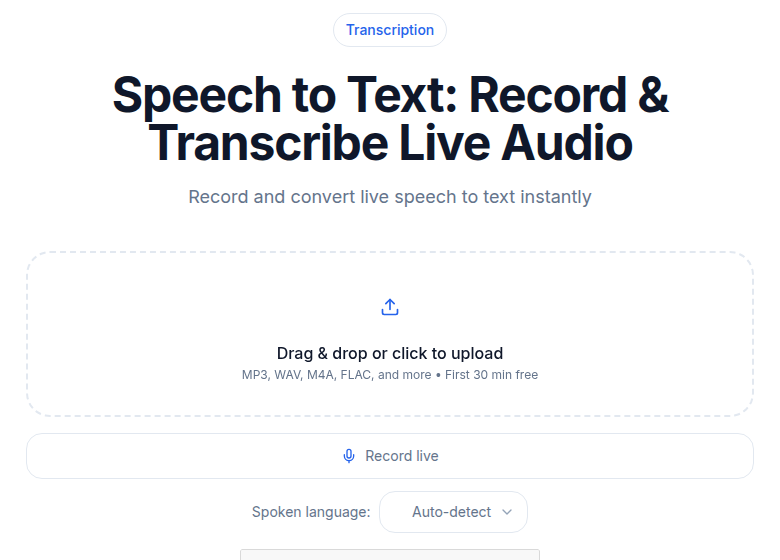 CATT speech-to-text tool interface
What Vendors Should Be Saying
The "98% accuracy" figure you see on landing pages is typically derived from benchmarks on clean American English. Most vendors do not publish accuracy breakdowns by accent, which means comparing tools on accented audio requires testing with your own samples.
The exception is Speechmatics, which publishes a "Global English" model explicitly designed to handle any English accent without user-side selection of an accent pack. Whether it outperforms engine-agnostic competitors on your specific accent is something you should verify with a 5-minute sample of your own audio, not their marketing page.
One sign of a vendor taking this seriously: they expose keyterm biasing and hint features rather than expecting the model to generalize from acoustic context alone.
What Actually Helps
Recording Quality Has More Leverage Than You Think
The single most reliable way to improve transcription accuracy on accented audio is better recording conditions. One benchmark summary noted that proximity to the microphone matters more than microphone price: a budget directional mic held 3-4 inches from the speaker's lips outperforms a premium conference mic placed on a desk across a room.
Clean audio gives the model more useful signal. When the model is already operating at the edge of its training distribution for a given accent, reducing noise gives it the best possible acoustic evidence to work from. This helps accented speakers disproportionately relative to speakers who are already close to the model's reference distribution.
See transcription accuracy explained for a full breakdown of how signal quality interacts with WER.
Keyterm and Vocabulary Biasing
Both Whisper and Deepgram Nova-3 support hints that bias the model toward expected vocabulary. Deepgram Nova-3 accepts up to 1,000 custom terms per request with configurable weights. AssemblyAI's Universal-3 Pro accepts natural-language keyterm prompting with up to 1,500 words. Whisper supports glossary prompting.
For accented speakers who use specific proper nouns, regional terms, or domain vocabulary, a hint list can recover accuracy on exactly the words that most matter to the transcript. If you are transcribing a Lagos fintech conference, providing terms like "Naira," "fintech," "NITDA," and relevant company names directly as hints steers the model toward the right vocabulary before it starts decoding.
Run Two Engines on High-Stakes Audio
For legal depositions, journalism interviews, or research recordings where every word matters, running the same audio through Whisper Large-v3 and Deepgram Nova-3 and comparing the outputs catches errors that one engine makes and the other gets right. The engines fail on different acoustic features, so errors rarely overlap exactly. Our post on Deepgram Nova-3 covers what Nova-3 does well.
This is more work, but for accented audio at the boundary of what AI reliably handles, it is often worth the compute cost.
Human Review for the Hardest Cases
For audio that sits at the edge of what AI can handle, human transcription remains the right answer. This is not a failure of AI; it is an accurate mapping of current capabilities to current use cases. See the honest comparison in AI vs human transcription.
The practical threshold: if AI transcription of your sample audio requires more than 10-15 minutes of editing per hour of audio, human-assisted transcription is likely faster overall.
Fine-Tuning for High-Volume Accent-Specific Work
For organizations transcribing a consistent accent at high volume, fine-tuning a Whisper base model on labeled audio from your speaker population can close part of the remaining gap. Research on Indian-accented English showed reduction from 8.6% to 7.1% WER with targeted adaptation. A UK government study on regional British dialects (Adapting Whisper for Regional Dialects, 2025) found similar gains for Glaswegian and Welsh English using even modest labeled datasets.
Fine-tuning is not a quick fix: you need a few hundred hours of labeled audio for meaningful gains, and the improvement is accent-specific rather than general. But for a call center or healthcare provider handling a single regional population, it is the right tool.
The Native-Language Route
Sometimes the best option is not to transcribe English at all. A speaker more comfortable in their first language often produces clearer audio in that language than in accented English, and the native-language transcription output may be more accurate than an English transcription would be.
Whisper Large-v3 supports 99 languages natively. For multilingual recordings where speakers alternate between English and another language, a common pattern in international business, modern engines handle code-switching but may produce confused output at language boundaries. Where the use case allows, single-language recording avoids that problem entirely. See guides for Hindi transcription and code-switching and Spanish transcription if your speakers are more comfortable in those languages.
The Broader Issue: Non-English Accents in an English-First AI World
Accent bias in ASR is one part of a broader problem covered in why AI struggles with low-resource languages: training data reflects who has historically had access to recording equipment, broadband, and platforms that index audio. The speakers who most need high-quality, affordable transcription are often the least represented in the data that produced the model.
That feedback loop is starting to break, slowly. African language speech datasets like AfriSpeech-200, community-contributed corpora, and enterprise fine-tuning on call center data are adding coverage. But for users in West Africa, South Asia, or Southeast Asia who need to transcribe English today, that progress is uneven and ongoing. Knowing the current state of accuracy for your specific accent is more useful than assuming the global benchmark applies to you.
Try Your Own Audio First
If you just need a clean transcript without a meeting bot or per-seat subscription, ConvertAudioToText's free tier transcribes the first 30 minutes of real audio with no account, and a free account keeps going with up to 30 files a day, up to 30 minutes each. Upload a sample from your actual speaker population and inspect the output. Your own audio is a better predictor of real-world accuracy than any benchmark number, because the benchmark reflects a distribution that may or may not include your accent.
Frequently Asked Questions
Does modern AI transcription handle all English accents equally well?
No. Multiple peer-reviewed studies confirm persistent gaps. American and Canadian English consistently produce the lowest WER on all major engines. AAVE speakers face roughly double the WER of white American English speakers on legacy commercial systems, and the bias persists in modern self-supervised models. Australian and British English register around 30 percent higher relative error rates than American English on Whisper in some benchmarks. Indian and West African English vary widely depending on regional variety and recording conditions.
Which transcription engine handles accented English best?
It depends on your specific accent and use case. A January 2025 benchmark found Gemini's multimodal model performed best on heavily accented audio overall, with AssemblyAI and Whisper ahead of Google Cloud STT and Azure on accent robustness. Speechmatics explicitly markets a Global English model for any accent. The most reliable answer is to test with 5 minutes of your own audio across two or three engines before committing.
Does recording quality matter more than the accent itself?
For most accents, yes. Better recording conditions (directional mic, quiet room, close proximity to the speaker's mouth) give the model more usable acoustic signal. When a model is already operating near the edge of its training distribution for a given accent, clean audio helps it recover from phonological uncertainty. The WER improvement from good recording often exceeds the WER gap from the accent itself, especially in the moderate-difficulty range.
Can I improve accuracy for my specific accent without building a custom model?
Yes, through two practical techniques. First, use keyterm biasing: both Deepgram Nova-3 and AssemblyAI's Universal-3 Pro accept custom vocabulary lists that steer the model toward expected terms. Second, provide a brief initial prompt in Whisper that contains representative vocabulary. These techniques require no training and can recover several percentage points of accuracy on domain-specific terminology. For high-volume production use, fine-tuning on a few hundred hours of labeled audio from your speaker population is a larger investment but produces more durable gains.
Is AAVE bias still a problem in newer AI models?
Yes. A 2024 study found that modern self-supervised learning models (wav2vec 2.0, HuBERT, WavLM, XLS-R) all produce higher WER on utterances with more AAVE phonological and morphosyntactic features. The disparity observed in the original 2020 Koenecke et al. PNAS study (0.35 WER for Black speakers vs. 0.19 for white speakers on five major commercial systems) has not fully closed in subsequent model generations. Research is ongoing, and several groups are working on dialect-specific datasets and annotation protocols to close this gap, but as of mid-2026 it remains real.
Sources
- Koenecke, A. et al. "Racial Disparities in Automated Speech Recognition." PNAS, 2020. https://github.com/stanford-policylab/asr-disparities
- Graham, C. and Roll, J. "Evaluating OpenAI's Whisper ASR: Performance analysis across diverse accents and speaker traits." JASA Express Letters, 2024. https://pubs.aip.org/asa/jel/article/4/2/025206/3267247/
- Kerson AI. "Accent Bias in Speech Recognition: Challenges, Impacts, and Solutions." https://kerson.ai/research/accent-bias-in-speech-recognition-challenges-impacts-and-solutions/
- AssemblyAI. "How accurate is speech-to-text in 2026?" https://www.assemblyai.com/blog/how-accurate-speech-to-text
- ISCA Archive. "Self-supervised Speech Representations Still Struggle with African American Vernacular English." Interspeech 2024. https://www.isca-archive.org/interspeech_2024/chang24d_interspeech.html
- Arxiv. "Adapting Whisper for Regional Dialects: Enhancing Public Services for Vulnerable Populations in the United Kingdom." 2025. https://arxiv.org/pdf/2501.08502
- Deepgram. "Speech Recognition Accuracy: Production Metrics." https://deepgram.com/learn/speech-recognition-accuracy-production-metrics
- OpenAI / Hugging Face. "whisper-large-v3 Model Card." https://huggingface.co/openai/whisper-large-v3
- Deepgram Nova-3 Review, Transcribe Blog. "Is It Still the Fastest STT API in 2026?" https://transcriber.talkflowai.com/blog/deepgram-nova-3-review-benchmarks-pricing
Try transcription free
Convert any audio or video to clean, unwatermarked text — speaker labels, timestamps, and AI summaries included. First 30 minutes free, no account.
Related Articles
Transcription for Non-Native English Speakers: The L2 Workflow
How non-native English speakers can use AI transcription as both a comprehension aid in meetings and a tool to capture their own spoken English accurately.

Handling Overlapping Speech: Prevention First, Tools Second
The best fix for overlapping speech in transcription is preventing it at recording time. Learn mic setups, moderation rules, and multitrack tools that actually work in 2026.