Transcription for Marketing Research: Verbatims That Hold
Summarize this article with:
Transcripts turn raw consumer sessions into quotable, codeable, and re-analyzable material that session notes can never replicate. For focus groups, the key challenges are speaker labeling and cross-talk; for IDIs, the value is in capturing off-script tangents and probe effectiveness; for concept tests, first-reaction language is the primary data. Tool choice depends on volume: per-minute services get expensive fast at research scale, while flat-rate unlimited plans work better for agencies running multiple projects per month. This post covers the full workflow, a tool comparison with verified 2026 pricing, and privacy handling for consumer PII.
The insight that changes a campaign positioning rarely survives intact from a focus group room to a strategy deck. It gets compressed, paraphrased, and softened until what lands in the report is a reasonable interpretation rather than what the consumer actually said. Verbatim transcripts fix this. They give you the raw material to code, count, and quote from, so findings are grounded in what participants said rather than what the moderator remembers.
This guide covers the full qualitative marketing research workflow: focus groups, in-depth interviews, ethnographic shop-alongs, and concept testing. It is written for in-house marketing researchers, brand strategists, and agency teams who need transcripts as a working analytical tool.
What Do Transcripts Actually Add to a Research Project?
The short answer: they turn sessions into data.
Session notes give you the moderator's interpretation. Transcripts give you the text. For most commercial marketing research, the gap matters in three concrete ways:
They make your findings countable. You can legitimately say "9 of 12 participants used safety as an unprompted category" because you have the transcript evidence. Without that evidence, the finding is an impression. With it, it is a claim you can defend to a skeptical client.
They give you real consumer language. Executives who would dismiss "consumers want simpler messaging" respond differently to a direct quote: "I just want them to tell me what it does in one sentence." The difference in persuasive weight is substantial, and it is only accessible through verbatim text.
They compound over time. A project transcript from a product launch can be re-read when the next campaign is being planned. The research investment earns returns beyond the original report.
Focus Groups: Where Transcription Is Most Demanding
Focus groups are the hardest format to transcribe well because the conversation is dynamic, overlapping, and multi-speaker.
Three things to plan for:
Speaker identification. AI tools tag speakers automatically, but in a group of six to ten participants, the labels are imperfect. Plan a review pass to validate speaker assignments before you start coding, particularly for sections with multiple voices. The more distinct the audio separation (individual lavaliers versus a single room mic), the better the initial tagging will be.
Cross-talk. Overlapping speech is a feature of a good focus group discussion and a problem for transcription accuracy. A multi-microphone setup dramatically improves output. With a single conference mic, expect garbled segments during high-energy exchanges and plan to review those sections manually.
Moderator versus participant speech. The moderator's questions and interventions should be clearly attributed in the transcript. When you code participant responses, you need to be able to filter out the moderator's framing without guessing who said what.
For more on how automatic speaker attribution works in practice, see speaker diarization explained.
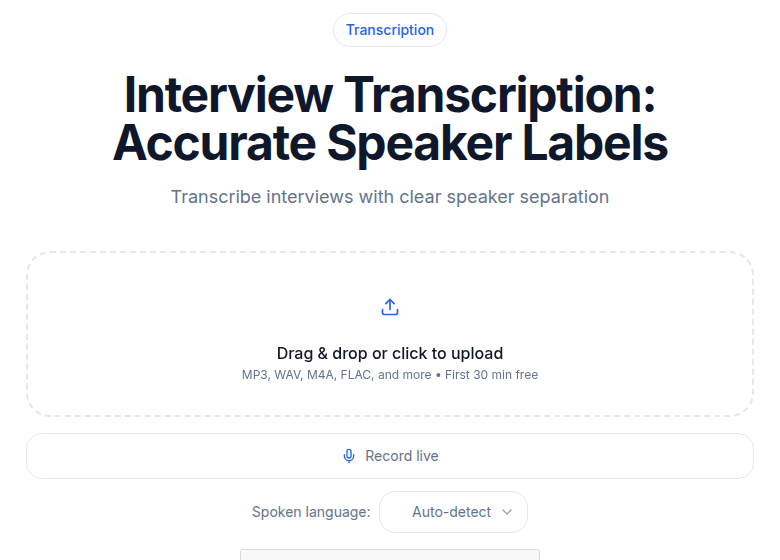 ConvertAudioToText interview transcription tool showing speaker labels and timestamps
In-Depth Interviews: High-Value, Easier to Transcribe
One-on-one IDIs run 45 to 90 minutes and go deep on a single consumer's perspective. The audio is cleaner (two speakers, controlled setting), which means AI transcription handles them with less manual cleanup.
The transcript value here is not just capturing the planned questions. It is capturing what happens off-script.
A few things the transcript enables that notes do not:
Probe effectiveness analysis. After ten IDIs, you can read across transcripts to see which moderator probes consistently generated rich material and which ones got flat, formulaic responses. That is a direct input to improving your discussion guide for the next wave of research.
Off-schedule moments. Consumers say their most useful things when they tangent. The transcript captures the tangent so the moderator does not have to choose between staying on time and capturing an unexpected finding.
Cross-participant comparison. With a standardized transcript structure, you can compare answers to the same question across all participants in a project, looking for patterns and outliers.
See also: how to transcribe an interview recording for setup and format guidance.
Ethnographic and Field Research
Ethnographic formats (shop-alongs, in-home visits, day-in-the-life observation) introduce audio challenges that studio-based formats do not have.
Background noise from real environments reduces AI transcription accuracy. A high-quality directional lavalier microphone on both the moderator and participant helps significantly more than upgrading the transcription tool.
Field sessions can run two to four hours. Plan transcript review time accordingly, and mark physical transitions in the recording so you can pair what was said with what was happening at that moment. The most actionable consumer language in field research often surfaces during activity ("I always have to do this extra step here, which is annoying"), not in the debrief.
Concept Testing: First-Reaction Language as Primary Data
In concept testing, the transcript is not a record of a conversation. It is the data itself.
Three things to extract systematically:
First-reaction language. The exact words consumers use in the first 30 to 60 seconds of seeing a stimulus reveal whether the concept is communicating what was intended. These words belong in the creative brief, not a paraphrase of them.
Confusion markers. Phrases like "I do not understand what this means" or "wait, is this for..." flag specific elements that are failing to communicate. Coding these by stimulus component gives you a prioritized list of what needs reworking.
Spontaneous competitive comparisons. When a consumer volunteers a comparison to a competitor or an existing product without being prompted, that comparison is real positioning data. The exact phrasing matters because it tells you which mental category the concept is landing in.
Coding Transcripts for Marketing Research Reports
The transcript is the input; the analysis is the work. For most qualitative marketing research projects, thematic coding is the right method:
- Read each transcript once end-to-end before coding
- Apply a predefined code frame to passages (major themes from your research questions)
- Add emergent codes for things that come up repeatedly that were not anticipated
- Pull the strongest verbatim quotes for each code
- Count mentions across participants and sessions to distinguish genuine patterns from individual observations
The count step is what makes findings defensible. A finding that was mentioned once by one participant and a finding that came up in eight of twelve sessions belong in different parts of the report and carry different strategic weight. The transcript is the only way to run that count reliably.
For a deeper look at the analysis layer, focus group transcription tips covers coding approaches specific to group dynamics.
Tool Comparison: Verified 2026 Pricing
The tool choice depends on your project volume and format.
| Tool | Pricing model | Estimated cost, 12h project | Best for |
|---|---|---|---|
| Rev (AI) | $0.25/min pay-as-you-go; subscriptions from $25.49/seat/mo (5,000 min) | ~$180 pay-as-you-go | One-off projects, English primary |
| Rev (human) | $1.99/min pay-as-you-go | ~$1,435 | High-stakes, sensitive content |
| Otter.ai Pro | $16.99/seat/mo (1,200 min/mo); Business $30/seat/mo (unlimited) | Likely needs Business tier for 12h | Meeting-heavy teams, Zoom/Teams integration |
| Happy Scribe | Subscription (120-6,000 min/mo); top-up credits at EUR 0.20/min | Depends on plan; top-up only: ~EUR 144 | European research, multilingual projects |
| Trint | ~$80/seat/mo (Starter, 7 files); ~$100/seat/mo (Advanced, unlimited) | Starter may not fit 8-session project | Editorial teams, built-in editor workflow |
| ConvertAudioToText | $14.99/mo month-to-month, unlimited (Pro); $99.99/yr billed annually | $14.99 flat (one month) | Agencies running multiple projects/month |
Prices verified against vendor pages July 2026. Rev human rate is $1.99/min pay-as-you-go per rev.com/pricing. Happy Scribe prices in EUR per happyscribe.com/pricing.
A note on the middle-tier tools: Otter's per-seat subscription is built around meeting recording and automatic join, not file import; the 1,200-minute Pro cap can be tight for a multi-session project heavy on file imports. Trint's Starter plan caps at 7 files per month, meaning an 8-session focus group project forces the Advanced tier. Both tools have strong editors designed for media workflows, which matters if your team codes inside the transcript interface rather than exporting first.
My take: for agencies running three or more qualitative projects per month, per-minute pricing is a line item that compounds. The math shifts toward flat-rate plans for anything beyond two or three hours of audio. For individual researchers doing occasional projects, Rev AI at $0.25/min or Happy Scribe's subscription model gives flexibility without a commitment.
If you want to start transcribing without setting up a platform first, ConvertAudioToText lets you drop in a file and get a transcript with speaker detection in minutes.
For a broader comparison of AI versus human transcription trade-offs, see AI vs human transcription.
Multi-Language Research
Qualitative research that spans markets requires transcription in the source language, not just a translated version.
Transcribing in the native language and translating separately preserves two things that matter: the verbatim quote in its original form, and an English version usable by a broader project team.
The workflow: transcribe in source language, machine-translate to English for the analysis team, and keep the original-language transcript as the authoritative record for quotes. For European markets, Happy Scribe has built-in multilingual support and operates under EU data handling, which can matter for client compliance requirements. Most AI transcription platforms now support 50 to 99 languages, but accuracy varies significantly by language and audio quality.
Privacy and Participant PII
Standard handling for consumer research:
- Use signed participant consent forms that cover recording, transcription, and storage explicitly
- Anonymize transcripts before sharing with clients: participant names become codes (P1, P2, etc.), and identifying details mentioned in conversation are stripped
- Keep the master participant mapping in a separate, access-controlled file, not inside the transcript
- For EU participants, processing must have a documented lawful basis under GDPR
- For research involving health, financial, or other regulated content, additional handling rules apply
- For agency work, confirm your data processing terms with clients before transcribing their participants' audio on third-party platforms
Common Questions
What transcription format works best for focus groups?
Intelligent verbatim is the standard choice: it removes filler words and false starts to produce readable text while keeping every substantive word the participant said. Full verbatim (including all "um," "uh," and repetitions) is rarely needed in commercial marketing research unless the analysis specifically concerns speech patterns or emotional indicators. Speaker labels and timestamps are non-negotiable for focus group work, because you need to trace who said what and when in a dynamic multi-person conversation.
How accurate is AI transcription for consumer research audio?
AI transcription handles clean, studio-quality audio from IDIs and concept tests at accuracy rates that are sufficient for coding and verbatim quoting. Focus groups are harder: overlapping speech, accents, and crosstalk over a single room microphone can introduce errors in 5-15% of words. The practical fix is a quick human review pass to catch misattributions and garbled overlaps before you start coding. For high-stakes or legally sensitive research, a human-reviewed transcript from a service like Rev is worth the cost premium.
Do I need speaker diarization for in-depth interviews?
For a true one-on-one IDI, automatic speaker labeling is straightforward because there are only two voices. Where it gets useful is in correctly separating the moderator's questions from the respondent's answers so you can filter them independently during coding. For focus groups with six or more participants, diarization is genuinely hard for AI tools, and you should plan a review pass to validate speaker assignments before sharing transcripts with clients.
How should I handle participant PII in research transcripts?
Standard practice is to anonymize transcripts before sharing with clients or storing beyond the project: replace participant names with codes (e.g., P1, P2), strip any identifying details that came up in conversation (employer, neighborhood, specific family details), and keep the master mapping in a separate access-controlled file. Use signed consent forms that explicitly cover recording, transcription, and storage. For EU participants, this processing must be covered under a lawful basis under GDPR, typically legitimate interest or explicit consent. For health, financial, or other regulated categories, additional restrictions apply.
Sources
- Rev pricing: rev.com/pricing (checked July 2, 2026)
- Otter.ai pricing: otter.ai/pricing (checked July 2, 2026)
- Happy Scribe pricing: happyscribe.com/pricing (checked July 2, 2026)
- Trint pricing: brasstranscripts.com/blog/trint-pricing via secondary source; direct pricing page unavailable (checked July 2, 2026)
- ConvertAudioToText pricing: convertaudiototext.com/pricing (checked July 2, 2026)
Try transcription free
Convert any audio or video to clean, unwatermarked text — speaker labels, timestamps, and AI summaries included. First 30 minutes free, no account.
Related Articles
Focus Group Transcription for UX Researchers: Turn Multi-Speaker Audio Into Usable Evidence
A practical guide to focus group transcription for UX and insights teams. See how CATT handles speaker labels, timestamps, AI summaries, and clean export.
Spotify Transcript Extractor: How to Copy and Download Episode Text
Get a Spotify podcast transcript you can copy and download: paste a public episode link, 30 minutes free with no signup, TXT or SRT files on eligible plans.