
Transcription ROI Calculator: The Real Math for 2026
Summarize this article with:
The Math in One Minute
AI transcription pays for itself in the first use. The reason is simple: manual transcription takes 4 to 6 hours for every hour of audio. AI transcription takes minutes per audio hour. If you earn more than $2 per hour, the time savings exceed the tool cost before you finish your first file.
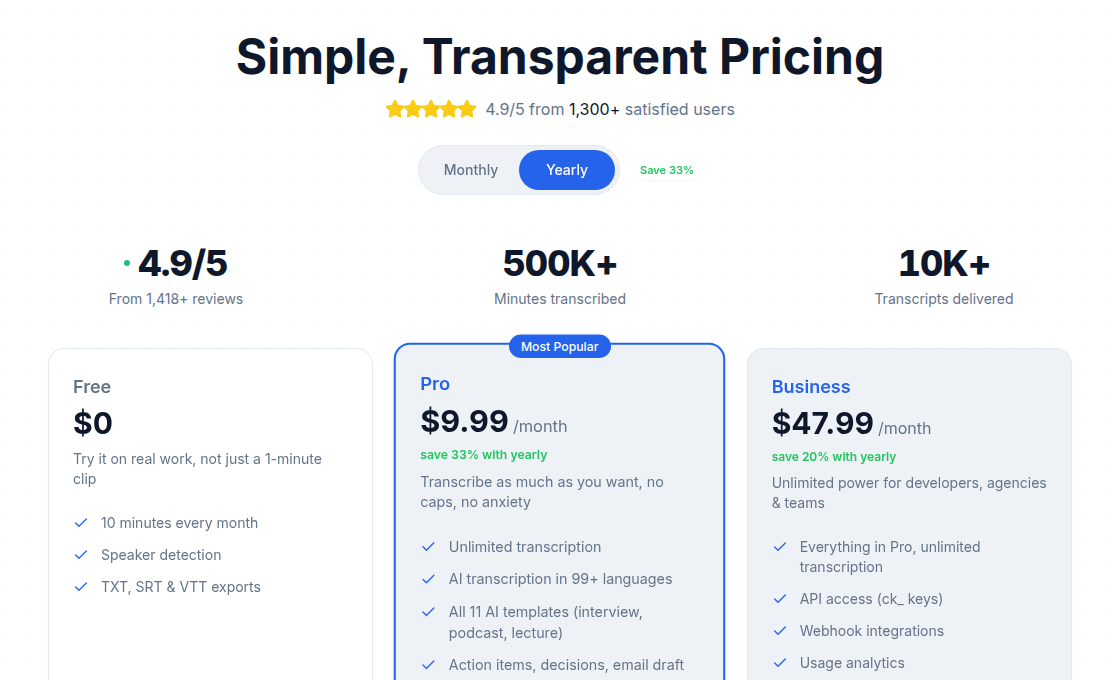 Fixed monthly cost makes the ROI arithmetic straightforward
The rest of this post walks through that math precisely, with three worked examples and a chart, so you can apply the numbers to your own situation.
How the Time Multiplier Works
The "4 to 6x" ratio is one of the most consistently cited figures in transcription guidance, and it's worth understanding what it actually means before building a calculator around it.
The 4x figure applies to an average person transcribing clear audio with no specialized shortcuts. Rev's guidance, GMR Transcription's research, and Notta's analysis all arrive at roughly 4 hours per audio hour for a competent adult with a good recording. Professional transcriptionists working specialized software (foot pedals, text expanders) can reach 2 to 3 hours per audio hour. Poor audio conditions (background noise, multiple overlapping speakers, heavy accents) stretch the ratio to 6 to 8 hours per audio hour.
For the worked examples below, the multiplier used is:
| Audio condition | Time multiplier |
|---|---|
| Clear, single speaker (lecture, solo podcast) | 4x |
| Multi-speaker, moderate background noise | 5x |
| Poor quality, heavy accents, crosstalk | 6x or more |
This matters because overestimating the ratio inflates your ROI number. If you pick 6x on clean audio to make the math look better, you're not doing honest analysis. Use 4x for clean recordings.
Three Worked Examples
Example 1: The Podcaster
A weekly podcast host records two 45-minute episodes per week. They do their own post-production and value their time at $40 per hour (a conservative freelance podcast editor rate).
Audio per month: 8 episodes x 45 minutes = 6 hours of audio.
Manual transcription time: 6 hours x 4 (clean audio) = 24 hours per month.
Labor value of that time: 24 hours x $40 = $960 per month avoided.
Tool cost: $14.99 per month ($179.88 per year, or $99.99 billed yearly).
Monthly ROI multiple: $960 / $14.99 = 64x.
Annual ROI: ($960 x 12) / $99.99 = 115x annualized.
The honest caveat: if you were not transcribing at all before adopting AI transcription, the saved hours are real only if you now do the transcription (for SEO, show notes, or content repurposing) whereas you previously skipped it. The time savings count only against work you actually do.
Example 2: The Qualitative Researcher
A UX researcher at a mid-size tech company runs 10 user interviews per month, each 50 minutes. Their loaded hourly cost is $75 (a conservative all-in figure for a mid-career UX researcher in the US, per ZipRecruiter and Salary.com data for 2026).
Audio per month: 10 interviews x 50 minutes = 8.3 hours of audio.
Manual transcription time: 8.3 hours x 5 (multi-speaker, some background noise) = 41.5 hours per month.
Labor value: 41.5 hours x $75 = $3,113 per month avoided.
Tool cost: $14.99 per month, or $99.99 billed yearly.
Monthly ROI multiple: $3,113 / $14.99 = 208x.
The secondary gain for researchers: transcripts become searchable. A researcher spending 30 minutes per week locating specific quotes in recordings (conservative estimate) saves 2 more hours per month. At $75, that adds $150 to the monthly return.
If you do user interviews, this is one of the clearest ROI cases for transcription. The speaker diarization feature in particular removes the otherwise-manual work of separating speakers in interview transcripts.
Example 3: The Agency
A content agency produces transcripts for 4 client podcasts per month, each delivering 4 hours of audio. They bill clients at $125 per hour for their time and need to staff for any manual work.
Audio per month: 4 shows x 4 hours = 16 hours of audio.
Manual transcription time at 4x: 64 hours per month.
Labor cost at $125/hour: 64 hours x $125 = $8,000 per month in staff time.
Tool cost: $59.99 per month (Business plan with API access for workflow integration).
Monthly ROI multiple: $8,000 / $59.99 = 133x.
The real gain here is capacity, not just cost. Those 64 hours freed up are billable hours the agency can redirect. At $125/hour, 64 hours is $8,000 in potential additional billings. The ROI case is not just cost savings; it is revenue that becomes accessible because the bottleneck is gone.
Hours Saved Per Month: The Chart
Calculated from verified 4-5x manual transcription ratio (Rev, GMR, Notta) and realistic monthly audio volumes per persona.
The Three Categories of Return
Time savings is the most defensible ROI category, but not the only one. Transcription delivers return in three ways, ranked by how easy they are to measure.
1. Time savings. Calculated above. Most reliable, most defensible in any business case.
2. Content reuse. When audio becomes a transcript, it also becomes raw material for blog posts, show notes, newsletters, and social clips. A 45-minute podcast episode that previously produced no written content can produce 1 show notes page, 5 pull-quote social posts, and a newsletter section once the transcript exists. The challenge is that this multiplier requires execution: the transcript is an input, not an output. Credit only the content that actually gets produced.
3. Knowledge capture. Searchable transcripts replace recordings that nobody re-listens to. For a team of 10, if each person saves 30 minutes per week on "find where we discussed X" searches, that is 20 person-hours per month. At $50 per hour, $1,000 per month. For a new hire, searchable transcripts of past meetings, customer calls, and training sessions can compress a 4-week ramp to 3 weeks. The numbers are real; the difficulty is measuring them with confidence.
The most defensible ROI case uses only category 1. Categories 2 and 3 are real but require honest assumptions about what changes in behavior when transcripts become available.
What the ROI Math Means for Choosing a Plan
The same calculation that shows a 64x to 208x ROI on a $14.99 plan also shows why obsessing over the price difference between plans is a distraction.
The gap between a $10/month and $60/month tool is $600 per year. The hours freed at any professional rate dwarf that number. If the more expensive plan unlocks API access for workflow automation or handles your volume without per-file friction, the upgrade pays for itself in minutes saved on tool management.
The only price decision worth careful analysis is the jump from a flat-rate AI tool to human transcription. Human transcription typically runs $1.99 to $2.00 per minute, which is $120 per audio hour. AI transcription at a flat-rate plan typically costs pennies per hour at volume. The accuracy difference (99%+ human vs 95-97% AI on clean audio) is real but often does not justify the cost gap for most use cases.
For a fuller look at what transcription actually costs across services, see the transcription pricing comparison and the breakdown of hidden costs that advertised prices leave out.
Common Mistakes in Transcription ROI Calculations
Three patterns that produce misleading numbers.
Counting time you would never have spent. If your pre-AI workflow was "don't transcribe this" rather than "transcribe this manually," the saved hours are hours of work you are now doing, not hours of work you replaced. The ROI is still real (new capability unlocked), but the framing should be "I can now do this" not "I saved 40 hours."
Crediting all content output to transcription. Some content would have been produced without a transcript. The honest credit is the marginal increase in content production that happens because the transcript removes friction. Crediting 100% of your content revenue to the transcription tool is almost never accurate.
Annualizing one-time savings. A research project where you transcribed 20 hours of interviews is a one-time event. Dividing by 12 and calling it a monthly recurring savings inflates the number. Separate project-based and recurring calculations.
The last thing worth keeping honest: the ROI math is so favorable that it almost does not matter. Even with conservative assumptions, transcription for any professional audio workflow pays back within the first session. The real question is usually not "is it worth it" but "what do you actually do with the transcripts once you have them."
Starting the Calculation for Your Situation
Run three numbers:
- Your monthly audio hours (from podcast episodes, interviews, meetings, lectures).
- Your time multiplier (4x for clean audio, 5x for multi-speaker, 6x for difficult conditions).
- Your hourly cost (loaded salary including benefits and overhead, or freelance rate).
Monthly labor saved = audio hours x multiplier x hourly rate.
Divide that by your tool cost. That is your monthly ROI multiple.
For most professional workflows, the number is above 50x. At that level, the specific tool matters far less than whether you actually use it consistently. If you just need clean transcripts without meeting bots or workspace integrations, ConvertAudioToText covers upload-and-go transcription for audio and video files, with a free tier to test on real content before committing to a plan. If you need a burst of minutes without a subscription, the $9.99 Weekly Pass gives 1,200 minutes (20 hours) for 7 days.
FAQ
How long does it actually take to manually transcribe one hour of audio?
The most commonly cited figure is 4 hours for a competent adult transcribing clear audio. Rev, GMR Transcription, and Notta all land near this number. Professional transcriptionists using specialized software (foot pedals, text expanders, playback control) can reach 2 to 3 hours per audio hour. Difficult audio (crosstalk, accents, background noise) pushes toward 6 to 8 hours per audio hour. For ROI calculations, use 4x for clean recordings and adjust up if your audio conditions are harder.
What is the ROI formula for transcription?
Monthly labor saved = (audio hours per month) x (time multiplier) x (hourly cost). ROI multiple = monthly labor saved / monthly tool cost. For a researcher with 8 hours of interviews per month at $75/hour using a 5x multiplier: 8 x 5 x $75 = $3,000 saved per month. At $14.99/month, that is a 200x monthly return. On the $99.99 yearly plan, it is about 360x a year.
Should I count content reuse value in my ROI calculation?
Count it only if you can link specific content output to the transcript. The safest method: track the content you produce in the 90 days after adopting transcription, compare to the 90 days before, and attribute the difference to the removal of the transcript-creation bottleneck. Do not pre-credit content you plan to create but have not yet.
Is AI transcription accurate enough for professional use?
For clean audio with a single speaker, AI transcription accuracy is typically in the 95 to 97 percent range for major services. For multi-speaker audio with speaker labels, errors cluster around speaker attribution at transitions rather than word errors throughout. Human transcription accuracy is typically cited at 99 percent or higher. Whether that gap matters depends on your use case: legal and medical work usually requires human review regardless; interview analysis, show notes, and meeting records usually do not.
Sources
- Rev: time-to-transcribe estimates: https://www.rev.com/resources/how-long-does-it-take-to-transcribe-audio-video
- GMR Transcription: transcription time per audio hour: https://www.gmrtranscription.com/blog/transcribing-an-hour-of-audio
- Notta: how long to transcribe 1 hour: https://www.notta.ai/en/blog/how-long-does-it-take-to-transcribe-1-hour-of-audio
- Otter.ai pricing (verified July 2026): https://otter.ai/pricing
- Descript pricing (verified July 2026): https://www.descript.com/pricing
- TurboScribe pricing (via opentools.ai, July 2026): https://opentools.ai/tools/turboscribe
- Happy Scribe pricing (verified July 2026): https://www.happyscribe.com/pricing
- Rev transcription pricing (verified July 2026): https://www.rev.com/services/transcription
- ConvertAudioToText pricing (verified July 2026): https://convertaudiototext.com/pricing
- ZipRecruiter UX Researcher salary data (June 2026): https://www.ziprecruiter.com/Salaries/Ux-Researcher-Salary
- ZipRecruiter Podcast Editor salary data (June 2026): https://www.ziprecruiter.com/Salaries/Podcast-Editor-Salary
Try transcription free
Convert any audio or video to clean, unwatermarked text — speaker labels, timestamps, and AI summaries included. First 30 minutes free, no account.
Related Articles

Spotify Transcript Extractor: How to Copy and Download Episode Text
Get a Spotify podcast transcript you can copy and download: paste a public episode link, 30 minutes free with no signup, TXT or SRT files on eligible plans.
Call Transcription for Customer Support QA: A Practical CATT Workflow
Use call transcription for customer support QA to review calls faster and coach agents. Upload audio or a meeting URL, get speaker labels and AI summaries.