Turn a Podcast Episode into a Blog Post That Reads Written
Summarize this article with:
A raw podcast transcript is source material, not a blog post. The five-step workflow: get the transcript, pick one topic from the episode, restructure it into scannable prose, add blog-specific elements like data and internal links, then do a fast SEO pass before publishing. One 60-minute episode can yield three to seven focused blog posts, each covering a different topic the episode touched on. The editing step is where quality comes from: AI can help draft but the heavy human rewrite is non-negotiable.
A raw podcast transcript is not a blog post. It is source material for one. The workflow that actually produces blog posts that rank starts at the transcript and ends somewhere around 1,500 words of restructured, de-verbalized, scannable prose that was clearly written, not dumped.
 Episode in, article draft out: the transcript is the bridge
This post walks the specific steps from audio file to published article.
Why Raw Transcripts Fail as Blog Posts
A transcript is faithful to the audio. That is the problem.
In audio form, conversational rambling, restarts, and filler words are invisible because the listener processes speech in real time. In text form, the same content is exhausting. Here is the difference in practice:
Raw transcript: "Yeah, so, I mean, the thing about content marketing, and I think most people miss this, is that, you know, it's not really about creating more content, it's about, um, like, creating content that actually, you know, serves a specific search intent. And, uh, I guess what I'm trying to say is..."
Restructured blog prose: "Most content marketing fails because it ignores search intent. Publishing more is not the answer. Publishing specifically is."
Same idea. Twenty-seven words versus sixty-two, no filler, one clear claim per sentence.
Beyond readability, raw transcripts fail because they:
- Lack structure (no headings, no scannable sections)
- Cover too many topics for one post
- Run 8,000-10,000 words for a 60-minute episode that should become 1,500 words
- Miss the visual elements (numbered lists, subheadings, block quotes) that readers scan for
The workflow below extracts the best material and rebuilds it for the medium.
Step 1: Get the Transcript Fast
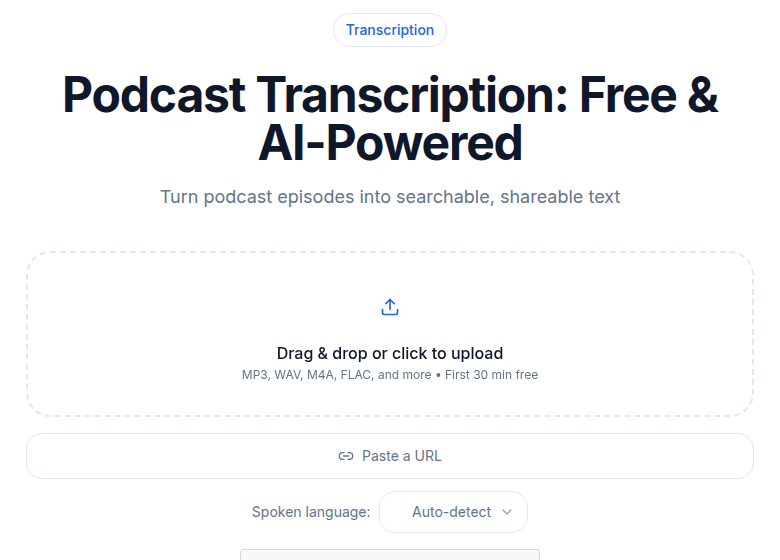
Upload the audio to Audio to Text. For a 60-minute episode, transcription takes 3-5 minutes. You get a word-for-word transcript with speaker labels and timestamps.
The timestamps matter. They let you skip to the strongest 10-15 minutes of one topic without rereading 9,000 words.
If you just need clean transcripts without a blogging workflow attached, ConvertAudioToText handles this for $14.99/month (unlimited), so per-minute costs do not factor into how many posts you try per episode.
Step 2: Pick One Topic and One Topic Only
This is where most podcasters go wrong. A 60-minute episode covers three to seven blog-worthy topics. Pick one per post. Save the rest for the following weeks.
Read through the transcript and mark the strongest 12-15 minutes of content on a single topic. That becomes your raw material. Everything else is future posts.
A post titled "The Three-Step Framework for Content That Ranks" will outrank a post titled "Everything We Discussed About Content Marketing" on every metric: focus, keyword targeting, and reader satisfaction.
Step 3: Restructure Into Blog Form
Take the 1,500-2,000 words of raw transcript you pulled in Step 2 and apply these structural moves:
Write a new opening (50-100 words). Podcasters often warm up for the first few minutes. Skip that. Start the blog post with the strongest claim from the topic section.
Break into H2 sections (three to seven headings). Each heading covers one discrete point. Headings should be specific: "Why Single-Topic Posts Rank Higher" beats "The Benefits."
Trim conversational filler. Remove "you know," "I mean," "kind of," "I guess," and false starts. Keep every substantive idea.
Convert dialogue into prose. Multi-speaker conversation reads awkwardly in blog form. For interview content, paraphrase to a single voice and save the two or three strongest quotes as block quotes.
Format lists as lists. If the speaker enumerated points in the audio, those become a numbered or bulleted list, not a paragraph.
Add direct quotes for color. Two to four pull quotes from the guest break up the text and signal the content is based on a real conversation, not generic writing.
Step 4: Add What Audio Cannot Have
A blog post needs things the audio does not.
Concrete examples. Audio is often vague: "several tools work well." Blog prose should name them. The transcript gives you direction; the blog post adds the specifics.
Numbers and data. The guest may have cited a stat verbally. A link to the original source in the blog post makes it checkable. Add data where it strengthens the point.
Internal links. This is the SEO move that compounds. Link to other posts on your site that expand on points touched in this one. See content repurposing from audio for the broader strategy across social, newsletters, and short clips.
A clear close. Podcast episodes end with sign-off chat. Blog posts need a specific action or next step for the reader. One sentence is enough: "Start with the transcript, restructure one topic, and publish. The second post is easier than the first."
Step 5: SEO Polish (30 Minutes)
Before publishing:
- Title: 50-70 characters with the primary keyword. "How to X" or "X: A Practical Guide" patterns convert well in search.
- Meta description: 150-160 characters with the keyword and the main benefit.
- URL slug: Short, keyword-relevant, no dates.
- Primary keyword: In the title, the first paragraph, at least one H2, and a handful of natural placements in the body.
- Internal links: Three to five links to other posts on your site.
- External links: One to three links to authoritative sources where you cite data.
The SEO pass is what separates a blog post that five people read from one that compounds over months.
Working With Multi-Speaker Audio
Interview podcasts require one extra decision: whose voice does the blog post use?
Host's voice is the most common pattern. The host summarizes what they learned, and two to three direct quotes from the guest carry the supporting content.
Guest's voice works when the guest is the expert and the host was facilitating. Write from the guest's perspective and credit them clearly.
Third-person editorial works for analysis or thought-leadership content where the podcast is the source, not the subject.
Pick one and stay consistent. Mixing all three in one post produces confusion about who is speaking.
A Note on AI-Assisted Drafting
Some podcasters use an AI tool to draft a section after they have identified the transcript excerpt. Tools like Castmagic (Hobby tier starts at $21/month billed annually) include one-click blog post generation from episode content. Descript covers the editing side.
My take: the one-shot "write me a blog post from this transcript" prompt produces generic output that needs almost as much editing as starting from scratch. The workflow that works is: identify the topic yourself, feed the transcript excerpt to AI for a rough draft of one section, then rewrite it heavily for your voice, specifics, and accuracy. The human editing step is where blog quality comes from.
The AI handles the first-pass scaffold. You make it sound written.
For a deeper look at the full repurposing stack (social clips, show notes, newsletters), see content repurposing from audio. For the show notes piece specifically, how to create podcast show notes automatically covers that lane.
The Multiplication Effect
One 60-minute episode becomes:
- Three to seven blog posts (one per topic)
- One newsletter highlight
- Five to fifteen social clips (see podcast clips for social media)
- One episode show notes page
The transcript is the source material for all of these. The recording investment is fixed. The output multiplies from there.
A podcaster publishing one blog post per episode, every week, for a year builds a library of 50-plus posts with strong topical coherence. That library drives search traffic back to the podcast, creates internal linking opportunities, and compounds in a way that social media does not.
A Real Example Timeline
For a 45-minute interview on content marketing:
- Transcribe: 3 minutes. 6,500-word raw transcript.
- Read and identify: 15 minutes. Three blog-worthy topics: why most content fails, a three-step framework, a tool stack.
- Pick topic one: "The Three-Step Framework for Content That Ranks."
- Pull the relevant excerpt: 10 minutes. About 1,800 words of raw transcript from the 12-minute section discussing the framework.
- Restructure: 60 minutes. Five H2 sections, three pull quotes, one numbered list, a clear close. About 1,400 words polished.
- SEO pass: 20 minutes. Title, meta description, slug, internal links, one image.
- Review and publish: 15 minutes.
Total: about two hours. From one 45-minute episode, you get three blog posts at this pace. The audio investment was identical whether you blogged from it or not.
Common Mistakes
Publishing the full transcript. Already covered. The transcript is raw material.
Writing too generic. The strength of podcast content is specificity. A guest describing their real experience produces detail that generic blog posts cannot match. Preserve those specifics when restructuring.
Removing all personality. Cleaning up filler is not the same as removing voice. The guest's phrasing, the host's perspective, the specific examples from the conversation: these are what make the content interesting. Keep them.
Skipping the SEO pass. A well-written blog post that does not rank is invisible. The 30-minute SEO layer at the end is what makes the post findable.
Blogging inconsistently. One blog post from one episode is not worth the effort. The system pays off at scale: one post per episode, every week, for six months.
For the transcription step, how to transcribe a podcast episode covers the mechanics if you are new to the process. For speed when you are on a deadline, transcribe a 30-minute podcast quickly has that specific workflow.
FAQ
Can I just publish my podcast transcript as a blog post?
You can, but you should expect poor results. A raw transcript is faithful to the audio, which means it includes filler words, restarts, and thousands of words of conversational rambling with no headings or scannable structure. Search engines can index it, but readers bounce fast. The better move is to use the transcript as source material and restructure it into a real blog post.
How long does a podcast-to-blog workflow actually take?
Expect about two hours per blog post once you have the transcript. Transcription is 3-5 minutes for a 60-minute episode. Reading through and identifying the best 10-15 minutes of material on one topic takes another 15-20 minutes. The structural rewrite and SEO polish is the remaining hour and a half. The pace improves quickly after a few episodes.
How many blog posts can one podcast episode generate?
A 60-minute episode typically covers three to seven blog-worthy topics. Each becomes its own post. Trying to cover all of them in one post produces unfocused content that ranks for nothing. Pick one topic per post and save the others for later weeks.
Do I need an AI writing tool beyond the transcription step?
No, but some podcasters use one for a first-pass draft of a section. The pattern that works is: transcribe, identify the topic, feed the relevant transcript excerpt to an AI for a rough draft, then heavily rewrite the draft for voice, specifics, and structure. The one-shot "write me a blog post from this transcript" prompt produces generic output that needs almost as much work as starting from scratch.
What is the single biggest mistake podcasters make when turning episodes into blog posts?
Picking too broad a scope. An hour-long episode covers multiple ideas. A blog post that tries to cover all of them ends up too long, unfocused, and unable to rank for any specific query. Picking one strong topic from the episode, writing 1,200 to 1,800 words on that topic alone, and linking to a second post for the next topic is the pattern that builds a real blog library.
Sources
- ConvertAudioToText pricing - verified Pro at $14.99/month or $99.99/year, Business at $59.99/month, Free with the first 30 minutes of any file with no account, plus free standard transcription of up to 30 files a day, up to 30 minutes each, on a free account
- Castmagic pricing - verified Hobby $21/month, Starter $79/month, Business $790/month (all annual billing)
- Content Allies: How to Repurpose Podcast Content (2026)
- Speechpad: Why AI Transcripts Hurt Your Podcast SEO
- Lower Street: Podcast SEO Best Practices 2026
Try transcription free
Convert any audio or video to clean, unwatermarked text — speaker labels, timestamps, and AI summaries included. First 30 minutes free, no account.
Related Articles

Spotify Transcript Extractor: How to Copy and Download Episode Text
Get a Spotify podcast transcript you can copy and download: paste a public episode link, 30 minutes free with no signup, TXT or SRT files on eligible plans.
How to Clean Up and Format a Messy Raw Transcript
Learn the exact steps to remove filler words, fix speaker labels, and format a raw transcript for professional use.