How to Convert WMA to Text: Rescuing Old Windows Audio Files
Summarize this article with:
WMA (Windows Media Audio) files from old Olympus recorders, Windows Sound Recorder, and archived interviews can be transcribed by any modern AI tool that accepts the format, or converted to MP3 first with a single ffmpeg command. The one hard blocker is DRM: WMA music files purchased from defunct Microsoft stores carry encryption that cannot be decrypted anymore since license servers shut down in 2017. Voice recorder and dictation WMA files are virtually never DRM-protected, so most rescue jobs go through cleanly.
Most WMA files from old recorders, Windows Sound Recorder, and archived interviews will transcribe fine today. Upload to a tool that accepts WMA, or convert to MP3 first with a single ffmpeg command. The one hard stop: DRM-protected WMA files from defunct music stores are permanently locked since Microsoft's license servers shut down in 2017.
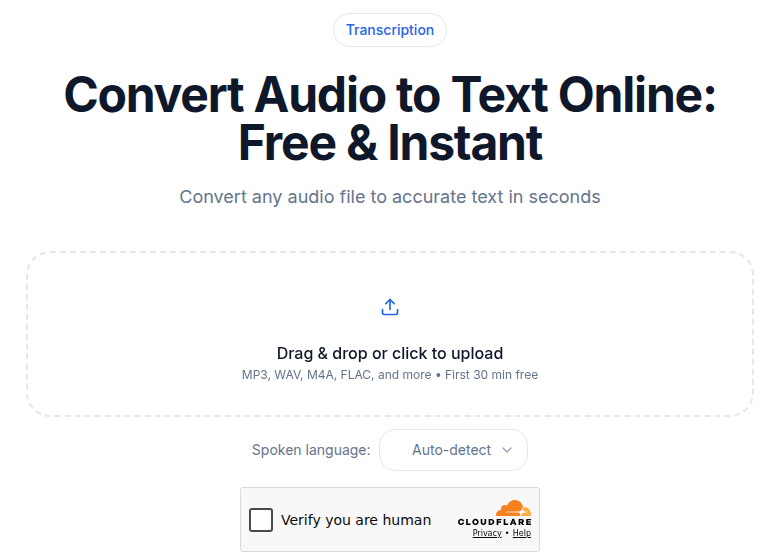 Unprotected WMA uploads transcribe like any audio file
Where WMA Files Actually Come From
WMA (Windows Media Audio) hit its peak between 2000 and 2012. If you have one in 2026, it almost certainly came from a narrow set of sources:
- A digital dictation recorder from Olympus, Sony, or Sanyo. Olympus shipped recorders that defaulted to WMA Standard well into the 2000s, producing files at 32-64 kbps mono.
- Windows Sound Recorder. Vista and Windows 7 saved recordings as WMA 9.2 at 96 kbps by default. There was no other option in the UI.
- Music ripped from CDs using Windows Media Player with default settings, which wrote WMA rather than MP3.
- Conference call or lecture recordings from Windows-based enterprise systems that used Windows Media Encoder.
The format has declined steeply since 2012. iOS and Android standardized on AAC/M4A, and no major recording app ships WMA today. What you have is legacy, and the question is always: can I get text out of it?
Four WMA Codecs, and Why It Matters for Transcription
The .wma extension covers four distinct codecs packaged inside Microsoft's ASF (Advanced Systems Format) container. They behave very differently.
WMA Standard is in 90% of WMA files. It competes directly with MP3, runs at 32-192 kbps, and uses psychoacoustic compression. Transcription tools handle it without issue. If your dictation recorder made WMA, this is what it made.
WMA Pro targets high-resolution multichannel audio: up to 8 channels, 24-bit depth, 96 kHz sampling. You will not encounter this in a voice recorder. It appeared mostly in commercial DVD releases. Transcription tools may or may not support it; if you hit a rejection, convert to MP3 first.
WMA Lossless is Microsoft's FLAC equivalent. Very rare in voice recordings, occasional in CD rips. It compresses without loss, so the audio content is perfect, but the file size is large (470-940 kbps equivalent). Any transcription tool that handles WMA Standard should handle Lossless.
WMA Voice is the odd one. It is a CELP-family speech codec, optimized for voice at bitrates up to 20 kbps and mono-only at up to 22.05 kHz. It is the codec that some older telephone dictation systems and very cheap recorders used. Modern transcription tools may reject it because it is technically distinct from the other three, even though the extension looks identical. If you see a WMA file that is suspiciously small (under 5 MB for an hour of audio), it is probably WMA Voice. Convert it to MP3 before uploading.
The DRM Gotcha (Read This Before You Start)
This is the one case where transcription is impossible without hardware intervention.
WMA files purchased from Microsoft's old music stores (MSN Music, Zune Marketplace, PlaysForSure retailers) were encrypted with Windows Media DRM. Microsoft shut down license acquisition servers definitively in March 2017 and removed WMDRM support from Windows 10 in the Anniversary Update. If you no longer have a machine with the original stored license, the file cannot be decrypted by any supported method. VLC throws "Could not demux ASF stream: DRM protected streams are not supported" when it hits one.
The good news for most people doing archive rescue: dictation recordings, interviews, and voice memos were never DRM-protected. DRM applied to commercial music purchases only. If your WMA came from a recorder or Sound Recorder, it is almost certainly clean.
To confirm: try playing the file in VLC. If it plays, you have no DRM problem. If VLC shows the demux error but Windows Media Player also cannot play it without prompting for a license, you are looking at a DRM-locked file that needs a machine with a surviving stored license to do a real-time audio capture.
How to Get a Transcript From a WMA File
This is one short section because the process is straightforward once you know the codec and DRM status.
Step 1: Confirm the file plays in VLC. VLC handles WMA Standard and Lossless natively on Windows, macOS, and Linux. If it plays cleanly, the file is healthy and unprotected.
Step 2: Identify WMA Voice files. File under 5 MB per hour of audio, or VLC shows the codec as "WMAv1/WMAv2 speech"? Convert to MP3 before uploading to any transcription service.
Step 3: Upload directly or convert first. If your transcription tool accepts WMA, upload it. If it rejects, convert with ffmpeg:
ffmpeg -i interview.wma -c:a libmp3lame -b:a 192k interview.mp3
192 kbps preserves all the fidelity that was in the original WMA Standard recording. There is no benefit to going higher for speech.
Step 4: Select the language manually. Auto-detect performs worse on older recordings with degraded audio. If your archive includes non-English interviews, pick the language explicitly. See the guide on supported audio formats for transcription for language coverage notes across tools.
Step 5: Review with format-specific caution. Old voice recorders had noisy mic preamps and low gain settings. Expect 90-95% accuracy rather than the 96-98% you get from a modern smartphone. Pay close attention to proper nouns, numbers, and any section where the recorder was more than 30 cm from the speaker.
The Real Problem With Old Dictation Recordings
The codec itself rarely causes transcription failures. The actual problems are analog, not digital.
Low recording levels. Recorders from the 2000s often captured at low gain to extend battery life. If the transcript comes back mostly blank, the audio peak is too low for the speech detection threshold. Open in Audacity, run Effect > Normalize targeting -1 dBFS, and re-export. Do not apply heavy noise reduction afterward: modern AI speech engines handle moderate background noise better than over-processed audio that has had speech harmonics stripped out.
Single-channel mono. Nearly all dictation WMA files are mono. Speaker diarization on mono works by analyzing voice characteristics rather than channel separation, which means accuracy suffers on two-speaker interviews. If speaker labels are critical, see the speaker diarization explained guide for what to expect and how to clean up the output manually.
Fragmented headers. Some very old WMA files have malformed ASF headers that confuse transcription tools even though the audio plays fine. If a file triggers a mysterious "format error" on upload but plays in VLC, re-wrap it first:
ffmpeg -i broken.wma -c:a copy fixed.wma
If re-wrapping fails, force a full re-encode to MP3:
ffmpeg -i broken.wma -c:a libmp3lame -b:a 192k fixed.mp3
Common WMA Archive Scenarios
Journalism interview archives
Newsrooms that converted cassette archives to digital in the late 2000s often landed on WMA because the Windows platform was standard. These files are now inaccessible to most modern tools. For a bulk job, convert the entire archive to MP3 in one batch command and then upload. The interview transcription guide covers structuring the output once you have the text.
Legal dictation and medical records
Lawyers and doctors who used Olympus or Sony recorders pre-2012 have stacks of WMA from the WMA Standard era at 32-64 kbps mono. Accuracy on clean dictation is typically 92-95% with modern AI, acceptable for a first draft that a human then reviews. The transcription accuracy explained piece breaks down what error rates mean in practice for different use cases.
Family history recordings
Genealogists sometimes inherit WMA files from relatives who recorded oral histories on a Windows XP laptop with a built-in microphone. These are the most challenging: low gain, mic rumble, reverb from recording in a kitchen or living room. A high-pass filter at 100 Hz in Audacity removes low-frequency rumble without affecting speech before you run transcription.
WMA vs. Formats You Should Use Today
| Format | Bitrate (voice) | Transcription accuracy | Tool support |
|---|---|---|---|
| WMA Standard | 32-128 kbps | 90-95% | Limited, declining |
| WMA Voice | 6-20 kbps | 80-88% | Poor, often rejected |
| MP3 | 64-192 kbps | 95-97% | Universal |
| AAC / M4A | 32-128 kbps | 95-97% | Universal |
| FLAC | Lossless | 96-98% | Wide |
| WAV (PCM) | Uncompressed | 96-98% | Universal |
If you are choosing a format for new recordings, use AAC, MP3, or WAV. For existing WMA, the codec itself is not a blocking problem for any of the Standard/Lossless variants; the issues are always the source audio quality and whether the tool accepts the container. If your tool does not, a single ffmpeg command converts the whole directory.
For a deeper look at how format choice interacts with accuracy, see transcription accuracy explained and how to convert MP3 to text for the format that most converted WMA files become.
My take: the WMA rescue cases I see are almost always solvable. The DRM dead-end catches people by surprise, but it only hits music purchases, not recordings. Everything else is a level problem or a wrong-codec problem, both fixable in Audacity or ffmpeg in under five minutes.
If you need a clean transcript from old recordings without friction, audio to text at ConvertAudioToText accepts WMA Standard and Lossless uploads directly.
FAQ
Can I transcribe WMA without converting it first?
Sometimes. A handful of modern transcription tools accept WMA directly, including the audio-to-text tool at ConvertAudioToText. Most generic upload tools reject the format and will ask you to convert to MP3 first, which takes one ffmpeg command.
My WMA file plays in Windows Media Player but not in VLC. Is it DRM?
Almost certainly yes. VLC throws the error "Could not demux ASF stream: DRM protected streams are not supported" on protected files. Microsoft's WMDRM license servers shut down in 2017, so if you no longer have a machine with a valid stored license, the file is effectively unrecoverable by any supported method.
How do I boost quiet audio from an old dictation recorder before transcribing?
Open the WMA in Audacity and run Effect > Normalize (target around -1 dBFS). This raises the speech above the noise floor without introducing clipping. Avoid heavy noise reduction afterward; modern AI speech engines handle moderate background noise better than they handle over-processed audio.
Is the WMA audio quality good enough for AI transcription, or should I just summarize manually?
Almost always good enough. WMA Standard at 32-128 kbps, which covers the entire dictation recorder era, carries enough fidelity for modern AI transcription. Expect 90-95% accuracy rather than the 96-98% you would get from a fresh smartphone recording, mainly because of old microphone preamps, not the codec.
Sources
Try transcription free
Convert any audio or video to clean, unwatermarked text — speaker labels, timestamps, and AI summaries included. First 30 minutes free, no account.
Related Articles
How to Convert AAC to Text: Streams vs M4A Explained
AAC to text: the raw-stream vs M4A container distinction that trips tools, broadcast origins, and the reliable workflow.
How to Convert FLAC to Text: Lossless Audio Guide 2026
FLAC to text for field recordings and archival interviews: why lossless helps, half-of-WAV file sizes, and the upload workflow.