Italian Transcription Guide: Dialects and Real Accuracy
Summarize this article with:
Quick Answer
Standard Italian transcribes reliably with any major AI engine in 2026. Whisper (all sizes), Deepgram Nova-3, and AssemblyAI Universal-2 all list Italian as a supported language with strong accuracy on clean audio. The challenges are specific: regional languages like Sicilian and Neapolitan (linguistically not Italian dialects), accent-direction rules that most exporters get wrong, and overlapping speech in Italian conversations that punishes diarization more than most European languages do.
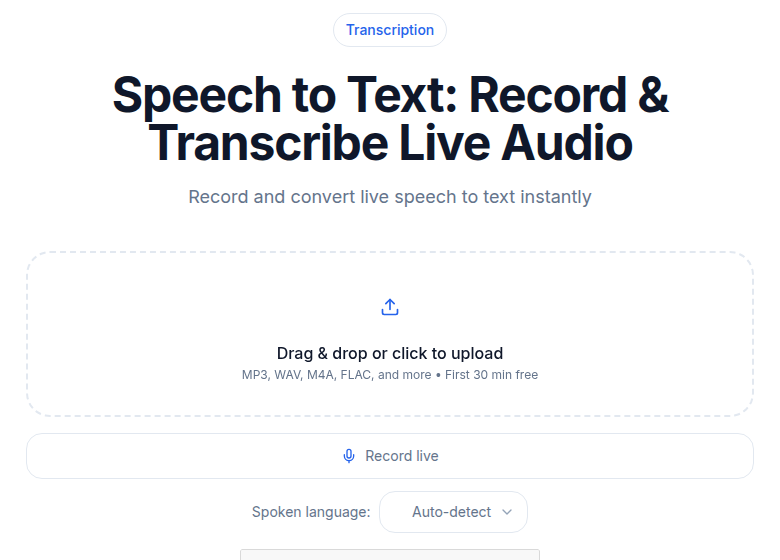 Italian transcription starts with an explicit language selection
The Three-Tier Reality for Italian Audio
Before picking a tool, you need to know which tier of Italian you are actually dealing with:
Tier 1: Standard Italian (Italiano Standard). The official language of Italy, San Marino, Vatican City, and the Italian-speaking cantons of Switzerland. Around 65 million native speakers. Used in news broadcasts (RAI, La7), academic lectures, formal business calls, and most Italian YouTube content. This is what AI models train heaviest on, and it is where accuracy is highest.
Tier 2: Italian with a regional accent. Standard Italian vocabulary and grammar, but the speaker's phonology is shaped by their region. A Milanese executive speaking Italian on a video call, a Roman journalist, a Sicilian academic presenting at a conference. They are speaking Italian. The regional phonetic overlay is real but the lexicon stays standard, and AI handles this well.
Tier 3: Actual regional languages. Sicilian, Neapolitan, Venetian, Sardinian, Lombard. These are not Italian accents or dialects in the technical linguistic sense. They are separate Romance languages with their own ISO 639-3 codes (Neapolitan: nap, Sicilian: scn), their own syntax, phonology, and centuries of literary tradition predating modern Italian. Sicilian is recognized by UNESCO as a minority language. Neapolitan has limited mutual intelligibility with Standard Italian. If your audio is in one of these, AI transcription in Italian will struggle badly.
Knowing your tier before you upload saves a lot of frustration.
Standard Italian: Orthography and Why Accent Direction Matters
Italian uses the Latin alphabet plus two accent types: grave (à, è, ì, ò, ù) and acute (é). The rules are specific:
- Grave is the default for most final-syllable stressed vowels: caffè, città, però, papà.
- Acute applies to the closed-e in the -ché family (perché, finché, benché, poiché) and in né and sé.
- No written accents appear on stressed non-final syllables; stress is implied.
The single most common error in Italian text is writing perchè (grave) instead of perché (acute). This is wrong even among native speakers in informal writing, but a professional transcript should get it right. Engines trained on properly accented Italian corpora, including OpenAI Whisper, generally reproduce this distinction because the training data is correctly accented. Engines trained on scraped web text (which skips accent marks frequently) will sometimes return perchè or even percheì, which requires a post-edit pass.
For transcripts destined for subtitles or published show notes, a quick find-and-replace on the -ché family catches the most common errors.
Regional Italian (Tier 2): What to Expect by Accent
Italian with a regional accent is something AI handles reasonably well, because the vocabulary is still Standard Italian. The phonetic variations create occasional mishearings, but they do not derail the transcript.
Some patterns worth knowing:
- Milanese Italian: the speaker's phonology is clean and close to broadcast standard. Fewest edge cases.
- Roman Italian (Romanesco-influenced): "r" sounds and some vowel shifts. The AI handles this reliably; the occasional "er" vowel shift does not confuse word boundaries.
- Neapolitan-influenced Italian: open vowels, some softening of double consonants. Occasional syllable-boundary confusion on words like "fatto" vs "fato." Still in a manageable range.
- Sicilian-influenced Italian: vowel reductions (Sicilian has no open /e/ or /o/ phonemes, only /i/ /u/ for those positions), which can affect word-boundary detection on function words.
None of these require a different model or language code. Setting the language to Italian and letting the model run is the right move.
Tier 3: What Happens When the Audio Is Actually Neapolitan or Sicilian
This is where you need to be honest with yourself about what you have. Neapolitan (ISO 639-3: nap) and Sicilian (ISO 639-3: scn) are not in the training data for any major commercial ASR model as of mid-2026. When you submit audio in actual Sicilian to an Italian-language model, the engine hears sounds that do not map cleanly to Standard Italian phonemes, and the output will be a partially recognizable Italian-adjacent text with frequent substitutions and insertions.
No current commercial API, including Whisper, Deepgram Nova-3, or AssemblyAI Universal-2, lists Sicilian or Neapolitan as a supported target language. The research community has begun building corpora (the MIT TACL work on Italian language varieties is a notable example), but these have not translated into shipping products yet.
Practical guidance for Tier 3 audio:
If you need a Standard Italian transcript of a speaker who normally uses Neapolitan or Sicilian, ask them to switch to Italian during recording. This is common practice in broadcast journalism. If you need to preserve the regional language itself, plan a manual editing pass with a fluent speaker, because no AI tool reliably produces it today.
Formality Registers and Transcription
Italian has a structural formal/informal distinction that English lacks: the formal second-person pronoun Lei (with a capital L in writing) vs. the informal tu. In a transcript, this distinction matters.
In business audio, a recorded call between a sales rep and a new client will often open in Lei and may shift to tu partway through (the phrase "diamoci del tu" signals this transition explicitly). A correct transcript should reflect whichever form the speakers use, including the capital L when Lei is used as a formal address, because it distinguishes it from the common noun "lei" (her).
AI engines that reproduce Lei correctly are doing so because their Italian training data included formal-register text. Whisper generally handles this; engines trained primarily on informal social-media Italian sometimes lowercase it indiscriminately. Worth checking if your content is formal.
Overlapping Speech: Italian Conversations and Diarization
Overlapping speech is where Italian audio diverges most sharply from, say, Finnish or Japanese. Italian conversational norms include frequent turn-taking overlap, enthusiastic interruptions in casual discussion, and what linguists describe as collaborative completion (where one speaker finishes another speaker's sentence). Italian podcast roundtables and panel discussions routinely have two people speaking simultaneously for half-second to two-second stretches.
This is not a flaw in how Italians speak; it is a feature of the conversational style. But it directly impacts diarization. Speaker diarization systems assign voice segments to speakers; when two voices overlap, the system has to choose or flag the segment as ambiguous. The published research on overlap-aware diarization shows diarization error rates on spontaneous conversational speech in the 10-20% range even for leading commercial systems, with overlapping segments being the primary driver.
Concretely, this means:
- A 2-speaker formal Italian interview (clean turns, minimal overlap) gives you reliable speaker labels.
- A 4-person Italian podcast with frequent cross-talk will have speaker-assignment errors at a notable rate.
- A recorded Italian business meeting with multiple participants calling in from different locations is the hardest case: compressed audio plus overlap plus variable acoustics.
The highest-impact fix is per-microphone recording. When each speaker is on their own mic track, the diarization engine has a channel-separation advantage that dramatically reduces overlap confusion. For remote calls (Zoom, Google Meet), the per-participant audio recording option, where available, produces meaningfully better speaker labels than a single mixed output.
For Italian speaker diarization in general, setting realistic expectations is part of the workflow.
Which Engines Support Italian
All three major AI transcription engines in production support Standard Italian as of mid-2026:
OpenAI Whisper. Italian is explicitly listed as an officially supported language (part of the 57-language list where word error rate is below 50%). Whisper Large-v3, used by most transcription services, is the version with the strongest non-English accuracy.
Deepgram Nova-3. Nova-3's multilingual model explicitly lists Italian as a supported language alongside English, Spanish, French, German, Hindi, Russian, Portuguese, Japanese, and Dutch. Nova-2 also includes Italian.
AssemblyAI Universal-2. Italian is supported and classified as "High accuracy" in their language documentation. The $0.15/hr rate applies to Italian as it does to other supported languages.
None of these engines support Neapolitan or Sicilian as separate target languages.
Code-Switching: Italian and English in Tech and Business
Italian professional audio increasingly contains English terms embedded in Italian sentences: "ho un meeting alle 14" (I have a meeting at 2pm), "dobbiamo fare un quick check" (we need to do a quick check), "lanciamo la feature entro venerdì" (let's ship the feature by Friday). This is common in Italian tech companies, startups, and media.
Whisper handles code-switching at clause boundaries reasonably well when the language is set to Italian. Problems arise inside words: the English word "meeting" sometimes comes back as "miting," "feautre" is phonetically italianized as "ficeacer." These are not engine failures in the strict sense; they are the expected behavior of a model that sees Italian phonemes and maps them to Italian-vocabulary probability distributions.
A quick review pass on any Italian tech audio catches most of these. Setting the language to Italian (not auto-detect) is important: auto-detect on fast Italian with scattered English can occasionally misclassify short segments.
If your content mixes Italian with English heavily, see the broader guide on fixing multilingual code-switching for workflow strategies.
Italian Podcast Workflow
Italian is one of the stronger languages for AI transcription in a podcast workflow, largely because most Italian podcasts are produced in Standard Italian with clean microphone setups.
A practical sequence:
- Record with per-microphone tracks wherever possible (even a basic USB mic per host gives the diarization engine something to work with).
- Export the mix or individual tracks as MP3 or WAV.
- Set the language to Italian explicitly. Do not rely on auto-detect if you have control over the setting.
- Use the transcript output as the base for Italian show notes. AI summaries in Italian are available on tools like ConvertAudioToText, which outputs summaries and chapter markers in the source language without a separate translation step.
- Export SRT for YouTube captions.
For a broader look at what makes transcription workflows cost-effective, the transcription pricing models explained guide covers the per-minute vs. unlimited tradeoff in detail.
Comparing Italian Transcription Tools
| Tool | Italian support | Free tier | Paid starting price | AI summary in Italian | Notes |
|---|---|---|---|---|---|
| Whisper (via API) | Yes, officially listed | Pay-as-you-go via OpenAI | $0.006/min (OpenAI Whisper API) | No built-in | Raw engine; no UI |
| Deepgram Nova-3 | Yes | $200 free credit | $0.0048/min (Nova-3 streaming, PAYG) | No built-in | Strong on clean Italian |
| AssemblyAI Universal-2 | Yes, high accuracy | $0 up to quota | $0.15/hr (Universal-2) | No built-in | Solid diarization |
| Otter.ai | Limited (primarily English meeting focus) | 300 min/month | $16.99/user/month (Pro) | English only | Meeting-bot product |
| Rev | Italian in Pro+ plans | 45 min/month (English only) | $29.99/month (Essentials) | No | Journalism-focused |
| Trint | Yes | None | $52/user/month (annual, Starter) | No | Journalism/media tool |
| ConvertAudioToText | Yes, 99+ languages | First file free on premium, then up to 30 files a day, up to 30 min each | $14.99/month (Pro) | Yes, in Italian | Unlimited on paid tier |
My take: for Italian podcast producers who need Italian-language show notes without a separate translation pass, the AI-summary-in-Italian output is the differentiator that the raw-API tools and most meeting-focused products do not offer. The engine accuracy gap between the top options is narrow on clean Standard Italian; the workflow difference is where you save hours.
If you just need a clean Italian transcript without meeting bots or complex integrations, ConvertAudioToText's audio-to-text tool handles Italian with speaker labels and Italian-language summaries on the same upload.
Tips for Better Italian Transcription Accuracy
Set the language to Italian explicitly. Auto-detect usually works, but on short clips (under 2 minutes) or clips with heavy English code-switching, auto-detect has more room to go wrong.
For Italian proper nouns, especially place names with apostrophes (L'Aquila, Reggio dell'Emilia), provide a glossary or custom vocabulary list if your tool supports one. AI models know these words but apostrophes in compound names create tokenization edge cases.
Record in low-reverb environments. Italian has a high vowel-to-consonant ratio (more open vowels than German or English), and reverb smears formant transitions. A professional interview recorded in a reflective space is genuinely harder to transcribe than the same audio in a treated room.
If you know the audio is in a genuine regional language (Tier 3), set the expectation upfront that you will need a manual editing pass. Plan that time rather than being surprised by it.
Common Questions
Does Whisper support Italian?
Yes. Italian is one of the 57 languages officially supported in OpenAI Whisper's documentation, meaning performance exceeds the 50% word error rate threshold the team uses as the support bar. Whisper Large-v3, used by most transcription services, gives the best results on Italian.
Can AI transcribe Neapolitan or Sicilian?
Not reliably. Neapolitan (ISO 639-3: nap) and Sicilian (ISO 639-3: scn) are distinct Romance languages, not dialects of Italian, and no major commercial ASR engine lists them as supported target languages as of mid-2026. Submitting Neapolitan or Sicilian audio to an Italian-language model will produce a partially intelligible output with significant errors. A manual editing pass with a fluent speaker is required.
Why do Italian meeting recordings have more diarization errors than other languages?
Italian conversational norms include frequent speaker overlap, enthusiasm-driven interruptions, and collaborative completions where one speaker finishes another's sentence. These overlap periods are the primary source of diarization errors across all engines. Recording each speaker on a separate microphone track is the highest-impact fix. On a mixed single-channel meeting recording with 4+ participants, expect meaningful speaker-assignment errors, especially in the overlap segments.
Does Deepgram Nova-3 support Italian?
Yes. Deepgram's documentation explicitly lists Italian as one of the languages in Nova-3's multilingual model. Nova-2 also includes Italian. Neither model supports Neapolitan or Sicilian as separate target languages.
Sources
- Deepgram models and languages overview: https://developers.deepgram.com/docs/models-languages-overview
- OpenAI Whisper supported languages: https://developers.openai.com/api/docs/guides/speech-to-text
- AssemblyAI language support documentation (Italian, Universal-2): https://www.assemblyai.com/docs/concepts/supported-languages
- AssemblyAI pricing: https://www.assemblyai.com/pricing
- Otter.ai pricing: https://otter.ai/pricing
- Rev pricing: https://www.rev.com/pricing
- Trint pricing (via Sonix analysis): https://sonix.ai/resources/trint-pricing/
- Sicilian as a UNESCO minority language: https://italianamericanherald.com/sicilian-spoken-by-5-million-is-recognized-by-unesco-as-a-minority-language/
- Neapolitan language ISO 639-3 classification: https://en.wikipedia.org/wiki/ISO_639:nap
- Italian accent marks and grave vs. acute rules: https://elon.io/grammar/italian/spelling/accent-marks
- Overlap-aware speaker diarization: https://www.assemblyai.com/blog/what-is-speaker-diarization-and-how-does-it-work
- ConvertAudioToText pricing: https://convertaudiototext.com/pricing
Try transcription free
Convert any audio or video to clean, unwatermarked text — speaker labels, timestamps, and AI summaries included. First 30 minutes free, no account.
Related Articles
Arabic Transcription: MSA vs Dialects in ASR (2026 Guide)
How diglossia shapes Arabic speech-to-text accuracy. MSA vs Egyptian, Gulf, Levantine, and Maghrebi dialects: WER data, engine support, and script mechanics explained.
Mandarin Transcription: Simplified, Traditional, and Tones
Mandarin Chinese transcription: Simplified vs Traditional output, tone homophones, Cantonese honesty, and engine support in 2026.