
Transcription API Comparison 2026: Dev Decision Matrix
Summarize this article with:
Deepgram Nova-3 is the lowest-cost streaming option and fastest for English. AssemblyAI Universal-2 beats everyone on batch price-per-minute while Universal-3 Pro delivers the best published WER. OpenAI's gpt-4o-transcribe is the strongest choice for multilingual batch jobs. AWS Transcribe makes sense only if you are already deep in the AWS stack. Google Cloud STT is cheapest of all on dynamic batch at $0.003/min but slow. Pick by volume, language mix, and latency requirement, not by name recognition.
Pick the wrong transcription API and you will pay 5x more than necessary, get half the languages you need, or build against a feature that only works for English. This post breaks down the major providers by verified pricing, accuracy benchmarks, and integration patterns, so you can make the call in one read.
The audience here is developers and technical teams. If you want a buyer-side comparison of SaaS tools rather than API integration, start with the best speech-to-text APIs in 2026 overview instead.
How the Market Breaks Down in 2026
Five providers handle the majority of production API traffic: Deepgram, AssemblyAI, OpenAI (gpt-4o-transcribe), AWS Transcribe, and Google Cloud STT. Each has a genuine niche.
The key differentiators:
- Cost per minute on batch: ranges from $0.0025 (AssemblyAI Universal-2) to $0.016 (Google real-time standard)
- Streaming latency: Deepgram under 300ms, others 300ms to 800ms or no streaming at all
- Language breadth: OpenAI at 99+, Deepgram strong on 10-30, AWS around 30
- Feature depth: AssemblyAI bundles diarization, redaction, entity detection, and summaries; others charge add-ons or skip the feature
Pricing below is pay-as-you-go, batch (pre-recorded), English audio unless noted. Verified July 2026 against vendor pages.
Provider-by-Provider Breakdown
Deepgram Nova-3
Nova-3 is the streaming speed leader. Batch pre-recorded costs $0.0043/min (English, PAYG), streaming is $0.0077/min (standard). The Growth plan with a $4,000+ annual commitment brings batch to $0.0036/min. Deepgram bills per second with no rounding.
Nova-3 Multilingual (non-English) runs $0.0092/min for batch, which is steeper. If you are transcribing heavy non-English volume, check whether the multilingual surcharge changes the math versus OpenAI.
The diarization model received a significant v2 update in 2026. Deepgram reports a 3.3x preference for v2 over v1 in side-by-side evaluation, with the largest gains on contact-center audio. You activate it via diarize_model=nova-3.
Deepgram claims 5.26% WER on Nova-3 batch across their production test set (2,703 files, nine domains). Languages supported at quality: around 30 for Nova-3, with 10 new monolingual European and Southeast Asian languages added in 2026.
Free credits: $200 with no credit card required.
Good for: Real-time voice agents, call centers, any app where streaming latency matters. Not the cheapest for bulk async batch at high volume.
AssemblyAI Universal-2 and Universal-3 Pro
AssemblyAI is the cheapest verified batch option for English at $0.0025/min ($0.15/hr) on Universal-2. Universal-3 Pro is $0.0035/min ($0.21/hr) and covers six languages with the highest published accuracy. Note: AssemblyAI's in-region pricing increased by 10% effective July 1, 2026, but you can avoid it by adding "model_region": "global" to your request.
Per AssemblyAI's June 2026 benchmark (80,000+ files, 26 datasets, OpenAI text normalizer), Universal-3 Pro scores 4.5% WER on pre-recorded English audio. Deepgram Nova-3 scores 6.66% in the same benchmark. These numbers are from AssemblyAI's own test suite, so treat them as directional, not as a neutral third-party verdict.
Feature add-ons stack on top of the base transcription rate. Speaker diarization on async adds $0.02-$0.065/hr. PII redaction is $0.08/hr. Content moderation is $0.15/hr. Summarization is $0.08/hr. For a diarized, redacted English transcript, you are looking at around $0.30/hr total.
Streaming (Universal-Streaming model): $0.15/hr, bills by WebSocket connection time, not audio duration. A connection open for 60 minutes with 30 minutes of audio spoken gets billed 60 minutes. Plan for that in latency-sensitive interactive apps.
Free credits: $50, no credit card required.
Good for: High-volume async batch, English-first pipelines where feature breadth (summaries, entities, moderation) matters. Not the best for non-English streaming.
OpenAI (gpt-4o-transcribe and gpt-4o-mini-transcribe)
For multilingual batch, gpt-4o-transcribe at $0.006/min is the most reliable option across 99+ languages. The mini variant cuts that in half at $0.003/min with a modest accuracy tradeoff. OpenAI's pricing page lists both as current models.
For real-time streaming, gpt-realtime-whisper (released May 2026) is the dedicated path at $0.017/min. It connects via WebSocket and delivers transcript deltas as the speaker talks.
The old "Whisper API has no streaming" claim is stale. Streaming now exists via the realtime path, just at a higher rate than batch.
Limitations that still apply: the hosted API has a 25 MB file size limit per request for standard batch. No native diarization on gpt-4o-transcribe (a separate diarize variant exists). No native AI summary. No HIPAA eligibility on the standard consumer API.
For a full pricing breakdown on OpenAI's audio models, see OpenAI Whisper API pricing 2026.
Good for: Multilingual transcription, apps already using the OpenAI API stack, scenarios where language coverage beats cost.
AWS Transcribe
AWS Transcribe's $0.006/min batch rate (US East, standard) is competitive, but it only makes sense if you are already invested in the AWS stack. Streaming is $0.01/min. Volume tiers kick in at 250K minutes (Tier 2: $0.0186/min, 38% off). Medical transcription is $0.075/min batch, $0.15/min streaming. All usage is billed in 1-second increments with a 15-second minimum per request.
Accuracy trails Deepgram and OpenAI on comparable clean-audio benchmarks. The integration story is the real value: S3 triggers, KMS encryption, IAM roles, CloudWatch logs, and PrivateLink all work natively. For a healthcare team already running Textract and Comprehend in AWS, the native integrations cut weeks of glue work.
AWS Transcribe is HIPAA-eligible (BAA available). Custom vocabulary and custom language models are available but billed as add-ons.
See AWS Transcribe pricing 2026 for the full volume-tier breakdown.
Good for: AWS-native architecture, HIPAA-eligible workloads, regulated industries already in the ecosystem.
Google Cloud STT (Chirp 2)
Google's most attractive rate is dynamic batch at $0.003/min, but you accept a 24-hour turnaround. Real-time standard via the V2 API is $0.016/min, dropping on volume (500K+ minutes: $0.01/min). The Chirp 2 model is included at standard pricing with no premium, and it adds word-level timestamps and model adaptation over the original Chirp.
Billing note: Google rounds up to the nearest second (not 15 seconds as with the older V1 API). Multichannel audio bills per channel, which can double your cost on stereo files.
Free tier: 60 minutes/month ongoing for new and existing accounts, plus $300 in first-90-day credits for new GCP accounts.
Google Cloud STT pairs well with BigQuery, Vertex AI, and Pub/Sub, so teams already running GCP infrastructure get the same integration savings argument as AWS teams.
Good for: GCP-native teams, workloads tolerant of async batch turnaround, applications needing Google's multilingual Chirp coverage.
Price Comparison at Real Batch Volumes
Batch processing, English audio, pay-as-you-go tier. CATT is a flat monthly plan (not per-minute), so it does not appear on a per-minute axis.
| Provider | Model | $/min (batch PAYG) | $/hr |
|---|---|---|---|
| AssemblyAI | Universal-2 | $0.0025 | $0.15 |
| OpenAI | gpt-4o-mini-transcribe | $0.0030 | $0.18 |
| Google Cloud | Dynamic batch (Chirp 2) | $0.0030 | $0.18 |
| Deepgram | Nova-3 (English) | $0.0043 | $0.26 |
| AssemblyAI | Universal-3 Pro | $0.0035 | $0.21 |
| OpenAI | gpt-4o-transcribe | $0.0060 | $0.36 |
| AWS Transcribe | Standard (US East) | $0.0060 | $0.36 |
| Google Cloud | Real-time standard | $0.0160 | $0.96 |
Pay-as-you-go rates for standard English batch transcription. Sources: vendor pricing pages, verified July 2026.
Streaming Rate Comparison
Real-time use cases change the cost picture significantly.
| Provider | Model | $/min (streaming) | Latency |
|---|---|---|---|
| Deepgram | Nova-3 streaming | $0.0077 | under 300ms |
| AssemblyAI | Universal-Streaming | $0.0025 ($0.15/hr) | ~300ms |
| OpenAI | gpt-realtime-whisper | $0.0170 | low-latency deltas |
| AWS Transcribe | Standard streaming | $0.0100 | ~800ms |
| Google Cloud | V2 real-time | $0.0160 | ~450ms |
Note: AssemblyAI's streaming bills by connection time, not audio time. A session idle for half the duration still accrues cost.
Feature Matrix
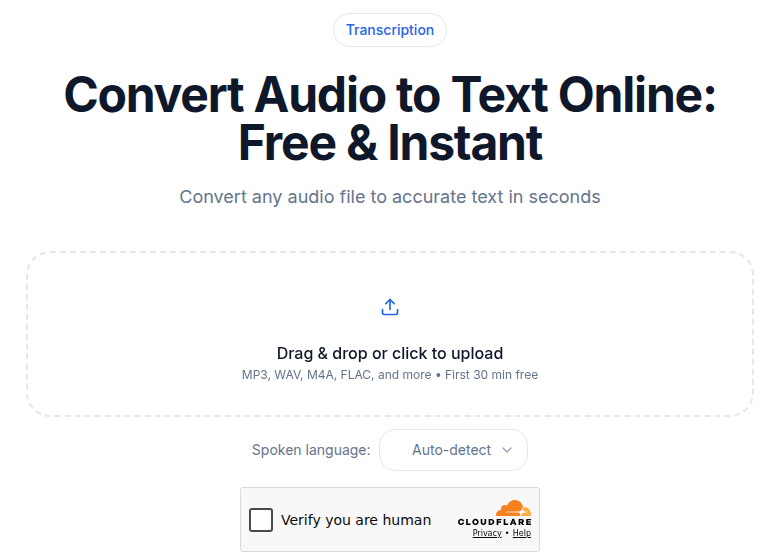 ConvertAudioToText API upload interface for audio transcription
| Feature | Deepgram | OpenAI 4o-T | AssemblyAI | AWS | |
|---|---|---|---|---|---|
| Diarization | Yes (v2) | Limited | Yes (+cost) | Yes | Yes |
| Streaming | Yes | Yes (realtime path) | Yes | Yes | Yes |
| AI summaries | No | No | Yes (+cost) | No | No |
| PII redaction | Yes | No | Yes (+cost) | Yes (+cost) | Yes |
| Custom vocab | Yes | Limited | Yes | Yes | Yes |
| Webhooks | Yes | No | Yes | Via Lambda | Via Pub/Sub |
| Languages (quality) | ~30 | 99+ | 99 (U2), 6 (U3) | ~30 | 100+ (Chirp 2) |
| HIPAA BAA | Enterprise | No | Enterprise | Yes | Yes |
| Free tier | $200 credit | No card needed | $50 credit | 60 min/mo | 60 min/mo |
For a deeper look at individual pricing models, see speech-to-text API pricing 2026 and transcription pricing models explained.
The Developer Decision Matrix
A few clean decision rules based on what actually matters:
You need streaming under 300ms for voice agents or live captions. Deepgram Nova-3. Nothing else matches the latency at that price point.
You want the lowest batch cost and English is your primary language. AssemblyAI Universal-2 at $0.0025/min. Add diarization and you are still under $0.30/hr.
You need 99-language coverage with solid accuracy. OpenAI gpt-4o-transcribe at $0.006/min. The multilingual benchmarks hold across more language-pairs than any competitor.
You want maximum accuracy on English and do not mind paying a modest premium. AssemblyAI Universal-3 Pro (4.5% WER per their June 2026 benchmarks, six languages).
You are already in the AWS ecosystem and need HIPAA. AWS Transcribe. At $0.006/min with native S3, KMS, and IAM, the integration savings offset the accuracy gap.
You run on GCP and your jobs are not time-sensitive. Google Cloud dynamic batch at $0.003/min is hard to beat when 24-hour turnaround is acceptable.
You want AI summaries and entity detection in one API call without wiring a separate LLM. AssemblyAI. The add-on pricing model means you only pay for the features you enable.
If you just need clean transcripts without building an integration, no signup, and instant turnaround, ConvertAudioToText handles audio, video, meetings, and YouTube links without an API key. The Business plan adds API access and webhooks for teams integrating at scale. It is a flat monthly fee rather than per-minute, so the math favors teams with regular, predictable volume over low-volume sporadic workloads.
Migration Patterns
Direct cutover for a single route. Replace one endpoint at a time. Send 10% of traffic to the candidate provider in a shadow pipeline for a week, compare WER on a sample of real audio, then flip.
Cost-driven migration above a volume threshold. If you are on a per-minute provider and costs are climbing, calculate your monthly audio hours. AssemblyAI Universal-2's $0.15/hr crossover against higher-priced alternatives is very short.
Feature-driven migration. Moving from a bare transcription API to AssemblyAI to get built-in summaries is usually cheaper than running a bare API plus a separate GPT-4o call per transcript. Run the numbers on your current per-transcript LLM spend.
The parallel test is always worth the hour it takes. Pick ten representative files across your real audio types (clean speech, noisy, accented, multilingual), run all candidates, compare the output against a ground truth. Lab benchmarks and vendor blog posts do not predict accuracy on your specific audio.
See transcription API comparison 2026 if you want to share a permalink to this matrix with your team.
FAQ
Which transcription API has the lowest per-minute cost in 2026?
AssemblyAI Universal-2 is the cheapest pay-as-you-go batch option at $0.0025/min ($0.15/hr). Google Cloud STT beats it only on dynamic batch mode ($0.003/min) but carries a 24-hour turnaround. Deepgram Nova-3 batch runs $0.0043/min, and OpenAI gpt-4o-mini-transcribe is $0.003/min for standard file uploads.
Does Deepgram or AssemblyAI have better accuracy?
Per AssemblyAI's own June 2026 benchmarks (80,000+ files, OpenAI normalizer), Universal-3 Pro scores 4.5% WER versus 6.66% for Deepgram Nova-3. Deepgram's own published figure is 5.26% WER for Nova-3. These are self-reported, so treat them as directional. Both comfortably exceed 95% on clean English audio.
Which API supports the most languages?
OpenAI's gpt-4o-transcribe supports 99+ languages at reasonable quality. AssemblyAI Universal-2 also covers 99 languages. Deepgram Nova-3 covers English and around 30 languages with quality tapering off outside the top ten. AWS Transcribe supports around 30 languages, and Google Cloud's Chirp 2 model covers 100+ with varying quality.
Which transcription API is best for real-time streaming?
Deepgram leads for real-time: the Nova-3 streaming API delivers under 300ms latency at $0.0077/min. OpenAI's gpt-realtime-whisper ($0.017/min) is newer and designed for live captioning and voice assistant flows. AssemblyAI's Universal-Streaming model runs around $0.15/hr with sub-second latency. AWS Transcribe streaming is $0.01/min and is the simplest to wire up if you live in the AWS ecosystem.
Do I need a credit card to try these APIs?
Deepgram gives $200 in free credits with no credit card required. AssemblyAI gives $50 in free credits without a card. OpenAI requires a credit card to access API keys. AWS Transcribe offers 60 free minutes per month for 12 months but requires an AWS account and billing setup. Google Cloud gives 60 free minutes per month on an ongoing basis plus $300 in new-account credits.
Which transcription API is HIPAA eligible?
AWS Transcribe (with a Business Associate Agreement), AssemblyAI Enterprise, and Google Cloud Speech-to-Text (with a BAA) all offer HIPAA-eligible paths. Deepgram offers a HIPAA BAA for enterprise customers. OpenAI's hosted API and ConvertAudioToText are not currently HIPAA-certified.
Sources
- Deepgram Pricing Page: https://deepgram.com/pricing (verified July 2026)
- AssemblyAI Pricing Page: https://www.assemblyai.com/pricing (verified July 2026)
- AssemblyAI Benchmarks: https://www.assemblyai.com/benchmarks (updated June 8, 2026)
- OpenAI API Pricing: https://developers.openai.com/api/docs/pricing (verified July 2026)
- Amazon Transcribe Pricing: https://aws.amazon.com/transcribe/pricing/ (verified July 2026)
- Google Cloud Speech-to-Text Pricing: https://cloud.google.com/speech-to-text/pricing (verified July 2026)
- Deepgram Nova-3 Introduction: https://deepgram.com/learn/introducing-nova-3-speech-to-text-api
- OpenAI voice models announcement: https://openai.com/index/advancing-voice-intelligence-with-new-models-in-the-api/
Try transcription free
Convert any audio or video to clean, unwatermarked text — speaker labels, timestamps, and AI summaries included. First 30 minutes free, no account.
Related Articles
Best Transcription Tools with API Access (2026)
Which transcription SaaS tools actually give you API keys, and on which plan? Verified pricing and plan gates for Descript, Sonix, Fireflies, Happy Scribe, AssemblyAI, and more.
Speech-to-Text API Pricing 2026: Per-Minute Rates Compared
What 5 speech-to-text APIs cost per audio minute, from $0.0025 to $0.024, with free tiers, streaming vs batch, and the real bill at 100 to 10,000 hours.