
Weekly Review From Voice Memos: A Workflow That Sticks
Summarize this article with:
The Voice-First Weekly Review
The fastest way to end your week with a structured written record is to walk and talk for ten minutes, then transcribe. You do not need a desk, a blank page, or a willpower reserve. You record five prompts on a Friday walk, drop the audio into a transcription tool, and spend five minutes reorganizing the text into a document you can search six months from now.
This is not a new idea dressed up in technology. It is the reflection part of David Allen's Getting Things Done framework, adapted for how most people actually have time to do it.
FAQ
Does the weekly review have to happen on Friday?
Friday works best for most people because the week's events are still fresh and you end with closure rather than carrying loose threads into the weekend. That said, any consistent day works. The key variable is consistency, not the specific day. Some people prefer Sunday morning when they are at a desk with their full system, which aligns more closely with the full GTD review format.
What if my recording is noisy or hard to understand?
Modern AI transcription handles ambient noise better than most people expect. Coffee-shop background noise, light outdoor wind, and treadmill hum all tend to produce usable output. For genuinely bad audio, listen back once and manually correct the few words that matter. The underlying ideas are usually clear enough even when individual words get muddied.
Do I need to keep the raw transcript after building the review?
Yes, at least for a while. The raw transcript often contains phrasing or tangents that do not fit the five-block structure but turn out to be useful later. Keeping it at the bottom of the weekly document costs nothing and has repeatedly saved people who wanted to remember exactly how they framed a concern three months ago.
Can I use this with Notion, Obsidian, or another PKM tool?
Yes. The five-block template pastes directly into any notes tool. Notion works well because you can create a database where each week is a row, making filtering and cross-referencing easy. Obsidian works well because the files are plain markdown and remain searchable locally. The transcription and Obsidian workflow covers the setup in detail. The pattern itself is PKM-tool agnostic.
Why Voice Beats Writing for Most People
Most people who have tried written reviews quit within three or four weeks. The friction is the writing surface, not the review itself. Talking surfaces details your fingers skip. Conversation-paced speech runs around 130 to 150 words per minute while most people type comfortably at 40 to 50. A ten-minute walk produces roughly the equivalent of 25 to 30 minutes of focused typing.
Voice also catches things you would never write down. "I felt flat after the Tuesday standup" exits your mouth in three seconds on a walk. It never makes it into a typed log because it feels too small to be worth starting a sentence over.
The old objection was that audio is not searchable. Once you transcribe it, that problem disappears. Every client name, every feeling, every half-formed idea becomes text your notes app can find.
The Five-Prompt Recording Structure
Record yourself answering these five questions on a Friday afternoon walk. Pause between each one but keep recording. The silence is fine.
- What did I actually finish this week? Name the deliverable, not the activity.
- What did I start that is still open? Be specific about what is blocking it.
- What did I learn about my work or myself that I want to remember?
- What drained energy and what gave energy? Name people, meetings, tasks.
- What is the one thing next week needs to move forward?
Eight to twelve minutes total. If you go past fifteen, you are over-thinking it.
Why These Five and Not the Full GTD Checklist
David Allen's official GTD weekly review runs through three phases: Get Clear, Get Current, and Get Creative. The full process, which Allen describes across roughly 11 steps in GTD materials, is designed for a Sunday morning at a desk with your full system in front of you. It is excellent for that context and difficult on a walk.
The five prompts above cover the things that actually shape a quarter: completed work, in-flight work, lessons, energy, and a single forward priority. System maintenance (clearing inboxes, reviewing someday/maybe lists) can happen separately when you are at a screen.
Recording Quality That Survives Transcription
Voice-memo apps are forgiving, but background noise still degrades output. A few things that matter:
- Use wired earbuds with an in-line mic when possible. When Bluetooth headsets are in mic mode, most phones default to HFP (Hands-Free Profile), which captures audio at 8kHz narrowband or 16kHz wideband depending on the headset, both noticeably lower quality than a wired mic.
- Avoid recording into wind. Outside, hold the phone at chest level rather than at your face.
- Speak at a normal, relaxed pace. Deliberately slowing down does not help. Transcription models train on natural speech rhythm, so halting delivery actually produces more errors than a steady conversational pace.
If you do hit a noisy recording, modern AI transcription handles surprisingly degraded audio. Coffee-shop ambient noise and outdoor street noise are well within what current models handle reliably.
Transcribing the Memo
Drop the file into Audio to Text, pick your language, and run transcription. A ten-minute memo typically finishes in under two minutes. Spanish, French, and other major languages work the same way with no features locked to English.
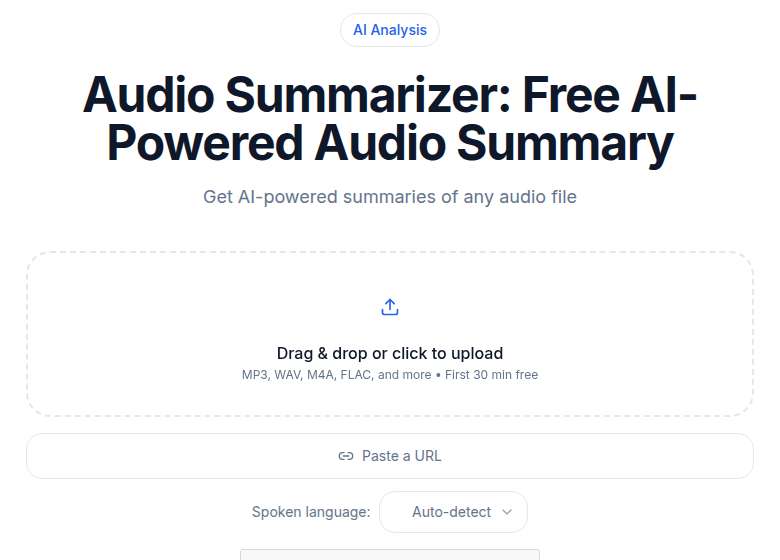 A week of voice notes condenses into one reviewable summary
The output is one long paragraph by default. That is fine. You do not need speaker labels for a solo memo. Timestamps are only useful if you plan to clip audio later.
If you prefer to keep voice memos organized as a searchable library over time, the searchable audio archive with transcripts approach pairs well with this weekly habit.
Structuring the Transcript Into a Review
Here is the step that makes this workflow valuable long-term. Once you have the raw transcript, paste it into a document with this five-block template:
## Week of [date]

**Shipped**
[bullets from prompt 1]

**Open**
[bullets from prompt 2 with blocker noted]

**Learned**
[1-3 sentences from prompt 3]

**Energy**
- Drained by: [from prompt 4]
- Energized by: [from prompt 4]

**Next Week Priority**
[one sentence from prompt 5]
Read through the transcript once, copy the relevant lines into each block, and you are done. The raw transcript stays at the bottom as source material in case you need to remember how you phrased something.
This reorganization takes about five minutes. The whole process from "start recording" to "finished document" is under twenty minutes.
A Real Example
Here is what a section looks like from someone running a small consulting practice:
Shipped: Final report for Acme delivered Wednesday. Three discovery calls with new leads. Updated proposal template based on what worked in the last two wins.
Open: Acme follow-up scope. Still waiting on their internal alignment. Blocker is their VP being out until next Monday. Two proposals out, expecting decisions within a week.
Learned: My discovery calls run long when I am tired. Need to schedule them for mornings only.
Energy: Drained by Thursday's back-to-back afternoon calls. Energized by the deep work session Wednesday morning on the Acme deliverable.
Next Week Priority: Close one of the two open proposals.
Eight minutes of talking, two minutes of transcribing, five minutes of restructuring. That is the entire review for one week.
What You Build Over Time
The quarterly move is to read 13 weeks of these back-to-back. Patterns become obvious in a way they never are inside a single week. You will see which clients drained you for months, which projects you actually shipped versus the ones you kept restarting, and which weeks were genuinely productive versus which ones just felt full.
Because every transcript is text, your notes app's search function becomes a time machine. Searching a client name pulls every reference across months. Searching "drained" surfaces every energy pattern. If you use a PKM tool like Notion or Obsidian, these weekly files slot in naturally. The transcription and Obsidian workflow covers how to wire that up.
If your goal is a broader system for capturing audio thinking across the week, not just the Friday review, building a second brain with audio picks up where this process leaves off.
What This Replaces
This workflow does real work replacing three habits people commonly attempt and abandon:
Daily journaling. Most people quit after two weeks. A weekly cadence is sustainable for most.
Tool-heavy review systems with a dozen open tabs. All you need here is a voice memo and a transcription step.
Sunday-evening dread. A Friday walk ends the week. It does not start the next one.
My take: the reason this one sticks when others don't is that walking removes the blank-page pressure. You are not writing a review. You are just talking out loud. The document is an artifact of that, not the point of it.
If you record on another device, the workflow for transcribing voice recorder recordings covers the most common file formats.
If you have been intending to start a review habit since January and it has not happened, try this once. Put your earbuds in on Friday afternoon, open your notes app to the five prompts, and walk for ten minutes. That is the entire on-ramp.
Sources
- Getting Things Done weekly review phases (Get Clear, Get Current, Get Creative) and 11-step episode: gettingthingsdone.com
- GTD weekly review checklist overview: get-alfred.ai/blog/gtd-weekly-review
- Average speaking rate research (130-150 wpm conversational): virtualspeech.com/blog/average-speaking-rate-words-per-minute
- Bluetooth HFP audio quality and sampling rates: Microsoft Community Hub
Try transcription free
Convert any audio or video to clean, unwatermarked text — speaker labels, timestamps, and AI summaries included. First 30 minutes free, no account.
Related Articles
How to Transcribe a Google Meet Recording
Turn a Google Meet recording into searchable text, speaker-labeled notes, action items, and subtitles with a clear step-by-step upload or URL workflow.
How to Remove Filler Words from a Transcript
Discover exactly how to remove filler words from a transcript. Follow this practical guide to clean up um, uh, and like for polished, professional, broadcast-ready text.