
Sentiment Analysis from Transcripts: What It Detects
Summarize this article with:
Sentiment analysis on transcripts measures polarity (positive, negative, neutral) at the sentence or turn level. It is a reliable flag system at scale, not a verdict on any single conversation. It cannot detect emotion reliably, misses sarcasm frequently, and is blind to speaker tone unless you pair it with audio-level analysis. Used correctly in sales, research, or quality monitoring pipelines, it surfaces patterns worth a human look. Used as a truth machine, it misleads.
Sentiment analysis on transcripts measures polarity, not emotion. It classifies each sentence or turn as positive, negative, or neutral toward whatever the speaker is discussing. It does not read frustration, joy, or grief reliably. That distinction matters before you build anything around it.
This post covers what the technology actually delivers in 2026, where it earns its keep, and the failure modes that cause teams to over-trust it.
What Sentiment Analysis Measures (and What It Does Not)
Three output types appear in production pipelines:
- Polarity: Positive, negative, or neutral per sentence or turn. The most reliable output.
- Aspect-based sentiment: Polarity anchored to a specific topic the speaker mentioned (the price, the onboarding, the support team). More actionable than overall polarity.
- Emotion labels: Joy, anger, sadness, frustration, and so on. The least reliable output, because emotion categories overlap, labeling is subjective, and human annotators themselves disagree at higher rates. Benchmarks reported at 90% accuracy on clean datasets typically drop to 75% or lower in production due to domain mismatch and edge cases.
The practical lesson: use polarity at scale, use aspect-based sentiment for product insight, and treat emotion labels as directional hints rather than facts.
Sentiment analysis also cannot capture speaker tone from a transcript. Text-based sentiment reads words. Acoustic or paralinguistic analysis reads pitch, energy, and rhythm directly from the audio. These two signals often disagree. A speaker can say "I'm fine" with words that score neutral and a tone that reads tense or disengaged. If affect and tone matter to your use case, a model that combines text and audio signals is more reliable than text alone.
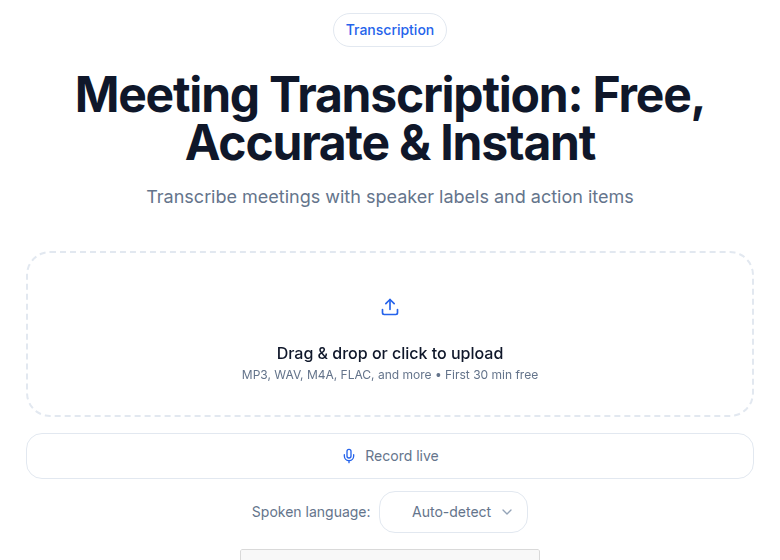 ConvertAudioToText meeting transcription tool
How the Two Main Approaches Work
Classifier-based models output polarity per sentence with a confidence score. They are fast, deterministic (same input always produces the same output), and run cheaply at scale. VADER, Cardiff NLP's twitter-roberta-base-sentiment-latest (available on Hugging Face), and fine-tuned BERT variants are the most commonly used open options. Their weakness is that they cannot explain a score, handle longer-form discourse poorly, and are heavily influenced by domain: a model trained on social media text may score clinical or financial language inaccurately.
LLM-based classification uses a prompt asking a model like Claude or GPT to score sentiment and explain why. Contextual understanding is stronger, and the explanation quality is genuinely better. The tradeoffs are real: outputs vary across runs (the model may give slightly different scores on identical input), cost per analysis is higher, and very long transcripts hit context window limits. Research using GPT-4 showed moderate inter-rater agreement (Cohen's kappa around 0.58) compared to human coders, which is useful but not definitive.
Most production pipelines in 2026 use classifier-based models for bulk scoring and an LLM only for explaining flagged segments. That keeps cost low and explainability where it matters.
Where Sentiment on Transcripts Actually Pays Off
Sales Call Analysis
The most common production use is sales call review. Transcribe the call, run sentiment scoring per speaker turn, and aggregate across the conversation. The pipeline that tools like Gong and Chorus run as their core product is a more sophisticated version of this.
What you get from a basic version of the same pipeline:
- Per-call net score: Lets a manager triage the call queue by sentiment rather than random sampling. Gong's pricing runs to thousands of dollars per seat per year; a self-built pipeline on top of meeting transcription is a viable alternative for smaller teams.
- Turn-by-turn timeline: Shows where sentiment shifted during the call, useful for coaching on objection handling or pricing conversations.
- Topic-level scores: Aspect-based sentiment anchored to what was discussed (the demo, the contract term, the competitor) is more actionable than overall call polarity.
For Zoom meeting transcription, transcript quality is the first dependency. Garbage transcripts produce unreliable sentiment scores.
User Interview Research
Researchers analyzing 20 to 50 interviews benefit from sentiment as a clustering signal. Across that many conversations about a feature or workflow, did sentiment toward that topic skew positive or negative? Which specific topics drew the strongest reactions?
A workable pipeline:
- Transcribe each interview. The interview transcription workflow covers the mechanics.
- Run aspect-based sentiment: prompt the model to identify topics discussed, then score sentiment per topic per interview.
- Aggregate across interviews. Look at which topics have the widest spread (some participants positive, some negative) alongside which topics are uniformly negative.
Watch for the false-precision trap: a sentiment score of 0.62 versus 0.58 reflects model noise as much as participant feeling. The directional signal (positive, negative, or split) is the output you can act on. Ignore decimal places.
Compliance and Quality Monitoring in Contact Centers
Call centers have used transcript sentiment for quality assurance longer than most teams. The pipeline: every customer-facing call gets transcribed and scored. Calls where customer sentiment crosses a threshold (strongly negative) get flagged for supervisor review. Calls where agent sentiment looks unprofessional get flagged for coaching.
Vendors like Verint, NICE CXone, and Cresta sell full solutions with emotion scoring across 11-plus dimensions, intent classification, and next-best-action recommendations. The DIY version using transcription plus a classifier gets you the basic flag system without the enterprise price tag or the over-engineered emotion taxonomy.
One workable threshold: flag the bottom 5% of calls by customer sentiment score for human review. That concentrates supervisor time on conversations that most need it.
The Failure Modes Worth Knowing
Sarcasm Detection
Classifier models miss sarcasm frequently. The challenge: sarcasm expresses negative intent using positive words ("What a great experience, I love waiting three hours"). LLM-based sentiment handles it better, but research shows that chain-of-thought prompting actually hurts sarcasm detection because sarcasm is a holistic, intuitive judgment that does not follow step-by-step reasoning. At aggregate scale, sarcasm misses tend to wash out across many conversations. On a single call, they can produce a meaningfully wrong score.
Cultural and Domain Context
General sentiment models are trained predominantly on English-language text from Western sources. Polite refusal in some business cultures reads as more negative on a US-trained model than it would be in context. Medical language ("the tumor is malignant") scores negative on a general model but is emotionally neutral in a clinical conversation. Financial analyst language ("downside scenario") reads negative in everyday use but is neutral in its domain.
For multilingual content, Cardiff NLP's twitter-xlm-roberta-base-sentiment-multilingual covers 30-plus languages and is available on Hugging Face. Domain-specific fine-tuning is the right answer for medical or financial transcripts, but it requires labeled training data.
Single-Call Noise
Sentiment on one conversation is noisy. The signal gets useful at 30 or more conversations. Treating a single sentiment score as a verdict on a single customer relationship overstates the model's confidence. See the speaker diarization guide for how turn-level attribution affects the score quality. Without accurate speaker labels, you cannot tell whether the negative turn came from the customer or the rep.
Polarity Is Not Satisfaction
A caller can express neutral polarity throughout a call and still churn. A call scored as positive overall may contain one highly negative turn that predicts more than the aggregate. Polarity scores are a filter, not a CX metric. Composite "customer satisfaction scores" derived purely from sentiment scoring and reported as executive KPIs tend to be optimized for in ways that make them counterproductive.
Open Source Options for DIY Pipelines
For teams building their own:
- VADER: Lightweight Python lexicon classifier. Fast, no GPU needed, English-only. Good first baseline for informal text. Available via
pip install vaderSentiment. - Cardiff NLP twitter-roberta-base-sentiment-latest: RoBERTa fine-tuned on 124 million tweets through 2021. Handles informal language well, available on Hugging Face. Best for social media and conversational text; preprocessing (replace usernames, URLs) improves performance.
- Hugging Face pipelines: Multiple pretrained multilingual and domain-specific models.
pipeline("sentiment-analysis")gives you a working classifier in five lines of Python.
For LLM-based analysis, simple prompts to Claude or GPT produce reasonable polarity classification with explanations. Cost is higher than running a classifier, but the reasoning output makes flagged cases easier to review.
If you are doing topic modeling from audio alongside sentiment, run topic extraction first and then score sentiment per topic. That is the aspect-based approach and it produces more actionable output than overall polarity.
For teams that just need a clean transcript without running their own analysis pipeline, ConvertAudioToText delivers structured output you can pass directly to a sentiment classifier or an LLM prompt. No meeting bot, no account required for a first run.
A Defensible Workflow
- Transcribe with high accuracy. Sentiment scores are downstream of transcript quality. See how to improve transcription accuracy for variables that matter.
- Score in bulk. Sentiment per turn, and sentiment per topic using an aspect-based prompt.
- Aggregate across conversations. Distributions, not single-call scores.
- Flag the tails. Calls or interviews in the bottom (or top) 5% by score are worth a human look.
- Validate monthly. Have someone review 20 random flagged samples and compare to the model output. If the false-positive rate on "negative" flags is above your tolerance, adjust the threshold. This step is what keeps the pipeline calibrated.
What to Skip
Three patterns that reliably produce bad output:
- Single-sentence sentiment as a churn signal. A customer saying "this is frustrating" in turn 12 of a 200-turn call is not a churn signal by itself. Flag the whole call based on aggregate score, then let a human decide.
- Overall polarity without topic anchoring. Knowing that a 45-minute call scored slightly negative tells you much less than knowing that sentiment turned negative specifically when pricing came up.
- Composite sentiment scores as executive metrics without human review. Teams optimize for whatever gets reported upward. A sentiment metric that can be gamed by training agents to sound positive while problems go unresolved is not measuring what it claims to.
FAQ
What is the difference between sentiment analysis and emotion detection?
Sentiment analysis classifies text as positive, negative, or neutral (polarity). Emotion detection tries to identify specific emotional states like anger, joy, or sadness. Polarity classification is more reliable in production because the task is simpler and inter-annotator agreement among human labelers is higher. Emotion detection suffers from label overlap, class imbalance (grief is rare, joy is common), and subjectivity that causes even human raters to disagree.
Can sentiment analysis detect sarcasm on a transcript?
Unreliably. Classifier-based models miss sarcasm a significant portion of the time because sarcasm uses positive words to express negative intent. LLM-based sentiment analysis handles sarcasm better, but research shows that chain-of-thought prompting actually hurts sarcasm detection performance because sarcasm is a holistic judgment that does not follow step-by-step reasoning. At aggregate scale (30-plus calls), sarcasm misses tend to wash out. On a single call they can produce a wrong score.
Why does transcript sentiment miss things that audio sentiment catches?
Text-based sentiment reads the words. Acoustic or paralinguistic sentiment reads the sound itself: pitch, energy, rhythm, and pace. A speaker can say "I'm fine" with text that scores neutral or positive, while the acoustic signal is flat or tense. These two readings measure different things and often disagree. If tone and affect matter for your use case, a hybrid model that combines both signals is more reliable than either alone.
How many calls or interviews do I need before sentiment trends are meaningful?
A useful rule of thumb is 30 or more conversations before treating the directional trend as a signal worth acting on. Single-call sentiment scores are noisy because model variance, sarcasm, domain-specific language, and cultural idioms each introduce error. Distributions across many conversations are what give sentiment its value. Validate by having a human review a random sample of flagged outliers each month.
Sources
- Sentiment Analysis: Methods, Challenges, and What Actually Works in 2026 - Label Your Data (checked 2026-07-02)
- Cardiff NLP twitter-roberta-base-sentiment-latest - Hugging Face (checked 2026-07-02)
- Comparing LLMs and human annotators in sentiment, sarcasm - Scientific Reports (checked 2026-07-02)
- Sentiment analysis on speech: text vs acoustic signals - Soniox Wiki (checked 2026-07-02)
- Gong Pricing in 2026 - CloudTalk (checked 2026-07-02)
- Best Call Center Speech Analytics Software 2026 - AmplifAI (checked 2026-07-02)
- VADER Sentiment Analysis - Hex (checked 2026-07-02)
Try transcription free
Convert any audio or video to clean, unwatermarked text — speaker labels, timestamps, and AI summaries included. First 30 minutes free, no account.
Related Articles
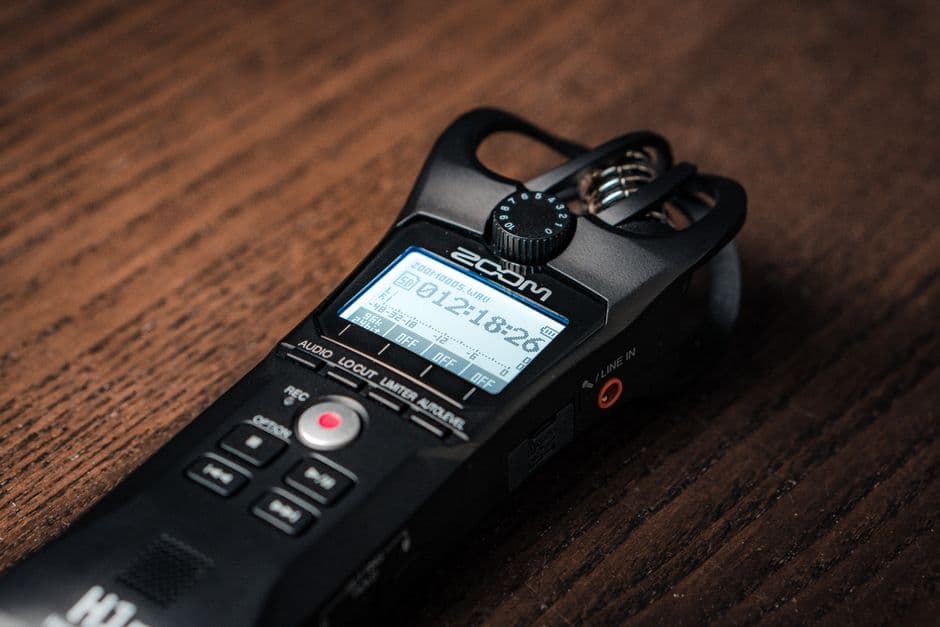
How to Transcribe Voice Recorder Recordings (Any Device)
Get text from any voice recorder, from Anker SoundCore Work to old Olympus dictaphones. Covers file transfer, formats, WMA conversion, speaker labels, and export options.

Draft a Follow-Up Email From a Meeting With AI (2026)
Turn any meeting recording into a polished follow-up email in under five minutes. Prompt templates, edit checklist, and privacy guidance for AI-drafted meeting emails.