
Transcription Budget for Small Business: What to Spend in 2026
Summarize this article with:
A five-person small business can spend anywhere from $0 to $500 per month on transcription, and most land under $80 when they match their pricing model to actual usage. This guide walks through three spend tiers, per-model pricing math, use-case worksheets for sales, research, and content teams, and the four ROI drivers that make transcription one of the easiest business expenses to justify.
A five-person small business with a moderate cadence of calls, meetings, and recordings can spend anywhere from $0 to $500 per month on transcription. Most land under $80. The right number depends on team size, pricing model, and what you actually do with the transcripts.
The Three Spend Tiers
Small business transcription spend clusters in three ranges, and knowing which tier fits your team before you buy a single seat saves meaningful money.
Under $50 per month covers most small businesses: one or two flat-rate accounts for the people who do the bulk of the recording work.
$50 to $200 per month fits teams where transcription is a daily, cross-functional activity, with shared workspaces and light integrations.
$200 to $500 per month applies to businesses where transcription feeds critical deliverables: agencies, podcast networks, legal practices, or teams using a developer API.
Above $500 monthly, the math and the vendor relationships shift into enterprise territory.
Pricing Model First, Tool Second
Before choosing a tool, choose a pricing model. The model determines your actual cost more than any feature comparison. The transcription pricing models explained post covers this in depth, but the short version:
Flat-rate unlimited: One price per seat per month, no per-minute charges. Predictable cost. The right choice if you transcribe more than 4 to 5 hours per month per user. Most SMB tools are in this category.
Metered (per minute): You pay for exactly what you use. Good for irregular, low-volume use, or developer API integration. AI rates in 2026 run roughly $0.15 to $0.25 per audio minute for managed services; human transcription runs $1.00 to $2.00 per audio minute per verified rate sheets from Rev and GoTranscript as of mid-2026.
Minute-bucket plans: A fixed allotment of minutes per month (common with Happy Scribe, which offers 120 minutes on Basic, 600 on Pro, 6,000 on Business, all at Euro-denominated prices with overages at €0.20 per minute). These sit between flat-rate and metered: predictable up to the cap, then metered above it.
Per-seat team plans: Team pricing with shared workspace and admin controls, charged per seat. Otter.ai Business runs $30 per seat per month on monthly billing ($19.99 on annual). Fireflies.ai Business runs $29 per seat per month ($19 on annual). Rev's Essentials plan is $29.99 per seat per month ($25.49 on annual).
The worksheet below uses these models to estimate your actual cost before you commit.
The Budget Worksheet
Work through these four questions before signing up for anything.
Step 1: Estimate monthly audio hours. Count the meetings, calls, interviews, or recordings your team produces per month that would benefit from a transcript. Be conservative: actual usage usually runs 60 to 70 percent of what you estimate before you start.
Step 2: Identify active users. How many people on your team will independently upload audio? If one person handles all transcription for everyone, you need one seat. If five people each have their own calls, you may need five.
Step 3: Apply the model math.
- Flat-rate at $10 to $20 per seat per month: works if each active user transcribes more than 2 hours monthly.
- Metered at $0.25 per minute: costs $15 per hour. Ten hours monthly equals $150. At that volume, a flat-rate plan is cheaper.
- Minute-bucket plans: divide your monthly hours by the bucket size. If you need 300 minutes monthly and the Basic plan gives you 120, you are paying overage every month: factor in the real cost.
Step 4: Add switching costs to your Year 1 estimate. Moving between tools takes time: re-training users, migrating transcript archives, reconnecting integrations. Budget at least one day of a power user's time for any major tool change, and weight that against short-term savings.
The Under-$50 Tier in Practice
The most common landing spot for small businesses is one or two flat-rate seats.
What it looks like:
- 2 seats on CATT Pro at $14.99 per month each: $29.98 monthly total. Unlimited transcription, speaker labels, AI summaries, all export formats.
- 2 seats on TurboScribe Unlimited at $20 per month each (or $10 per month each on annual billing): $20 to $40 monthly total.
- 2 seats on Otter.ai Pro at $16.99 per user per month (annual billing): $33.98 monthly total.
Who fits: solo founders, a founder plus an assistant, professional service firms with one or two principals doing the recording work, content businesses with one primary host.
My take: the right answer for most businesses at this tier is one primary account used well, not multiple seats used lightly. Most small teams do not need every member to have their own account. A single account that processes audio from multiple contributors captures 80 percent of the value at a fraction of the cost.
The $50 to $200 Tier in Practice
This tier serves teams where transcription is a shared daily workflow.
What it looks like:
- 5 seats on Otter.ai Business at $19.99 per seat per month (annual billing): $99.95 monthly. Includes shared workspace, admin controls, and longer per-meeting limits.
- 5 seats on Fireflies.ai Business at $19 per seat per month (annual billing): $95 monthly. Includes unlimited storage, CRM sync, and team analytics.
- Happy Scribe Business at €89 per month (~$96 at current rates), covering 5 seats and 6,000 minutes of AI transcription monthly, with overages at €0.20 per minute.
What you get: shared transcript libraries, admin visibility into team usage, often priority processing, and basic integrations with Slack, Notion, or CRM tools.
The shared-workspace value matters here. When one team member transcribes a customer call and three others can search and reference it, transcription becomes a knowledge management tool rather than a personal productivity tool.
 ConvertAudioToText meeting transcription tool
The $200 to $500 Tier in Practice
At this tier, transcription is feeding a critical business process or a client deliverable.
What it looks like:
- 10 seats on Fireflies.ai Business at $19 per seat per month (annual): $190 monthly. Appropriate for a full sales team where every call is transcribed and reviewed.
- Rev Pro at $59.99 per seat per month (monthly billing), covering up to 10,000 AI transcription minutes per seat: expensive, but includes human transcription discounts useful for high-stakes content.
- Hybrid model: flat-rate AI for the majority of content, plus a $100 to $200 monthly budget for human transcription on the subset where accuracy requirements are highest.
Who fits: agencies doing client work requiring transcripts as deliverables, sales operations teams with daily call review programs, research firms with continuous interview pipelines.
At this tier, evaluate whether per-minute API pricing might be cheaper than per-seat licensing if usage is concentrated. See the transcription pricing comparison for 2026 for a full side-by-side.
Use-Case Budget Frameworks
Four specific use cases with real cost math.
Sales Operations
A 5-person sales team recording 20 hours of calls per week, 4 hours per person.
- Model: 5 flat-rate seats at $15 to $30 per seat per month.
- Monthly cost: $75 to $150.
- Per-call value: a transcript that surfaces objections, competitor mentions, and pricing discussions accelerates coaching and shortens ramp time for new reps. The business case at this volume is not close.
Free tiers will not cover 20 hours of weekly calls. This is a paid-plan use case from day one.
Customer Research
A 3-person research team running 15 user interviews per month at 60 minutes each (15 hours total).
- Model: 3 flat-rate seats or a single shared account with team access.
- Monthly cost: $30 to $90.
- Workflow benefit: searchable transcripts replace hours of re-listening. A researcher finds the quote they need in seconds instead of scrubbing through audio.
Strong fit for flat-rate plans. Per-minute pricing at 15 hours monthly would cost $135 to $225 on AI rates, making flat-rate clearly better.
Content Marketing
A 2-person content team transcribing podcasts, interviews, and customer testimonials for content repurposing.
- Model: 2 flat-rate seats.
- Monthly cost: $20 to $40.
- Workflow benefit: each 60-minute episode becomes draft material for blog posts, social clips, and newsletters. The best transcription tools for podcasts in 2026 post covers the workflows worth automating.
Flat-rate is right here. At typical content-team volumes, per-minute pricing would cost more and provide no accuracy or speed advantage.
Legal and Compliance Work
A small law firm with 4 attorneys doing dictation, deposition summaries, and client intake recordings.
- AI transcription on flat-rate: $40 to $80 monthly for the core volume.
- Human transcription budget for high-stakes depositions and court filings: $200 to $400 monthly at $1.00 to $2.00 per audio minute.
- Total: $240 to $480 monthly.
The hybrid pattern is the right answer. AI on clean audio reaches 95 percent accuracy or better on modern benchmarks, which is sufficient for internal drafts. Human transcription covers the small subset where an error has legal consequences.
Clinical and therapy practices have a separate cost structure due to HIPAA requirements, BAA agreements, and EHR integrations that push per-provider costs well above typical SMB ranges.
What Drives Transcription ROI
Three things determine whether transcription spending pays back.
Time Savings
A 60-minute interview transcribed manually takes 4 to 6 hours of human time. AI transcription takes 3 to 5 minutes. At $50 per hour fully loaded for a marketing analyst, transcribing 20 hours of audio monthly saves 80 to 120 hours of equivalent labor, or $4,000 to $6,000 in opportunity cost. A $30 monthly subscription returns that in the first week.
This is the most straightforward ROI calculation, and it clears the bar for almost every business that records regularly.
Knowledge Capture
When meeting recordings, customer calls, and interviews become searchable text, institutional memory compounds. A new hire onboarding can read six months of customer conversations rather than relying on a colleague's memory. A sales manager can search every call where a specific competitor came up. An agency can pull every past client discussion about a topic in seconds.
This value is harder to put a number on, but it is consistently real in teams that make transcription a habit.
Content Reuse
A 60-minute podcast episode becomes source material for 3 to 5 blog posts, 10 social clips, a newsletter section, and SEO content. For content-heavy businesses, this multiplication effect often dominates the ROI calculation. The hidden costs of transcription services post covers where this math breaks down if the tool creates friction in the export or editing step.
Common Budget Mistakes
Buying too many seats. Most teams do not need every member to have their own account. One or two power users transcribing for everyone usually costs less and works better. Audit who is actually uploading audio before adding seats.
Overpaying for human transcription on content that does not need it. AI transcription on clean audio reaches 95 percent accuracy on leading models in 2026. Paying $1.99 per minute for human transcription of internal meeting notes is rarely the right call.
Underbuying on the wrong axis. Choosing the cheapest plan when you need features locked behind paid tiers (SRT export, speaker labels, AI summaries) means the savings disappear in workaround time or manual cleanup.
Switching tools too often. Tool migration carries real costs: user retraining, integration reconnection, archive migration. Pick a tool that fits your primary use case and stay with it for at least a year before reevaluating. The choose right transcription software post covers the evaluation framework.
Ignoring the pricing model mismatch. The biggest budget mistake is paying flat-rate when you use too little, or paying per-minute when you use too much. The break-even on most flat-rate plans is 40 to 70 minutes of audio per month. Below that: per-minute or free tiers. Above that: flat-rate is almost always cheaper.
The Simplest Starting Budget
For a small business getting started, this sequence works:
Month 1: one paid account on a flat-rate plan around $10 to $20 per month. Run everything through it: last week's customer calls, your most recent podcast, this month's research interviews. See what the output is worth and how much time it saves.
Month 2: add a second seat if the first user is hitting collaboration friction. Stay at one seat if not.
Month 3 and beyond: evaluate. Are you hitting limits? Do you need shared workspaces? Is there content that warrants human transcription or higher accuracy than your AI tier delivers?
Most small businesses steady-state at $20 to $80 monthly. Above that range, confirm that the marginal features justify the marginal cost before committing.
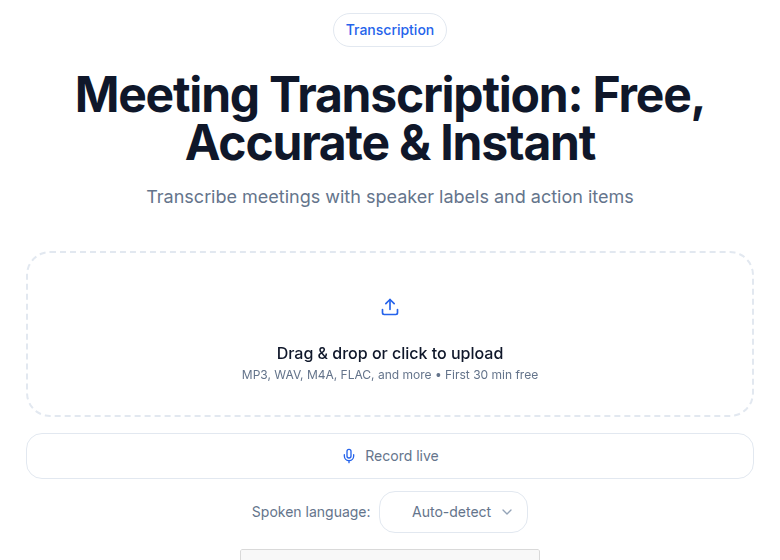
If you want to test on your team's actual audio before paying anything, ConvertAudioToText's audio-to-text tool processes a file without requiring an account, which is the fastest way to validate whether the output quality fits your use case. For a full alternative comparison once you know what you need, the transcription pricing comparison for 2026 covers the major tools side by side.
Common Questions
How much should a small business budget for transcription?
Most small businesses spend $20 to $80 per month. One or two seats on a flat-rate unlimited plan cover the majority of use cases. Only teams with daily, cross-functional transcription needs or developer API requirements push past $100 monthly.
Is per-minute or flat-rate pricing better for small businesses?
Flat-rate wins if you transcribe more than 4 to 5 hours per month per user. Per-minute pricing (typically $0.15 to $0.25 per minute for AI, $1.00 to $2.00 per minute for human) is cheaper only for occasional, low-volume use. The break-even point on most flat-rate plans is roughly 40 to 70 minutes of audio per month.
When does human transcription make financial sense for a small business?
Human transcription costs $1.00 to $2.00 per audio minute (verified against Rev and GoTranscript rates as of mid-2026), which is $60 to $120 per hour. It makes sense for content where legal liability, compliance, or verbatim accuracy requirements mean an AI error costs more than the correction does. Most internal meetings, sales calls, and podcast drafts do not clear that bar.
Can a small business get by on free transcription tools?
For testing and very low volume, yes. Most free tiers cap at 10 to 45 minutes per month, which is not enough for active business use. If you transcribe even one 60-minute call per week, you will exhaust free tiers in the first week of the month.
Sources
- Otter.ai pricing page: https://otter.ai/pricing (checked July 2026)
- TurboScribe pricing: https://turboscribe.ai/pricing (verified via search results, July 2026)
- Fireflies.ai pricing page: https://fireflies.ai/pricing (checked July 2026)
- Happy Scribe pricing page: https://www.happyscribe.com/pricing (checked July 2026)
- Rev pricing page: https://www.rev.com/pricing (checked July 2026)
- ConvertAudioToText pricing: https://convertaudiototext.com/pricing (checked July 2026)
- GoTranscript human transcription rates referenced via https://gotranscript.com (July 2026)
Try transcription free
Convert any audio or video to clean, unwatermarked text — speaker labels, timestamps, and AI summaries included. First 30 minutes free, no account.
Related Articles

Spotify Transcript Extractor: How to Copy and Download Episode Text
Get a Spotify podcast transcript you can copy and download: paste a public episode link, 30 minutes free with no signup, TXT or SRT files on eligible plans.
Focus Group Transcription for UX Researchers: Turn Multi-Speaker Audio Into Usable Evidence
A practical guide to focus group transcription for UX and insights teams. See how CATT handles speaker labels, timestamps, AI summaries, and clean export.